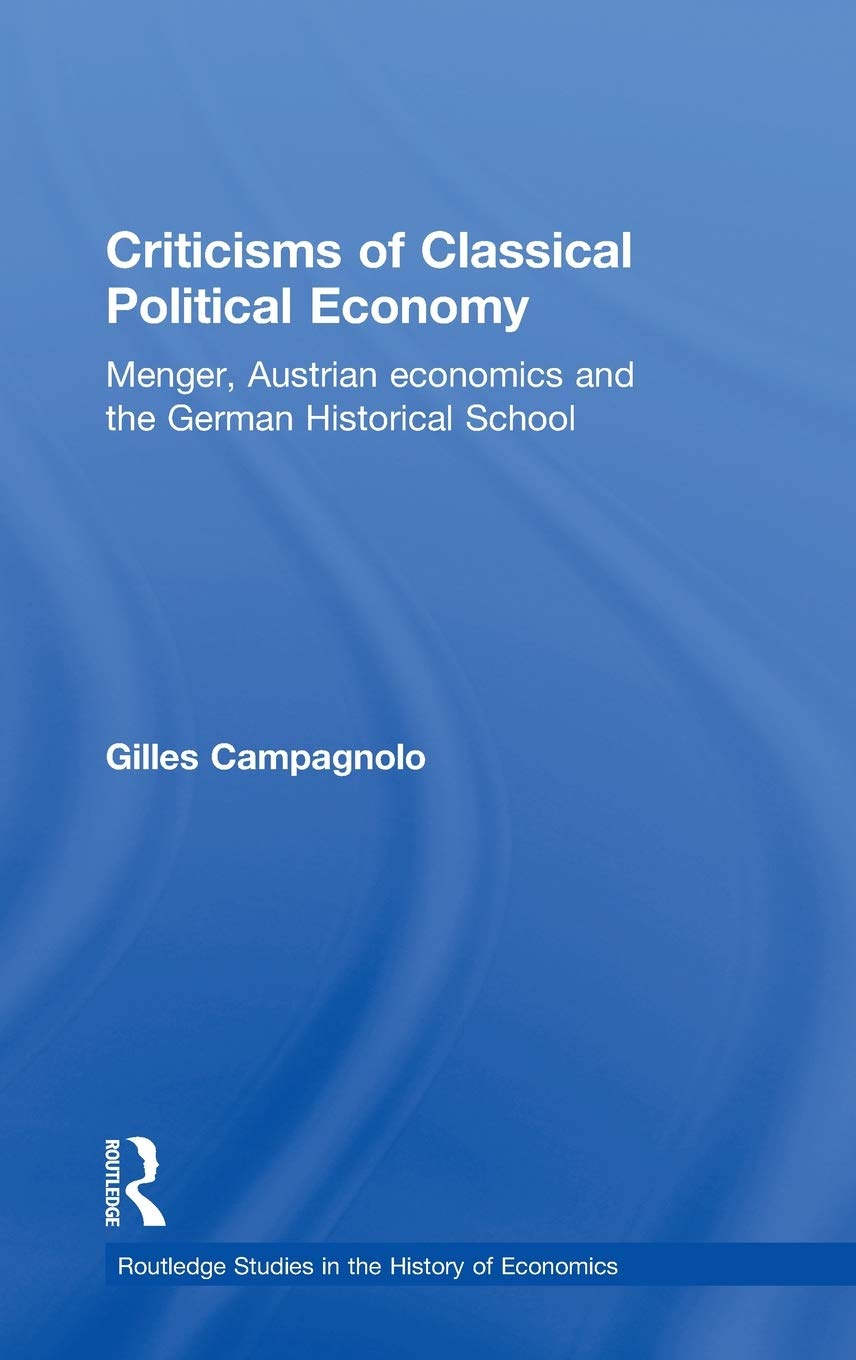
Critiques of Classical Political Economy: Menger and German School
Critiques of Classical Political Economy: Menger and German School
Price subject to change. Tap below for current.
Couldn't load pickup availability
The book Criticisms of Classical Political Economy by Gilles Campagnolo offers a profound exploration of the tensions between the Austrian School of Economics and the German Historical School. This scholarly work delves into the critiques posed by Carl Menger and his contemporaries, providing readers with a comprehensive understanding of the evolution of economic thought.
In this insightful text, Campagnolo meticulously examines the foundational principles of Austrian Economics, highlighting its emphasis on individual action and subjective value. The author argues that these principles stand in stark contrast to the deterministic views held by the German Historical School, which prioritized empirical data and historical context over theoretical abstraction.
One of the key themes of the book is the significance of methodological individualism in the Austrian tradition. Campagnolo illustrates how Menger's approach to economics was revolutionary, advocating for a focus on the choices and actions of individuals rather than broad societal trends. This perspective is crucial for understanding the dynamics of market behavior and the role of entrepreneurship.
Furthermore, the text addresses the criticisms that the Austrian School has faced over the years, particularly regarding its perceived lack of empirical rigor. Campagnolo defends the Austrian methodology, asserting that its qualitative insights provide a necessary complement to quantitative analysis. The book encourages readers to appreciate the value of theoretical frameworks that prioritize human agency and decision-making.
Throughout the chapters, the author engages with various economic theories, offering a balanced critique of both the Austrian and German schools. By doing so, he sheds light on the ongoing debates within the field of economics, making this book a valuable resource for students and scholars alike. The exploration of historical context is particularly noteworthy, as it situates the arguments within the broader narrative of economic thought.
In addition to its academic rigor, the book is written in an accessible style, making complex ideas understandable for a wider audience. Campagnolo's ability to distill intricate concepts into clear arguments is a testament to his expertise in the field. Readers will find themselves engaged with the material, as the author skillfully weaves together theory and practice.
Overall, Criticisms of Classical Political Economy is an essential read for anyone interested in the history of economic thought. It not only provides a thorough analysis of Menger's contributions but also invites readers to reflect on the relevance of these ideas in contemporary economic discussions. This book is a significant addition to the literature on Austrian Economics and serves as a critical resource for understanding the complexities of economic theory.
Share