

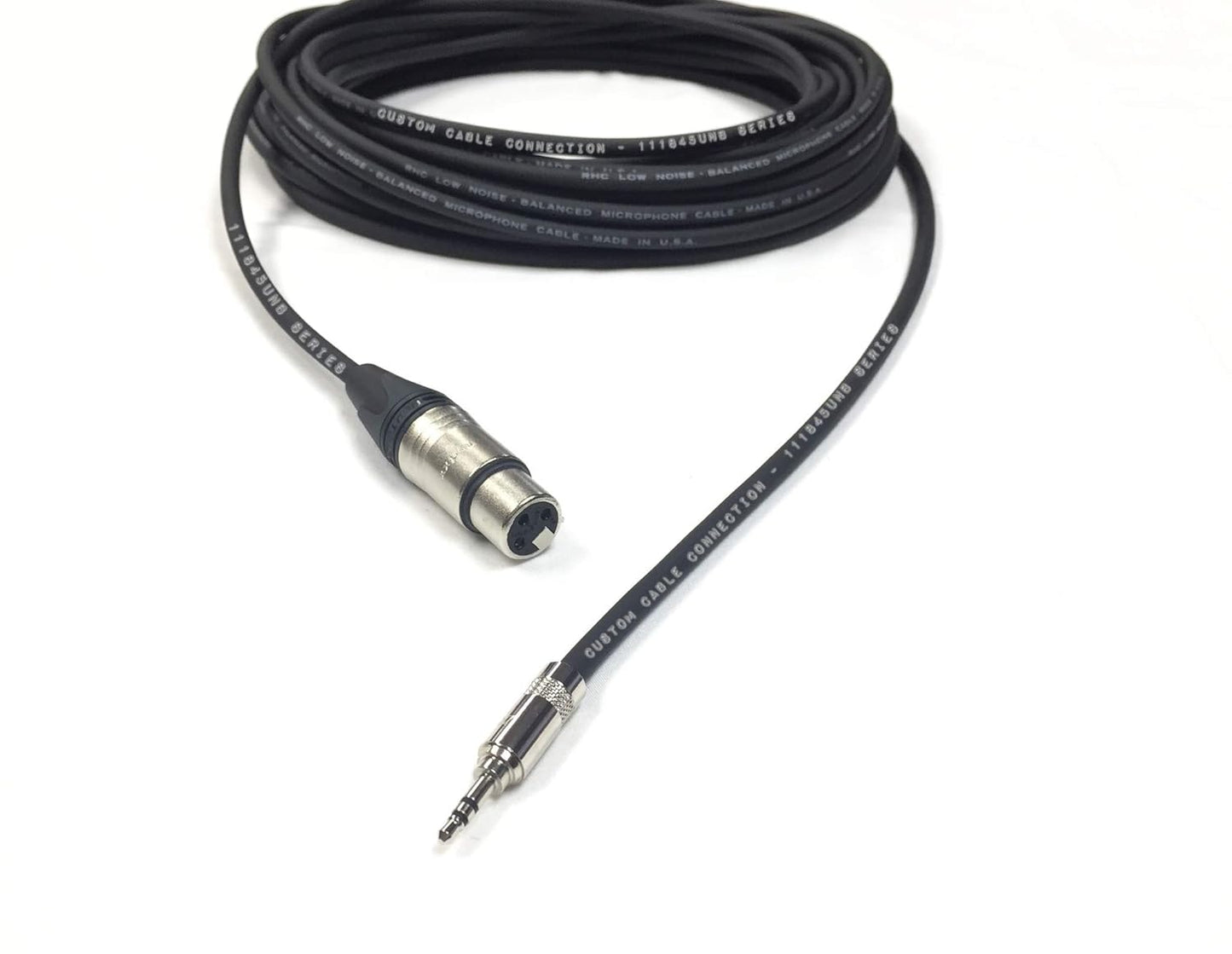
100 Foot XLR Female to 1/8 in Male Unbalanced Audio Cable - Long Run
100 Foot XLR Female to 1/8 in Male Unbalanced Audio Cable - Long Run
Price subject to change. Tap below for current.
Couldn't load pickup availability
In this review the 100 ft XLR female to 1/8 in male unbalanced audio cable is evaluated for location sound, DSLR recording, and desktop capture. Its single biggest advantage is length: a full 100 ft run that keeps a mic connected without needing repeaters or messy extensions. The cable is presented as a practical workhorse for anyone who needs to route a mono XLR microphone into a 3.5 mm input on a camera, recorder, or sound card, and the review focuses on build, signal behavior, and real-world limitations.
Key Features
- Unbalanced XLR to 3.5 mm: Connects a mono XLR microphone output to a 1/8 in mini input on camcorders, DSLR cameras, or computer sound cards for direct capture without adapters when the device accepts TRS mic input.
- Length: The 100 ft length lets users position microphones far from the recorder for location shoots, stage work, or long cable runs without needing multiple shorter cables joined together.
- 24 AWG annealed copper: The shielded 24 AWG conductors are annealed to stay flexible and resist breakage while preserving clear audio for low-voltage microphone wiring.
- Dual-mono feed: The cable splits the mono mic across the phone jack input so the signal is fed equally to both left and right channels on the camera or sound card, improving capture consistency.
- Low capacitance and defined impedance: With about 21 pF/ft capacitance and a characteristic impedance near 70 Ohm, the cable maintains clear audio quality across the long run for typical mic-level signals.
Who It's For
This cable is aimed at videographers, podcasters, and live sound users who need to run a professional XLR mic into a 3.5 mm TRS mic input on a camera or computer and require a very long, single-cable run. It is also useful for stage setups where a mic must travel a long distance to a recorder without relying on wireless systems.
It is not for users who need TRRS compatibility on phones or tablets with four-pole jacks; those devices require a TRRS-to-TRS adapter before this cable will work. Also, those who require balanced, noise-immune runs for critical studio recording should prefer a balanced XLR-to-XLR cable instead of an unbalanced conversion.
Pros & Cons
Pros
- Very long 100 ft length removes the need to splice multiple cables for long-distance mic placement.
- Flexible annealed copper conductors and shielding make the cable manageable and durable during setup and teardown.
- Design splits mono mic to both channels on 3.5 mm inputs, ensuring consistent dual-mono capture on cameras and sound cards.
Cons
- Unbalanced wiring can be more susceptible to noise on very long runs compared with a fully balanced XLR-to-XLR connection.
- Does not work directly with TRRS four-pole phone jacks without an adapter, so smartphone users need an extra part.
Specifications
| Connector A | Neutrik XLR Female |
| Connector B | 1/8 in (3.5 mm) Male TRS |
| Length | 100 ft |
| Conductor | 24 AWG annealed copper |
| Capacitance | 21 pF/ft (approx) |
| Characteristic Impedance | 70 Ohm (approx) |
| Cable Type | Unbalanced, mono to dual-mono TRS |
Our Verdict
The 100 ft XLR female to 1/8 in male unbalanced cable is a practical, cost-effective solution for anyone needing long mic runs into cameras or computer inputs. Its flexible annealed copper conductors and attention to mic-level signal routing make it strong value for location videography and basic capture, so long as users accept the trade-offs of an unbalanced conversion and plan for TRRS adapters when using phones.
Frequently Asked Questions
Will this cable work with a smartphone that has a TRRS jack?
Not directly; phones with TRRS four-pole jacks need a TRRS-to-TRS adapter first, then this cable plugs into the adapter.
Is this a balanced cable suitable for long stage runs?
No, this product performs an unbalanced conversion to 3.5 mm TRS and is more susceptible to noise than a balanced XLR-to-XLR run on very long distances.
Does the cable feed mono to both left and right channels?
Yes, it splits the mono mic across the phone jack input to provide dual-mono output on compatible camera and sound-card inputs.
Editor's Take
The 100 ft XLR female to 1/8 in male unbalanced cable is a practical, long-run solution for connecting XLR mics to 3.5 mm camera or computer inputs; it offers flexible annealed copper conductors and dual-mono output but remains an unbalanced conversion requiring a TRRS adapter for phones.

Recently viewed
Recently viewed products will appear here as customers browse the store.