

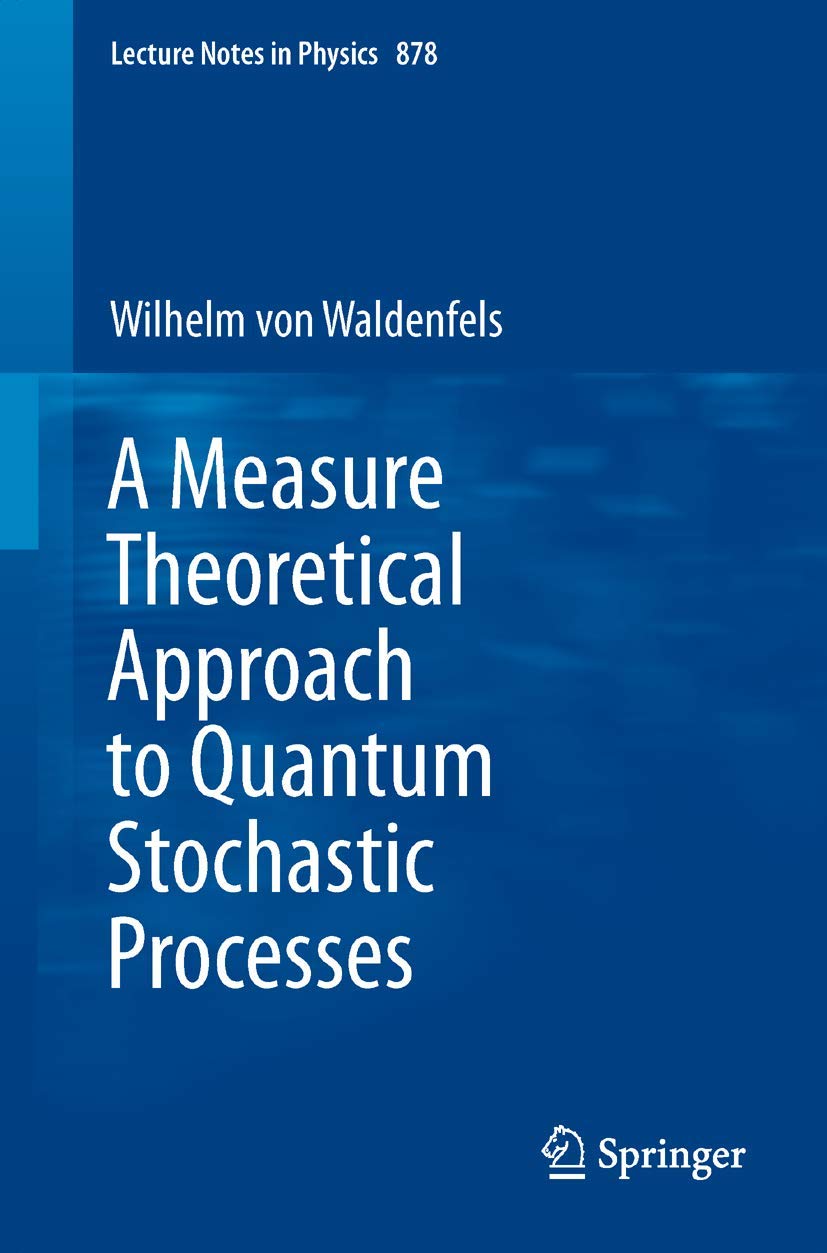
A Measure Theoretical Approach to Quantum Stochastic Processes
A Measure Theoretical Approach to Quantum Stochastic Processes
Price subject to change. Tap below for current.
Couldn't load pickup availability
Our review examines A Measure Theoretical Approach to Quantum Stochastic Processes and its value for researchers and advanced students. This monograph treats abstract quantum stochastic processes as a one-space, one-time quantum field theory and emphasizes rigorous representation of operators in normal-ordered power series using classical measure theory. The single biggest reason to buy is its thorough mathematical derivations of Hamiltonians and explicit spectral decompositions for key examples, making it a practical reference for mathematical physicists seeking a measure-theoretic foundation for quantum stochastic methods.
Key Features
- Measure-theoretic foundation: Presents operators as power series in creation and annihilation operators using classical measure theory, giving a rigorous basis for stochastic constructions.
- Concrete examples: Works through four basic examples, including a two-level atom coupled to a heat bath of oscillators, to show how abstract constructions apply to physical models.
- Spectral decomposition: Determines the Hamiltonian of the one-parameter strongly continuous group and calculates explicit spectral decompositions in generalized eigen-vectors for each case.
- Advanced topics covered: Includes treatment of the Hudson-Parthasarathy equation and the amplified oscillator problem to connect to contemporary quantum stochastic analysis.
- Mathematical rigor: Emphasizes explicit calculations and proofs, making it useful as a reference text for rigorous work in quantum stochastic processes.
Who It's For
This book is best for researchers, postgraduates and advanced graduate students in mathematical physics who need a rigorous, measure-theoretic account of quantum stochastic processes and explicit operator representations. It suits readers who already have a solid background in functional analysis, operator theory and quantum field methods and who want worked examples with spectral calculations.
Those looking for an introductory or physics-first textbook with minimal measure theory or for a practical engineering guide to quantum systems should look elsewhere, as the monograph presumes significant mathematical maturity and focuses on theoretical foundations rather than experimental techniques.
Pros & Cons
Pros
- Provides a clear and rigorous measure-theoretic approach that connects quantum stochastic processes to quantum field theory in one space and one time coordinate.
- Offers detailed worked examples, including the two-level atom coupled to a heat bath, that illuminate abstract theory with concrete models.
- Covers advanced material such as the Hudson-Parthasarathy equation and amplified oscillator problem, useful for further research.
Cons
- High level of mathematical rigor makes it unsuitable for beginners or readers seeking an elementary introduction.
Specifications
| Title | A Measure Theoretical Approach to Quantum Stochastic Processes |
| Series | Lecture Notes in Physics, 878 |
| Author | Wilhelm Waldenfels |
| Main focus | Measure-theoretic operator representations and quantum stochastic processes |
| Key topics | Creation and annihilation operator series, Hamiltonian determination, spectral decomposition |
| Advanced topics | Hudson-Parthasarathy equation, amplified oscillator problem |
Our Verdict
This monograph is a strong purchase for mathematical physicists and advanced students who need a rigorous, example-driven treatment of quantum stochastic processes. Its explicit spectral decompositions and measure-theoretic operator framework make it a valuable reference for theoretical work, though its density and prerequisites limit its appeal to specialists rather than general readers.
Frequently Asked Questions
Is this book suitable for beginners?
Answer. No, it requires solid background in functional analysis and quantum field methods and is aimed at advanced students and researchers.
Does it include worked physical examples?
Answer. Yes, it treats four basic examples in detail, including a two-level atom coupled to a heat bath of oscillators with explicit spectral calculations.
Are advanced stochastic equations covered?
Answer. Yes, the book discusses the Hudson-Parthasarathy equation and the amplified oscillator problem as advanced topics.
Editor's Take
A rigorous, example-driven monograph ideal for mathematical physicists and advanced students who need a measure-theoretic foundation for quantum stochastic processes; excellent reference value despite steep prerequisites.

Recently viewed
Recently viewed products will appear here as customers browse the store.