

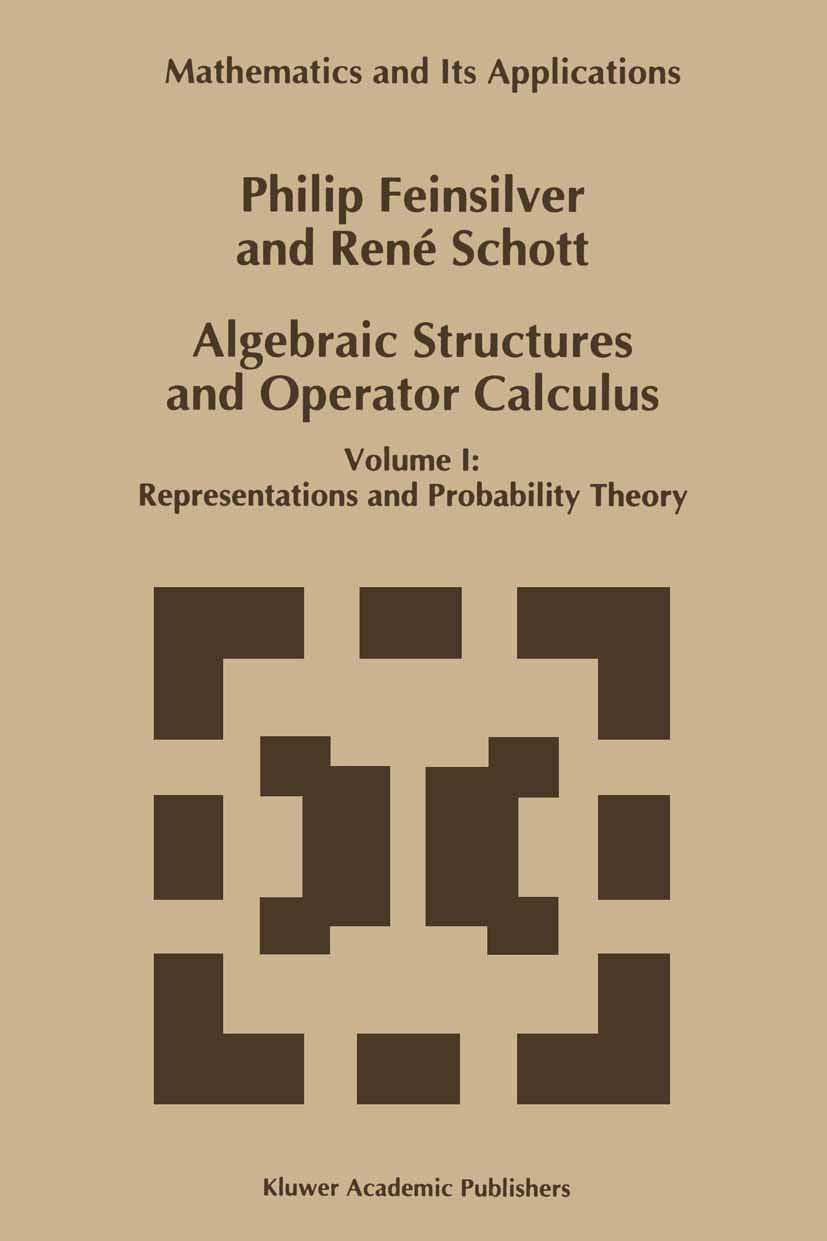
Algebraic Structures and Operator Calculus Volume I - Representations
Algebraic Structures and Operator Calculus Volume I - Representations
Price subject to change. Tap below for current.
Couldn't load pickup availability
In this review of Algebraic Structures and Operator Calculus: Volume I, the reviewer finds a compact but dense treatment aimed at mathematicians and advanced students who want a unified presentation of probability theory tied to group representations. The book's single biggest reason to buy is its original synthesis of probability theory and representation theory, which is presented in one place rather than scattered across papers. Readers seeking an accessible textbook will find it demanding, but those who need the connections between operator calculus and special functions will appreciate the authors' focused approach.
Key Features
- Consolidated material: Collects tools from probability, operator calculus, and representation theory that are otherwise scattered in the literature, saving researchers time finding relevant references.
- Original presentation: Offers the authors' own approach to linking group representations with probabilistic methods, providing fresh perspectives for advanced study.
- Applied orientation: Emphasizes applications to mathematics, physics, and computer science, making it useful for interdisciplinary projects that require rigorous foundations.
- Series context: Fits into a larger three-volume work where Volume II treats computer science applications and Volume III addresses infinite-dimensional representations, helping readers plan further study.
- Special functions and operators: Examines special functions alongside operator calculus to support practical computations and theoretical insight used in applied problems.
Who It's For
This volume is best for graduate students, researchers, and practitioners in pure mathematics, mathematical physics, and theoretical computer science who already have a background in functional analysis and group theory. It serves readers who want a concentrated, original treatment of how operator calculus interacts with probability and representations.
It is not ideal for beginners or undergraduates without prior exposure to advanced algebraic structures; those seeking an introductory text on probability or representation theory should look for more pedagogical treatments with extensive exercises and elementary introductions.
Pros & Cons
Pros
- Unique consolidation of material makes it a convenient reference for specialists needing probability and representation connections.
- Original authorial viewpoint provides novel insights not commonly found in standard textbooks.
- Clear placement within a series allows readers to follow applications and advanced topics across volumes.
Cons
- Dense and advanced presentation limits accessibility for readers without strong prerequisites.
Specifications
| Title | Algebraic Structures and Operator Calculus: Volume I |
| Subtitle | Representations and Probability Theory |
| Series | Mathematics and Its Applications (multi-volume) |
| Authors | P. Feinsilver, Rene Schott |
| Subject areas | Probability theory, operator calculus, representation theory, special functions |
| Intended audience | Graduate students, researchers in mathematics, physics, and computer science |
Our Verdict
Algebraic Structures and Operator Calculus: Volume I is a valuable, well-focused resource for specialists who need a single source linking group representations and probability theory. Its original presentation and series context make it good value for researchers planning to work through the full trilogy, though beginners should prepare by consulting more introductory texts first.
Frequently Asked Questions
Does this volume explain probability from first principles?
Answer. No, the book presents probability in connection with representation theory and assumes prior familiarity with core probability concepts.
Is this volume suitable for computer science applications?
Answer. It lays theoretical groundwork and points toward applications, with Volume II addressing computer science more directly.
Will I find worked examples and computations?
Answer. The text includes discussions of operator calculus and special functions to support computations, but it is not a problem-driven textbook for novices.
Editor's Take
A focused, original resource linking probability theory and group representations that is valuable for advanced students and researchers, though it is dense and expects strong prerequisites.

Recently viewed
Recently viewed products will appear here as customers browse the store.