

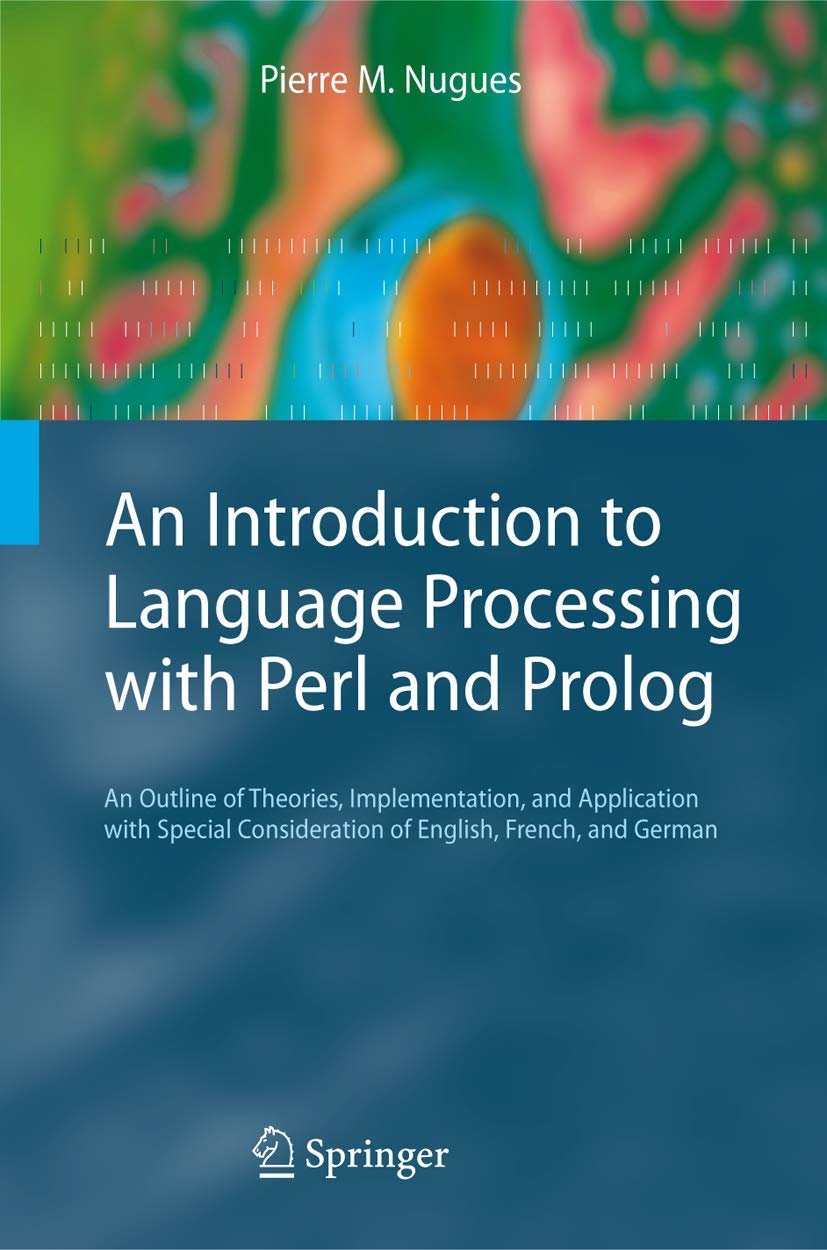
An Introduction to Language Processing with Perl and Prolog
An Introduction to Language Processing with Perl and Prolog
Price subject to change. Tap below for current.
Couldn't load pickup availability
In this review of An Introduction to Language Processing with Perl and Prolog, the book is presented as a practical, theory-aware guide for readers who want to understand how natural language processing systems are built and why specific techniques work. The single biggest reason to buy is its dual focus on linguistic foundations and concrete implementation using Perl and Prolog, which makes it useful for readers wanting both conceptual clarity and hands-on examples rather than a purely theoretical treatment.
Key Features
- Linguistic foundations: The book explains core concepts such as encoding, entropy, and annotation schemes, giving readers a firm basis for understanding language data and preprocessing choices.
- Tokenization and morphology: It defines words, tokens and parts of speech and examines morphology, helping practitioners handle real text variation across languages.
- Tagging techniques: The coverage of part-of-speech tagging includes both rule-based and stochastic approaches, useful for comparing methods on small and large datasets.
- Grammar and parsing: Using Prolog to write phrase-structure grammars and parsing techniques provides concrete examples for building syntactic analyzers.
- Semantics and logic: The book addresses semantics, predicate logic and lexical semantics, which supports readers aiming to move beyond syntax to meaning representation.
- Multilingual focus: Special consideration of English, French and German illustrates how language-specific issues affect processing choices and evaluation.
Who It's For
This book is best for graduate students, researchers, and software developers who already have some programming experience and want to deepen their understanding of how linguistic theory informs implementation. Its emphasis on Perl and Prolog makes it particularly useful for readers interested in symbolic and rule-based approaches alongside stochastic methods.
Readers seeking a modern, deep dive into neural methods or large-scale applied machine learning may find the coverage limited; this is not a primer on current deep learning toolkits but rather a focused treatment of classical NLP theories and implementations.
Pros & Cons
Pros
- Clear linkage between linguistic theory and implementation, so readers learn why algorithms behave as they do.
- Practical examples in Perl and Prolog let readers experiment with grammars, parsing and tagging directly.
- Multilingual examples (English, French, German) demonstrate language-specific considerations for real applications.
Cons
- Coverage focuses on classical techniques and does not address modern neural network toolchains in depth.
Specifications
| Title | An Introduction to Language Processing with Perl and Prolog |
| Author / Brand | Pierre M. Nugues |
| Subject areas | Natural language processing, computational linguistics |
| Languages discussed | English, French, German |
| Implementation focus | Perl and Prolog examples |
| Topics covered | Encoding, entropy, annotation, POS tagging, grammars, parsing, semantics |
Our Verdict
This book is a solid choice for readers who want a principled, implementation-oriented introduction to NLP that links linguistic concepts to working code. It offers good value for students and developers interested in symbolic methods and multilingual issues, though those seeking state-of-the-art neural approaches should supplement it with more recent resources.
Frequently Asked Questions
Does the book include code examples?
The text provides examples and implementation guidance using Perl and Prolog to illustrate grammars, parsing and tagging.
Which languages does it focus on?
It gives special consideration to English, French and German with examples and discussion of language-specific issues.
Is it suitable for beginners?
It assumes some programming familiarity; beginners with no coding experience may need supplementary material to follow the examples.
Editor's Take
A principled, implementation-oriented introduction to NLP that links linguistic theory to Perl and Prolog examples, ideal for students and developers interested in symbolic methods and multilingual issues.

Recently viewed
Recently viewed products will appear here as customers browse the store.