

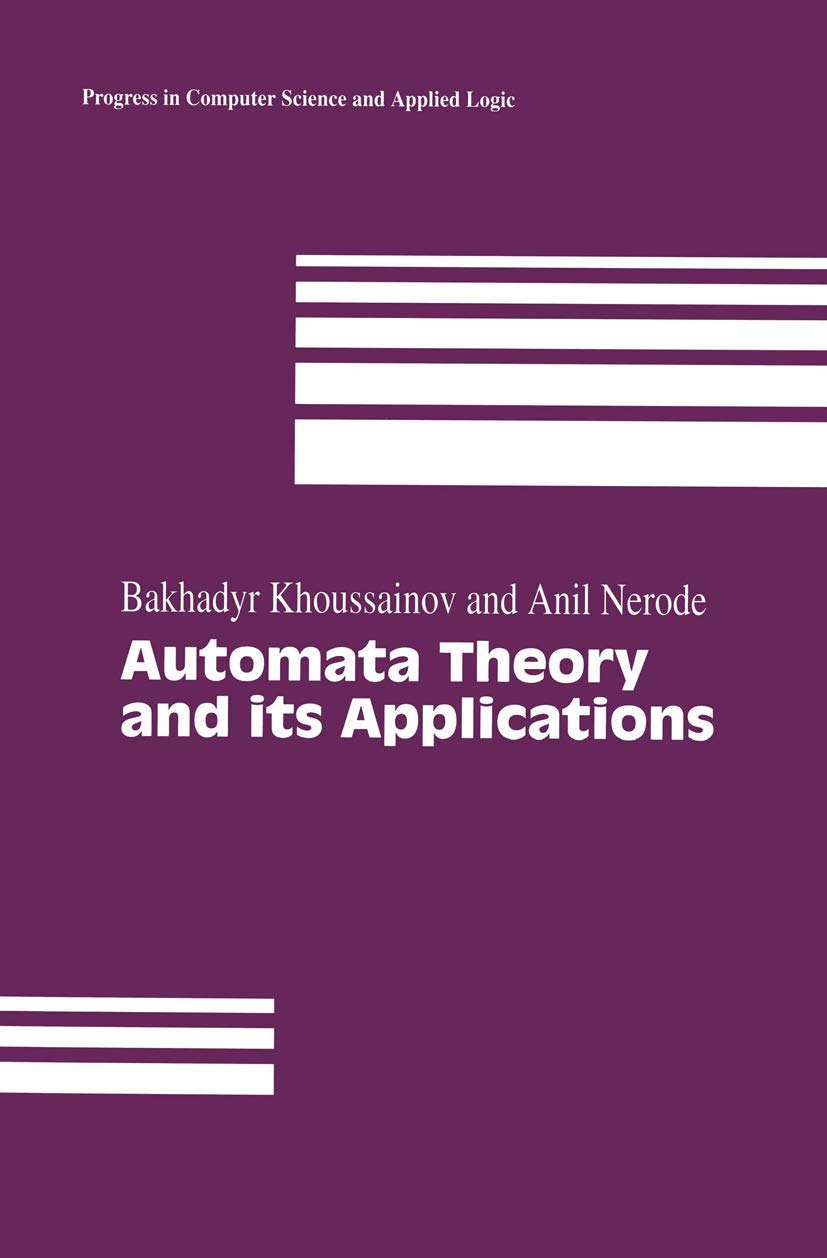
Automata Theory and its Applications - Unified Treatment of Finite
Automata Theory and its Applications - Unified Treatment of Finite
Price subject to change. Tap below for current.
Couldn't load pickup availability
In this review of Automata Theory and its Applications, the book's single biggest strength is its rigorous, unified treatment of automata across finite strings, infinite strings and trees, making it a practical textbook for courses and a strong reference for researchers. Readers will find a clear exposition of standard finite automata results followed by in-depth sections on Buchi and Rabin automata and their use in logical theories like S1S and S2S. This review focuses on who benefits most and why the coverage of infinite structures sets this volume apart.
Key Features
- Unified scope: Presents finite automata and automata on infinite strings and trees within a single coherent framework to help readers connect classical and advanced topics.
- Deep coverage of Buchi and Rabin automata: Explains construction, acceptance conditions and applications so students can apply these models to logic and verification problems.
- Connections to logic: Demonstrates how automata techniques apply to theories such as S1S and S2S, useful for researchers in logic and formal verification.
- Game-theoretic models: Describes game-theoretic approaches to concurrent and communication systems, offering methods to reason about interactive behavior.
- Self-contained learning aids: Includes numerous examples, illustrations and exercises that support classroom use across undergraduate and graduate courses.
Who It's For
The book is aimed primarily at computer science and mathematics majors taking a two-semester undergraduate course or a one-semester graduate seminar on automata and formal methods; instructors will find it suitable as a course text because it combines foundational material with advanced topics. It also serves researchers and practitioners who need a reference on automata over infinite objects and their connections to logical theories.
Those seeking a gentle, purely application-oriented introduction to machine learning or practical programming tools should look elsewhere; this is a theory-focused text that assumes mathematical maturity but no advanced prerequisites, and it is best for readers who want rigorous proofs and formal treatments.
Pros & Cons
Pros
- Comprehensive treatment linking finite automata with automata on infinite strings and trees, aiding conceptual continuity.
- Detailed exposition of Buchi and Rabin automata with clear applications to S1S and S2S logical theories.
- Numerous examples and exercises that make the material suitable for classroom use and self-study.
Cons
- Focused on formal theory rather than implementation, so it is less useful for readers seeking coding examples or tool tutorials.
Specifications
| Title | Automata Theory and its Applications |
| Series | Progress in Computer Science and Applied Logic |
| Authors | Bakhadyr Khoussainov, Anil Nerode |
| Scope | Finite automata, infinite strings, trees, Buchi and Rabin automata |
| Applications covered | Logical theories S1S and S2S; game-theoretic models of concurrent systems |
| Includes | Examples, illustrations and exercises; self-contained exposition |
Our Verdict
This is a strong value for instructors and students seeking a rigorous, unified textbook on automata that extends beyond finite strings to infinite structures and trees. Its deep coverage of Buchi and Rabin automata and connections to logical theories make it a durable reference for formal methods courses and researchers who need a theory-focused resource.
Frequently Asked Questions
Is prior advanced math required?
No; the book is described as self-contained and does not require an advanced mathematical background, though readers should be comfortable with undergraduate-level proofs.
Does it cover practical verification tools?
It focuses on theoretical foundations and logical applications rather than tool-specific tutorials or implementation guides.
Is it suitable for a graduate seminar?
Yes; the text is appropriate for a one-semester graduate course or seminar and can also be used across two undergraduate semesters.
Editor's Take
A rigorous, unified textbook ideal for courses and researchers; it covers finite and infinite automata, Buchi and Rabin automata, and links to logical theories, offering strong classroom value.

Recently viewed
Recently viewed products will appear here as customers browse the store.