

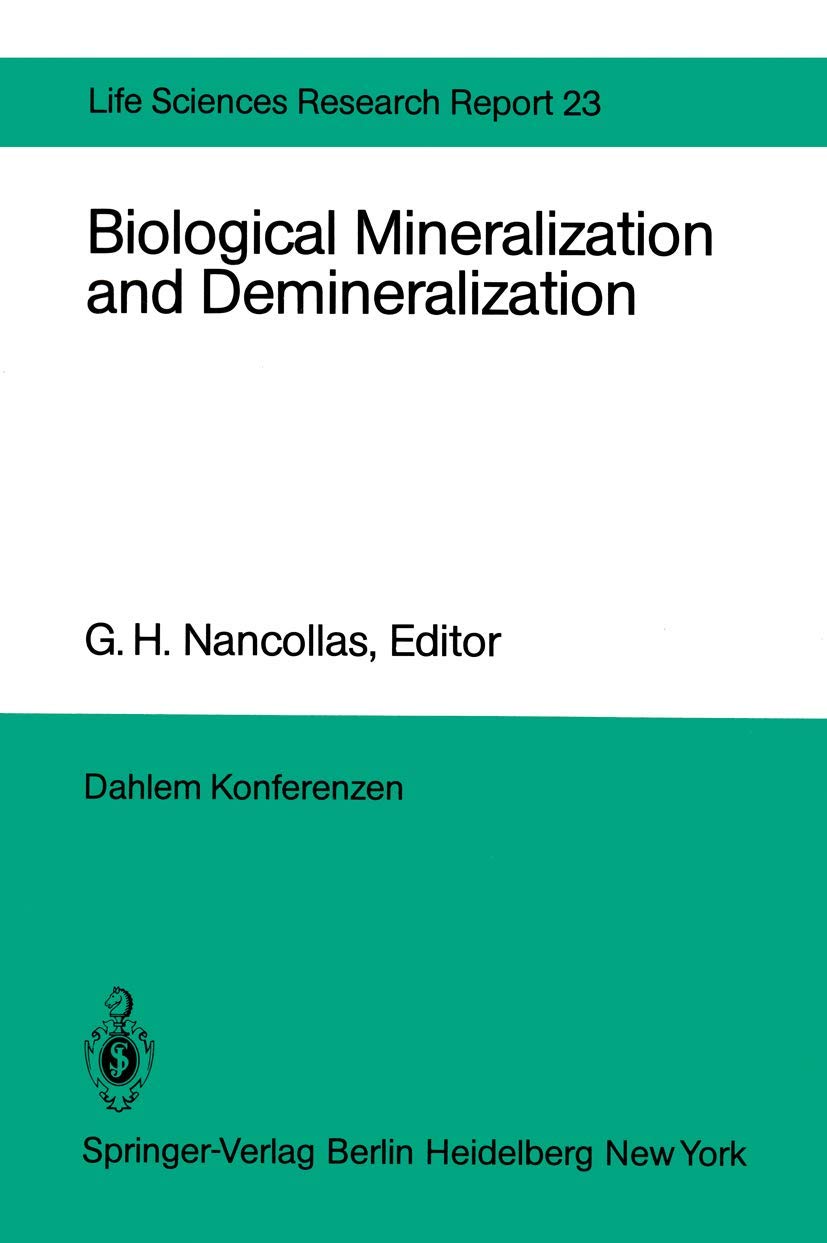
Biological Mineralization and Demineralization - Workshop Report
Biological Mineralization and Demineralization - Workshop Report
Price subject to change. Tap below for current.
Couldn't load pickup availability
Our review of Biological Mineralization and Demineralization examines a specialist conference volume aimed at researchers and advanced students interested in the chemistry and biology of hard tissues and plant deposits. This collection from the Dahlem Workshop presents focused discussions on normal and pathological mineral deposits, including vertebrate calcification and intracellular calcium oxalate in plants. The single biggest reason to consult this work is its concentrated expert treatment of factors that control mineral phase formation, offering a compact reference for anyone studying biogenic calcium carbonate and related processes.
Key Features
- Workshop compilation: Brings together papers and discussions from the 1981 Dahlem Workshop to present multiple expert viewpoints on mineralization and demineralization.
- Cross-kingdom coverage: Addresses both vertebrate mineralization and plant intracellular deposits, helping readers compare mechanisms across organisms.
- Focus on mineral phases: Explores why both calcite and aragonite form in biogenic calcium carbonate and what controls final mineralogy.
- Pathology and normal physiology: Discusses normal and pathological deposition of calcium salts, useful for those studying disease-related calcification.
- Thermodynamics and kinetics: Considers how less stable mineral phases can be kinetically stabilized by biological molecules, providing a mechanistic perspective.
Who It's For
The book is best suited to researchers, advanced undergraduates, and graduate students in biological mineralization, biomineralization, and related fields who need a concise record of workshop contributions and discussion summaries. It functions well as a reference for scientists interested in the interplay between chemistry and biology in shell and bone formation.
It is less appropriate for casual readers or those seeking a general textbook introduction; individuals new to the subject without prior background in chemistry or biology may find the conference-style chapters dense and focused on specific problems rather than broad pedagogy.
Pros & Cons
Pros
- Concentrated expert perspectives collected from a specialized workshop provide depth on niche topics.
- Useful comparative treatment of mineralization across taxa, including vertebrates and plants.
- Detailed discussion of factors controlling mineral phase selection, valuable for researchers studying phase stability.
Cons
- Conference volume format means uneven chapter styles and assumes reader familiarity with core concepts.
Specifications
| Title | Biological Mineralization and Demineralization |
| Event | Dahlem Workshop, Berlin 1981 |
| Editors / Authors | G.H. Nancollas; I. L. Matthews; I. I. Reynolds; W. G. Robertson; K. Simkiss |
| Subject focus | Normal and pathological mineralization; plant calcium oxalate; calcium carbonate phases |
| Topics covered | Calcite vs aragonite formation, kinetic stabilization, intracellular deposits |
| Intended audience | Researchers and advanced students in biological sciences |
Our Verdict
This workshop report is a compact, specialist resource that rewards readers with prior background in chemistry or biology. Those researching biogenic calcium carbonate formation or pathological calcification will find valuable mechanistic discussion and comparative insights, making it a good value as a focused reference despite the uneven chapter presentation typical of conference volumes.
Frequently Asked Questions
Does this volume cover both animals and plants?
Yes. The collection discusses vertebrate mineralization and also addresses intracellular calcium oxalate deposits in plants.
Is this book suitable for beginners?
Not ideal for complete beginners; it assumes familiarity with basic chemistry and biology and reads more like a specialist reference.
Does it explain why different calcium carbonate phases form?
Yes. Several contributions examine factors that control formation of calcite versus aragonite and how biological molecules can kinetically stabilize phases.
Editor's Take
This workshop report is a compact, specialist resource for researchers of biogenic calcium carbonate and pathological calcification, offering mechanistic discussion and comparative insights despite the uneven chapter styles.

Recently viewed
Recently viewed products will appear here as customers browse the store.