

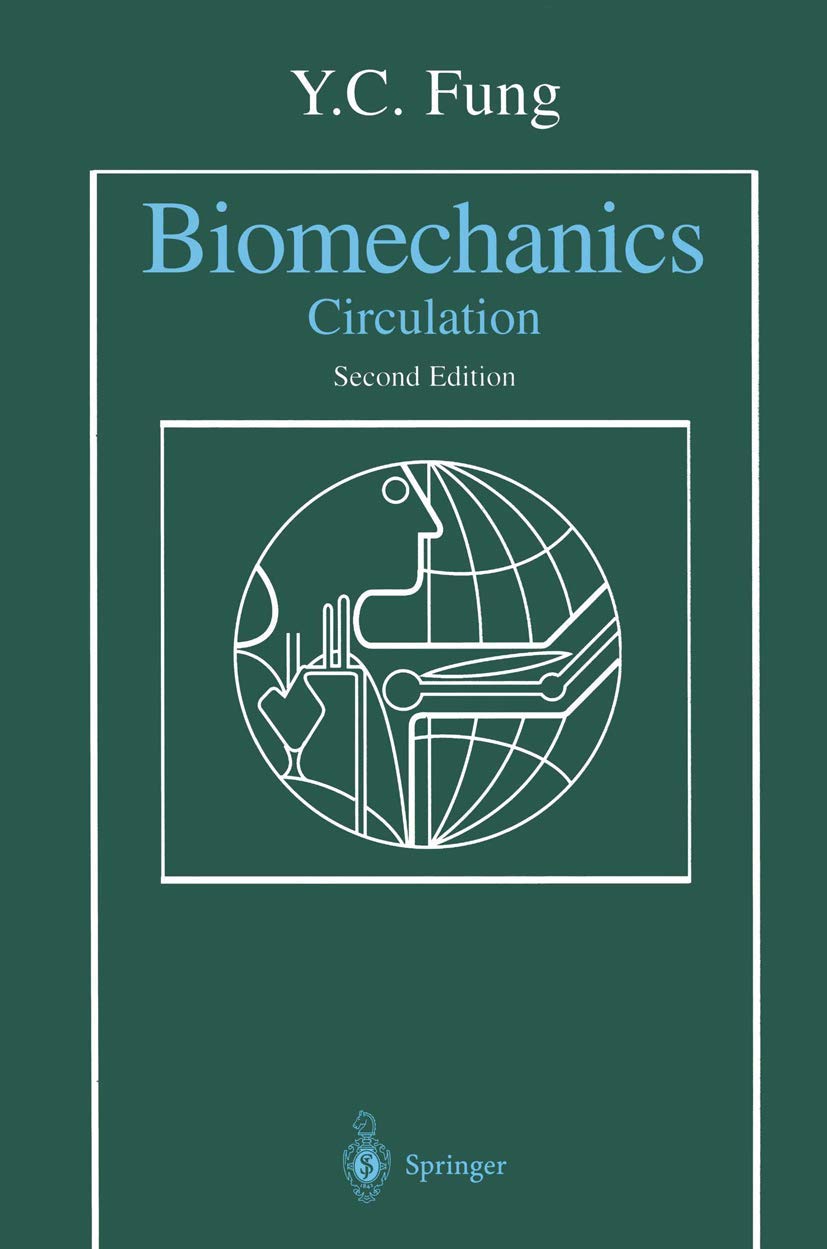
Biomechanics: Circulation - Rigorous Text on Vascular Mechanics
Biomechanics: Circulation - Rigorous Text on Vascular Mechanics
Price subject to change. Tap below for current.
Couldn't load pickup availability
In this review of Biomechanics: Circulation the reviewer finds a rigorous, mathematically grounded treatment of the mechanics of blood flow that will appeal to graduate students and researchers seeking physical insight rather than a purely clinical overview. The book's single biggest reason to buy is its clear coupling of fluid and solid mechanics applied to the heart, arteries, veins and microcirculation, presented with the precision of physics and a focus on problem formulation for experiments and models.
Key Features
- Mathematical formulation: The text frames experimental and theoretical problems in clear mathematical terms so readers can translate physiological questions into testable models.
- Comprehensive organ coverage: Chapters address the physics of the heart, arteries, veins, microcirculation and pulmonary blood flow to provide a broad, organ-level perspective.
- Coupling of fluids and solids: The book emphasizes the interaction between flowing blood and compliant tissues, which helps explain realistic physiological responses.
- Experimental orientation: Fung links in vivo observations and model experiments to theory, making the material useful for those designing or interpreting experiments.
- Expanded second edition: New chapters on coronary blood flow and skeletal muscle perfusion broaden the book's relevance to current research topics.
Who It's For
Biomechanics: Circulation is best suited to graduate students, bioengineers and physiologists who are comfortable with calculus and basic continuum mechanics and who want a physically rigorous treatment of circulatory systems. Its focus on mathematical problem formulation and coupling of tissues and fluids makes it valuable for researchers developing models or planning experiments.
Readers looking for a short primer, a clinically focused textbook, or a lay introduction to cardiovascular disease should look elsewhere, since the book assumes a technical background and emphasizes physical and experimental reasoning over clinical practice.
Pros & Cons
Pros
- Provides a rigorous, physics-based framework that helps translate physiological phenomena into quantitative models.
- Wide coverage of circulatory components, including heart, arteries, veins and microcirculation, supporting cross-organ understanding.
- New chapters on coronary and skeletal muscle blood flow increase the book's applicability to contemporary research questions.
Cons
- The mathematically intensive approach may be challenging for readers without a solid background in mechanics or applied mathematics.
Specifications
| Title | Biomechanics: Circulation |
| Author | Y.C. Fung |
| Edition | Second edition (adds coronary and skeletal muscle chapters) |
| Subject focus | Physics of heart, arteries, veins, microcirculation, pulmonary flow |
| Approach | Mathematical formulation, experimental linkage, in vivo observation |
| Intended audience | Graduate students, researchers, bioengineers |
Our Verdict
Biomechanics: Circulation is a valuable, high-quality reference for readers who need a physically rigorous, mathematically precise treatment of circulatory mechanics. Its expanded chapters and emphasis on fluid-solid coupling make it well worth acquiring for researchers and advanced students who will use the material to design experiments or build predictive models.
Frequently Asked Questions
Is this book suitable for medical students?
It is best for those with a technical background; medical students without mechanics training may find the mathematical emphasis demanding.
Does the second edition include new content?
Yes, it adds chapters on coronary blood flow and blood flow in skeletal muscle.
Will this help with experimental design?
Yes, the book links theory to model experiments and in vivo observations to aid experimental planning.
Editor's Take
Biomechanics: Circulation is a mathematically rigorous, experimentally oriented reference ideal for graduate students and researchers who need a physics-based treatment of heart, vessel and microcirculatory mechanics.

Recently viewed
Recently viewed products will appear here as customers browse the store.