

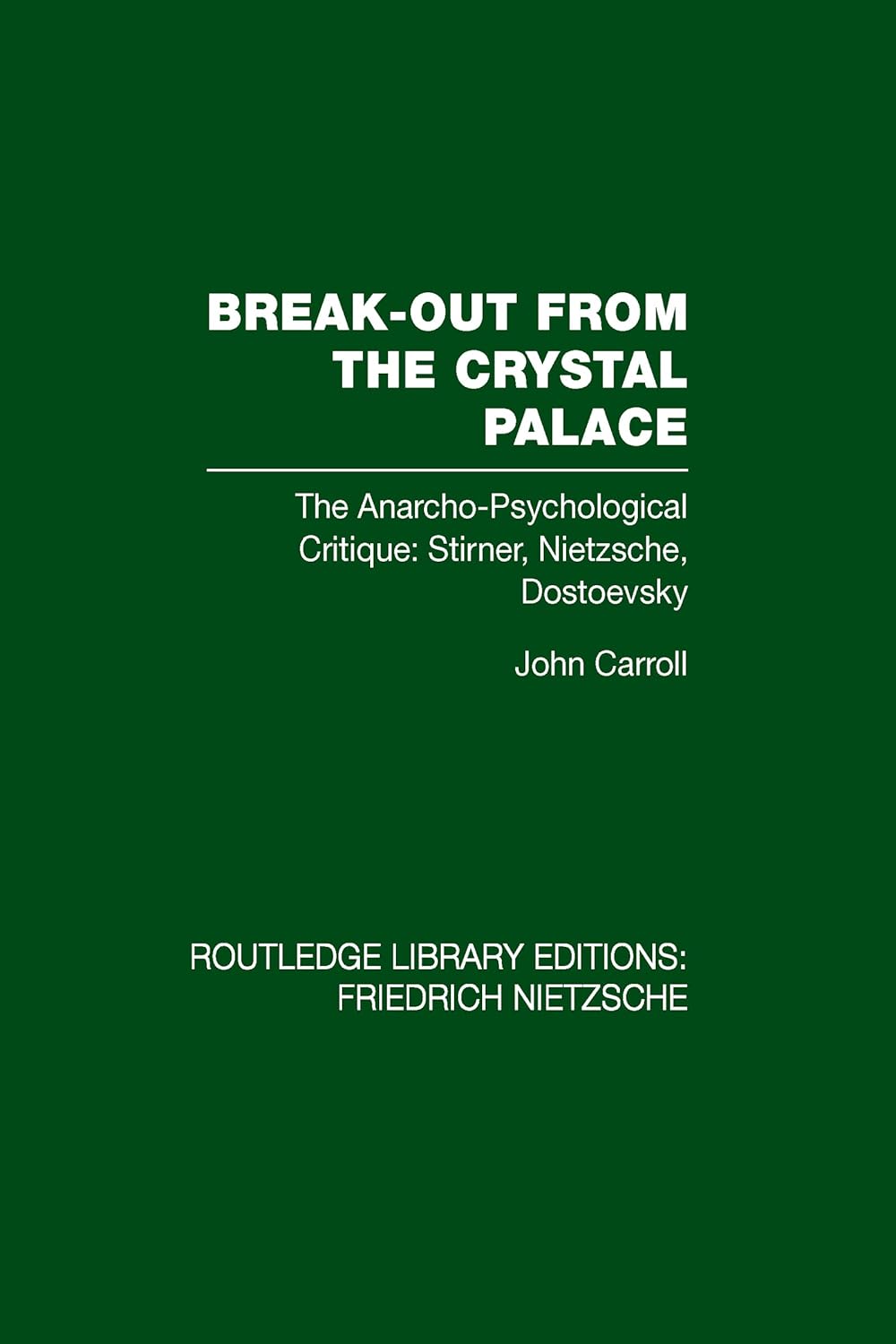
Break-Out from the Crystal Palace - Classic Nietzschean Critique
Break-Out from the Crystal Palace - Classic Nietzschean Critique
Price subject to change. Tap below for current.
Couldn't load pickup availability
In this review of Break-Out from the Crystal Palace, John Carroll offers a concise, historically minded study for readers interested in the origins of modern anarcho-psychological critique. The bottom line: this book is for serious students of 19th century thought who want a focused account linking Stirner, Nietzsche and Dostoevsky to later critiques of industrial modernity. Carroll's narrative is tightly argued and documents how a psychological demolition of dominant social theories emerges before mid 20th century continental critiques, making it a worthwhile companion for advanced readers of philosophy of modernity.
Key Features
- Historical tracing: Carroll tracks the development of anarcho-psychological critique back to nineteenth century writers, clarifying intellectual lineage for readers.
- Concise framing: The book compresses complex connections between Stirner, Nietzsche and Dostoevsky into a readable argument for students and scholars.
- Contextual relevance: Carroll situates these thinkers against the symbol of the Crystal Palace to examine reactions to technologico-industrial progress.
- Intellectual synthesis: The title explains how attacks on ideology, absolute morality, and scientific habits of mind converge in a psychological critique.
- Accessible scholarship: First published in 1974, the work remains a compact, useful introduction for those exploring precursors to later continental critics.
Who It's For
This book is best for graduate students, instructors, and informed general readers who already have some familiarity with Nietzschean themes and want a targeted study of how nineteenth century figures anticipated later critiques of industrial rationalism. It serves as a focused supplement to broader surveys of modern European thought.
Readers looking for a comprehensive textbook, a lengthy anthology of primary texts, or an introductory primer with glossary entries and pedagogical aids should look elsewhere; this title assumes engagement with philosophical concepts and offers concentrated analysis rather than a beginner's course.
Pros & Cons
Pros
- Clear linking of Stirner, Nietzsche and Dostoevsky provides a coherent narrative for the origins of anarcho-psychological critique.
- Focused scope makes it efficient to read for those researching the intellectual history of social criticism.
- Timely framing around the Crystal Palace symbol highlights tensions between progress and ideology that remain relevant.
Cons
- Not an introductory textbook; newcomers to Nietzsche or Dostoevsky may find assumptions of prior knowledge a limitation.
Specifications
| Title | Break-Out from the Crystal Palace |
| Series | Routledge Library Editions: Friedrich Nietzsche |
| Author | John Carroll |
| First published | 1974 |
| Subject | Philosophy, social critique, history of ideas |
| Topics covered | Stirner, Nietzsche, Dostoevsky, critique of industrial modernity |
Our Verdict
Break-Out from the Crystal Palace is a compact, thoughtful work that rewards readers already versed in continental debate; its careful linking of nineteenth century figures to later critiques makes it a good value for scholars and informed readers seeking depth without unnecessary breadth. Those seeking a gentle introduction should pair it with primary texts or broader surveys.
Frequently Asked Questions
Is this book suitable for undergraduate courses?
It can be assigned in upper-level seminars where students have prior exposure to Nietzsche and continental thought, but it is not a basic textbook.
Does the book include primary texts from the thinkers discussed?
The work is a secondary study and focuses on synthesis and interpretation rather than reproducing primary texts.
How does the Crystal Palace symbol function in the book?
Carroll uses the Crystal Palace as a cultural symbol of technologico-industrial progress and rationalist ideology to frame the book's critique.
Editor's Take
Break-Out from the Crystal Palace is a compact, thoughtful study that links nineteenth century thinkers to later critiques of industrial modernity; ideal for scholars and informed readers seeking a focused intellectual history.

Recently viewed
Recently viewed products will appear here as customers browse the store.