

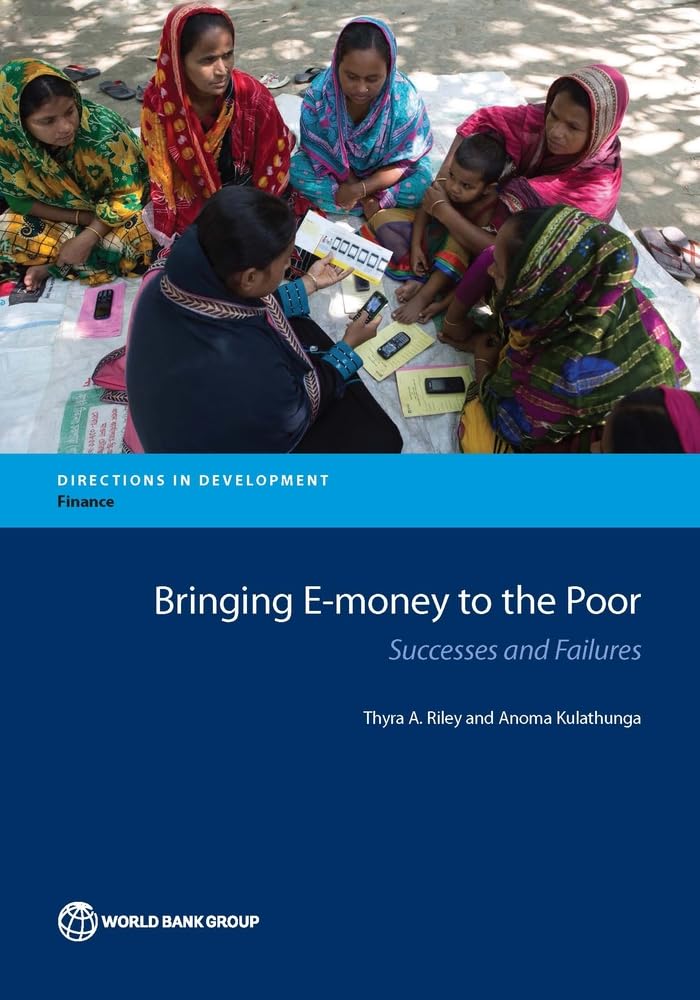
Bringing E-money to the Poor: Successes and Failures - A Practical
Bringing E-money to the Poor: Successes and Failures - A Practical
Price subject to change. Tap below for current.
Couldn't load pickup availability
In this review the book Bringing E-money to the Poor: Successes and Failures is assessed as a focused study for policymakers, development practitioners, and researchers who need concrete lessons on financial inclusion. The authors examine how e-money, mobile accounts, debit cards, and low-cost bank accounts were deployed in several countries to expand access. The single biggest reason to read it is the comparative, case-based approach that isolates real-world successes and setbacks, making it a useful reference for anyone designing or evaluating digital finance initiatives.
Key Features
- Country case studies: Detailed examinations of Kenya, South Africa, Sri Lanka, and Thailand provide practical lessons on how different markets enabled e-money deployment.
- Comparative analysis: Cross-country comparisons highlight which policy and business model choices correlated with greater financial access for low-income populations.
- Technology focus: Discussion of mobile accounts and e-money platforms explains how new technologies removed barriers to entry for underserved users.
- Inclusion instruments: Coverage of debit cards and low-cost traditional bank accounts shows multiple pathways to broaden access beyond mobile-only solutions.
- Policy relevance: The narrative emphasizes reforms and regulatory approaches that supported scale-up, useful for decision makers crafting enabling environments.
Who It's For
Development practitioners, central bankers, regulators, and NGO program managers will find this book most useful because it links technological options to governance and market outcomes with real examples. Academics studying financial inclusion will appreciate the comparative frame and country-level detail that support empirical and policy-oriented work.
Readers seeking a step-by-step technical manual on building mobile wallets or developers looking for product design templates should look elsewhere, as the book focuses on macro lessons, case evidence, and policy implications rather than engineering schematics.
Pros & Cons
Pros
- Clear, case-based evidence from multiple countries that illustrates what enabled e-money adoption.
- Useful synthesis of technology, business model, and regulatory factors that affected scale and inclusion.
- Practical lessons that policymakers can adapt to local conditions without excessive theoretical jargon.
Cons
- Not a technical handbook; readers seeking implementation blueprints for software or platforms may find the coverage high level.
Specifications
| Title | Bringing E-money to the Poor: Successes and Failures |
| Series | Directions in Development - Finance |
| Authors | Thyra A. Riley, Anoma Kulathunga |
| Focus | Case studies of financial inclusion and e-money deployment |
| Countries covered | Kenya, South Africa, Sri Lanka, Thailand, Maldives, Philippines |
Our Verdict
Bringing E-money to the Poor is a compact, evidence-driven resource for anyone shaping financial inclusion policy or program design. Its value lies in comparative case studies and pragmatic lessons that translate across contexts, making it good value for practitioners and researchers who need actionable insight rather than technical implementation detail.
Frequently Asked Questions
Does the book cover specific technologies used for e-money?
The book discusses mobile accounts, e-money platforms, and related instruments in the context of country cases, focusing on their role in expanding access rather than technical specifications.
Which countries are profiled?
Main case studies include Kenya, South Africa, Sri Lanka, and Thailand, with additional lessons from the Maldives and the Philippines.
Who wrote the book?
The authors are Thyra A. Riley and Anoma Kulathunga, writing from a development finance perspective in the Directions in Development - Finance series.
Editor's Take
A concise, evidence-driven resource for policymakers and practitioners; the book offers comparative case studies and practical lessons on expanding financial access through e-money and related instruments.

Recently viewed
Recently viewed products will appear here as customers browse the store.