

Chaos Near Resonance - In-depth of Resonant Dynamics
Chaos Near Resonance - In-depth of Resonant Dynamics
Price subject to change. Tap below for current.
Couldn't load pickup availability
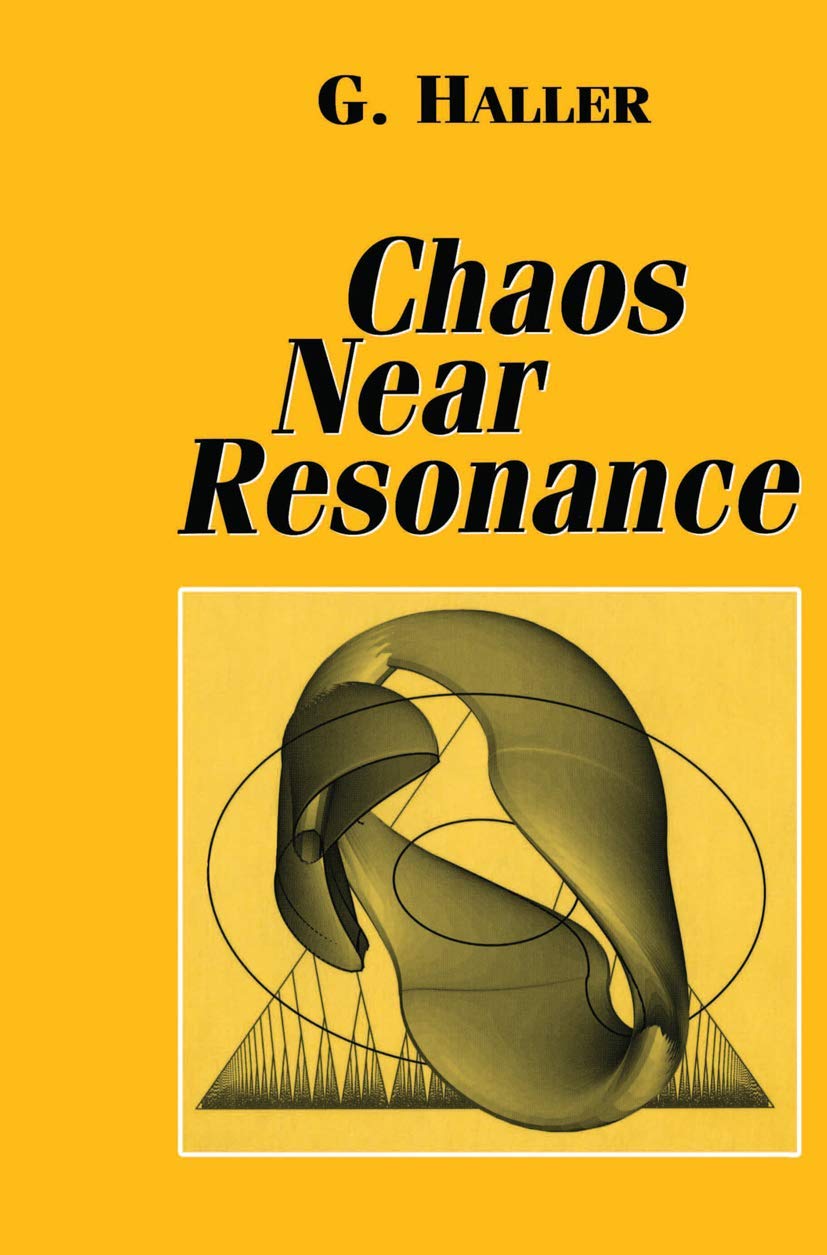
In this review of Chaos Near Resonance the focus is on readers who need a rigorous, mathematically driven account of resonances and the onset of chaotic behavior in finite-dimensional systems. The book's single biggest reason to buy is its unified development of homoclinic jumping and the mechanisms that produce slow-fast and irregular dynamics, presented with both dissipative and Hamiltonian perspectives. For mathematicians and advanced graduate students working on dynamical systems, this text serves as a research-level reference rather than a casual introduction.
Key Features
- Unified theory: The book develops a general finite dimensional theory of homoclinic jumping, giving readers a coherent framework for understanding resonant-induced chaos.
- Dissipative and Hamiltonian perspectives: Both contexts are discussed, allowing comparisons of how resonances generate complex behavior in different physical settings.
- Illustrative examples: Concrete examples accompany the theory to clarify how abstract results appear in specific dynamical systems.
- New results: Previously unpublished results on universal homoclinic bifurcations and multi-pulse Silnikov manifolds expand the literature for researchers seeking recent developments.
- Background survey: A concise survey of necessary background material prepares readers for the more technical sections that follow.
Who It's For
Chaos Near Resonance is aimed at researchers, postdoctoral fellows, and advanced graduate students in mathematics, physics, and engineering who work on dynamical systems, bifurcation theory, or nonlinear differential equations. Its emphasis on rigorous arguments and new bifurcation results makes it most useful as a reference for ongoing research projects or seminar reading.
Readers seeking an elementary introduction to chaos or a classroom textbook for introductory courses should look elsewhere, since the exposition assumes familiarity with homoclinic theory and advanced methods in applied mathematics.
Pros & Cons
Pros
- Comprehensive development of homoclinic jumping provides a single, coherent treatment of resonance-induced chaos.
- Coverage of both dissipative and Hamiltonian mechanisms helps bridge different subfields of dynamical systems.
- Includes previously unpublished results that will be valuable to active researchers in bifurcation theory.
Cons
- Not suitable as a first exposure to chaos; the material is technical and assumes substantial background.
Specifications
| Title | Chaos Near Resonance (Applied Mathematical Sciences) |
| Author | George HallerG. Haller |
| Subject | Resonances, homoclinic jumping, chaos in dynamical systems |
| Scope | Finite dimensional theory, dissipative and Hamiltonian contexts |
| Includes | Survey of background, examples, new homoclinic bifurcation results |
| Intended audience | Researchers and advanced graduate students in applied mathematics |
Our Verdict
Chaos Near Resonance is a focused, research-oriented work that delivers a rigorous account of homoclinic jumping and resonance-driven chaos, making it a solid value for specialists who need recent results and a unified theoretical treatment; those needing an introductory text should consider an alternative.
Frequently Asked Questions
Is this book suitable for a graduate course?
The book is most appropriate for advanced seminars or topics courses where students already have a background in dynamical systems and bifurcation theory.
Does it cover numerical methods or simulations?
The emphasis is theoretical with illustrative examples; it does not function as a hands-on numerical methods manual.
Are new research results included?
Yes, the text presents previously unpublished results on universal homoclinic bifurcations and multi-pulse Silnikov manifolds.
Editor's Take
Chaos Near Resonance is a rigorous, research-focused treatment of homoclinic jumping and resonance-induced chaos, ideal for researchers and advanced graduate students who need a unified theoretical reference.

Recently viewed
Recently viewed products will appear here as customers browse the store.