

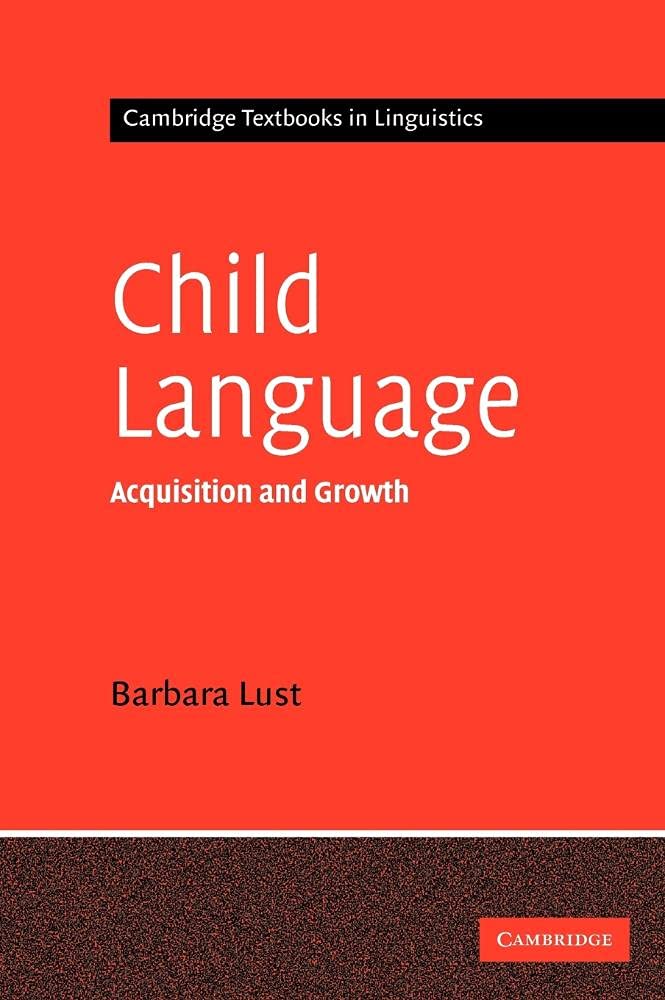
Child Language: Acquisition and Growth - Accessible Textbook
Child Language: Acquisition and Growth - Accessible Textbook
Price subject to change. Tap below for current.
Couldn't load pickup availability
In this review of Child Language: Acquisition and Growth the bottom line is clear: this textbook is an accessible, theory-focused introduction to how children develop language, best suited for students and instructors in linguistics and cognitive science. Barbara C. Lust presents central debates about what in the human mind enables language learning and explores universals and environmental effects, making this a useful course text rather than a quick reference. Readers seeking a compact survey of theoretical and developmental perspectives will find real value here.
Key Features
- Clear theoretical framing: The book lays out major debates about biological programming versus environmental influence so readers can compare competing accounts of acquisition.
- Focus on first and second language: It distinguishes first language development in childhood from second language learning in adulthood to clarify differences in mechanism and outcome.
- Crosslinguistic perspective: By asking whether stages are universal across languages, the text encourages readers to think beyond English and consider wider data.
- Course-ready structure: The organization and level make it suitable for university courses in linguistics, developmental psychology and cognitive science, supporting classroom use and assigned reading.
- Accessible prose: The writing is aimed at students new to the field, making complex theoretical issues approachable without sacrificing substance.
Who It's For
This book is aimed squarely at undergraduates and graduate students taking introductory courses in child language acquisition, as well as instructors looking for a single text that covers theory, developmental stages and comparative issues. It will also suit readers in cognitive science and developmental psychology who want a linguistics-centered view on language growth.
Readers who need exhaustive empirical datasets, step-by-step teaching activities, or a handbook-style reference might look elsewhere; this is primarily a conceptual and pedagogical text rather than a data compendium or activity workbook.
Pros & Cons
Pros
- Provides a coherent presentation of major theoretical debates, helping students form a clear conceptual foundation.
- Addresses both first and second language learning, clarifying important contrasts between childhood and adult acquisition.
- Encourages crosslinguistic thinking about universals and variation, useful for comparative coursework.
Cons
- The text prioritizes theory and overview, so readers seeking exhaustive empirical tables or extensive raw data sets may find it limited.
Specifications
| Title | Child Language: Acquisition and Growth |
| Series | Cambridge Textbooks in Linguistics |
| Author | Barbara C. Lust |
| Scope | First language acquisition, second language contrasts, universals |
| Audience | Undergraduate and graduate students; instructors |
| Disciplines | Linguistics, developmental psychology, cognitive science |
Our Verdict
Child Language: Acquisition and Growth is a thoughtful, course-ready introduction that balances theory and developmental description, making it a strong choice for students and instructors who want a conceptual foundation in child language acquisition. It is good value for classroom use, though readers seeking exhaustive empirical appendices should supplement it with primary studies.
Frequently Asked Questions
Does this book cover both first and second language learning?
Yes, the text explicitly compares first language acquisition in childhood with second language learning in adulthood and discusses differences in mechanisms.
Is this suitable for use in undergraduate courses?
Yes, the accessible writing and structure make it appropriate for undergraduate and graduate courses in linguistics and related fields.
Does the book include crosslinguistic material?
Yes, it asks whether developmental stages are universal across languages and encourages comparative thinking rather than focusing only on one language.
Editor's Take
A thoughtful, course-ready introduction that balances theory and developmental description, ideal for students and instructors seeking a conceptual foundation in child language acquisition; supplement with empirical studies if needed.

Recently viewed
Recently viewed products will appear here as customers browse the store.