

Class Field Theory: From Theory to Practice - Practical Guide
Class Field Theory: From Theory to Practice - Practical Guide
Price subject to change. Tap below for current.
Couldn't load pickup availability
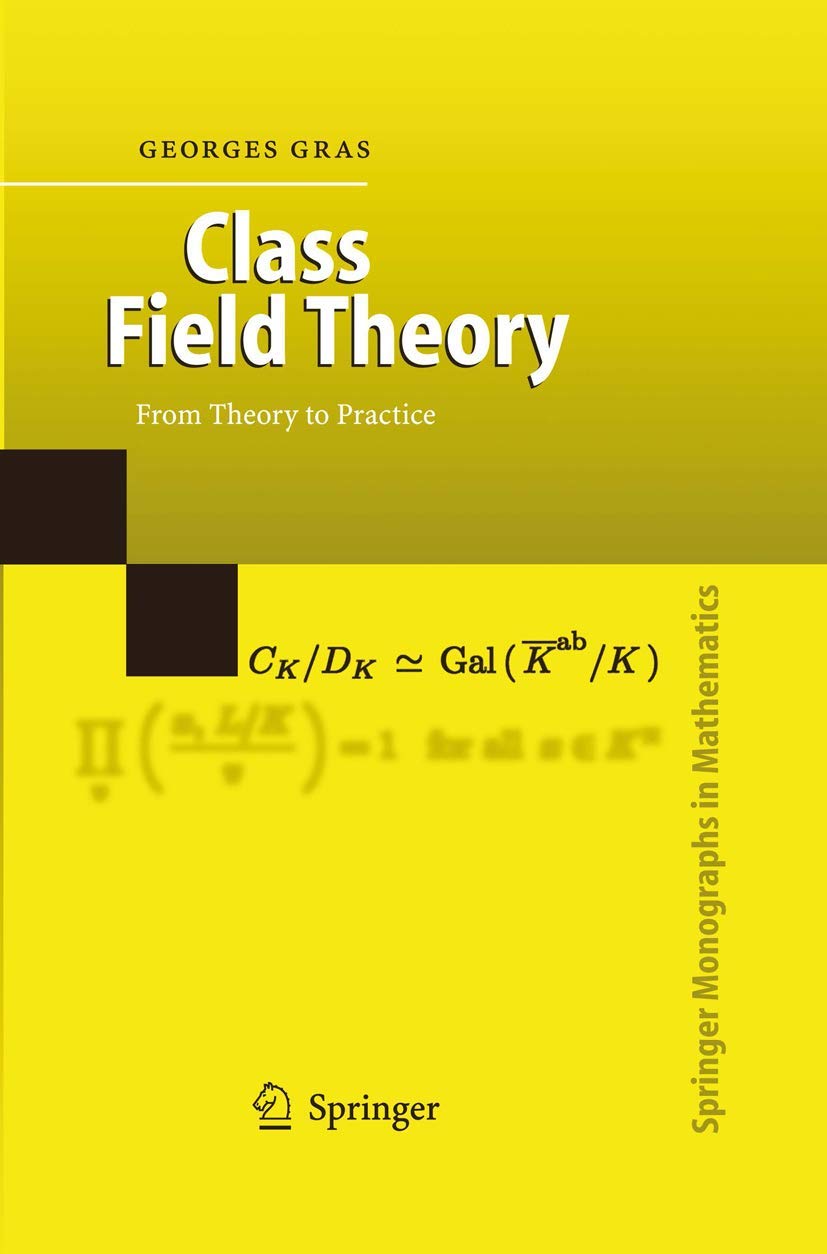
In this review of Class Field Theory: From Theory to Practice the emphasis is on utility for researchers and advanced students. The book is recommended for those who want a clear bridge between the abstract statements of global class field theory and worked consequences; its single biggest reason to buy is the combination of a rigorous presentation of the reciprocity map with numerous detailed illustrations that show how to apply existence theorems in practice. This corrected second printing improves many technical points, making the exposition more reliable for study and reference.
Key Features
- Concise exposition: The text presents the functorial properties of the reciprocity map in a focused way that clarifies the structure of global class field theory.
- Practical illustrations: Detailed studies of classical subjects show concrete consequences of the existence theorem and how to use results in computations and proofs.
- Corrected second printing: Revisions throughout the book improve accuracy and clarity, reducing common gaps found in earlier editions.
- Theoretical depth: Coverage emphasizes the major achievements of algebraic number theory while keeping the chain of implications transparent for the reader.
- Reference value: The combination of theory and practice makes the book a useful reference for researchers returning to class field theory arguments.
Who It's For
The primary audience is graduate students and researchers in algebraic number theory who already have background in algebraic structures and want a focused treatment of global class field theory that emphasizes the reciprocity map and the existence theorem. It is well suited to mathematicians who need worked examples linked to the general theorems rather than an encyclopedic survey.
Those looking for an elementary introduction to algebraic number theory or a computational textbook with extensive algorithmic material should look elsewhere; this book assumes familiarity with abstract tools and aims at deepening theoretical and practical understanding rather than teaching from first principles.
Pros & Cons
Pros
- Clear focus on the reciprocity map makes the main ideas easier to follow for readers with the necessary background.
- Numerous detailed illustrations demonstrate how to apply the existence theorem in classical contexts.
- The corrected second printing addresses many technical points, improving reliability as a reference.
Cons
- Not intended as an introductory textbook; readers without prior algebraic number theory may struggle.
- The book emphasizes theory and examples over computational algorithms, so it may not suit those seeking extensive numerical methods.
Specifications
| Title | Class Field Theory: From Theory to Practice |
| Series | Springer Monographs in Mathematics |
| Authors / Brand | Georges Gras, H. Cohen |
| Subject | Global class field theory and reciprocity map |
| Edition note | Corrected second printing, 2005 |
| Intended audience | Graduate students and researchers in algebraic number theory |
Our Verdict
Class Field Theory: From Theory to Practice is a focused and valuable resource for advanced students and researchers who want to move from abstract statements to concrete consequences. Its corrected second printing makes it a dependable reference, and the emphasis on practical illustrations offers strong value for those working with the reciprocity map and existence theorem.
Frequently Asked Questions
Is this book suitable for self-study?
The book is suitable for self-study if the reader already has graduate-level background in algebraic number theory and abstract algebra.
Does the book contain worked examples?
Yes, it contains detailed studies and illustrations showing how to apply the main theorems in classical settings.
What is new in the corrected second printing?
The corrected second printing improves many details throughout the book to enhance clarity and correctness.
Editor's Take
A focused, practical resource for advanced students and researchers that connects abstract global class field theory to concrete applications; the corrected second printing improves clarity and makes it a dependable reference.

Recently viewed
Recently viewed products will appear here as customers browse the store.