

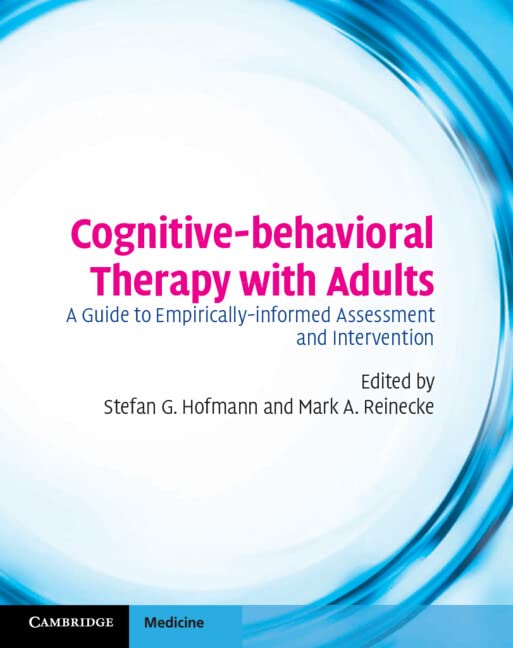
Cognitive-behavioral Therapy with Adults: Evidence-Based Guide
Cognitive-behavioral Therapy with Adults: Evidence-Based Guide
Price subject to change. Tap below for current.
Couldn't load pickup availability
In this review of Cognitive-behavioral Therapy with Adults readers will find a practical, evidence-centered handbook intended for clinicians and trainees who want a systematic approach to assessment and intervention. The book's single biggest strength is its focus on empirically supported methods: it synthesizes contemporary CBT research into step-by-step guidance and case examples, making it valuable for therapists who need techniques grounded in evidence-based medicine rather than theory alone.
Key Features
- Integrated assessment: Presents a systematic approach to conceptualizing adult disorders that helps clinicians form clear, testable case formulations.
- Evidence focus: Emphasizes empirically supported interventions so readers can choose treatments with demonstrated effectiveness.
- Practical case studies: Includes numerous real-world cases that demonstrate how techniques are applied and adapted in routine practice.
- International authorship: Chapters by a variety of experts provide diverse clinical perspectives and treatment strategies from multiple training backgrounds.
- Hands-on recommendations: Offers concrete steps for common clinical problems and troubleshooting guidance for barriers to progress.
Who It's For
This volume is best suited for clinicians, clinical psychology trainees, psychiatry fellows, and other mental health professionals seeking a compact yet comprehensive guide to CBT for adults, with an emphasis on assessment and empirically informed intervention. It works well as a course text or a clinic reference when planning treatment across common adult disorders.
Readers looking for a self-help workbook, a brief therapist primer for a single disorder, or an introductory nontechnical overview may want a different, more focused title; this book assumes some familiarity with clinical concepts and emphasizes applied, research-based techniques rather than pop-psychology simplifications.
Pros & Cons
Pros
- Strong emphasis on empirically supported approaches that link assessment to intervention choices.
- Many case studies make abstract methods concrete for day-to-day clinical work.
- Contributions from international experts broaden the clinical perspectives and reduce single-author bias.
Cons
- Not written as a beginner's self-help guide; clinicians need some prior training to use it effectively.
Specifications
| Title | Cognitive-behavioral Therapy with Adults: A Guide to Empirically-informed Assessment and Intervention |
| Format | Hardcover |
| Series | Cambridge Medicine |
| Primary authors | Stefan Hofmann, Mark Reinecke |
| Scope | Assessment and intervention for adult mental disorders with case studies |
| Approach | Empirically supported, evidence-based clinical methods |
Our Verdict
For clinicians and trainees who want a rigorous, practice-oriented CBT handbook, this Cambridge Medicine hardcover is a strong value: it connects research to clinical steps and supplies case material that speeds adoption in practice. Its focus on evidence-based assessment and intervention makes it particularly worthwhile for anyone treating adult psychopathology in clinical settings.
Frequently Asked Questions
Is this book suitable for beginners?
It assumes some prior clinical training; beginning self-help readers may find it too technical.
Does it include practical case examples?
Yes, the book contains numerous case studies demonstrating specific techniques and problem-solving strategies.
Are the methods research-based?
Yes, the authors emphasize empirically supported assessment and intervention throughout the volume.
Editor's Take
A practice-oriented, evidence-based CBT handbook for clinicians and trainees that links assessment to intervention with useful case studies, making it good value for clinical use.

Recently viewed
Recently viewed products will appear here as customers browse the store.