

Collaborating to Meet Language Challenges in Indigenous Mathematics
Collaborating to Meet Language Challenges in Indigenous Mathematics
Price subject to change. Tap below for current.
Couldn't load pickup availability
In this review of Collaborating to Meet Language Challenges in Indigenous Mathematics Classrooms the bottom line is clear: this is a thoughtful, practice-focused book for educators working where an Indigenous language intersects with mathematics learning. It is best for teachers, school leaders and curriculum developers who need concrete examples of collaboration between teachers, community and researchers. The single biggest reason to buy is the book's clear exposition of how language functions as both a support and a hindrance to mathematical thinking in a Maori immersion context, with practical solutions drawn from real classroom collaboration.
Key Features
- Focus on language and mathematics: Explains how the mathematics register in an Indigenous language can enable students to discuss and develop mathematical ideas more effectively.
- Case study approach: Describes challenges and responses from a Maori immersion school so readers see how theory translates into classroom practice.
- Collaborative solutions: Details how teachers, the wider community and other stakeholders worked together to create sustainable pedagogical responses.
- Multi-dimensional analysis: Identifies political, mathematical, community and pedagogical challenges to the mathematics register, helping readers assess multiple influences.
- Practical orientation: Offers concrete examples and strategies that teachers can adapt rather than only abstract theory.
- Author expertise: Draws on the combined experience of Tamsin Meaney, Tony Trinick and Uenuku Fairhall to ground recommendations in classroom reality.
Who It's For
This book is aimed at classroom teachers in Indigenous immersion settings, curriculum designers and school leaders seeking realistic, collaborative approaches to developing a mathematics register. It suits readers who need both analysis of challenges and documented examples of teacher-led solutions, especially those working in Maori-medium or similar language contexts.
Those looking for a general introduction to mathematics pedagogy without a language focus, or readers expecting exhaustive lesson plans and worksheets, should look elsewhere. This is strongest as a reflective, evidence-informed resource rather than a step-by-step activity manual.
Pros & Cons
Pros
- Offers a clear, practice-oriented examination of how language impacts mathematical thinking in Indigenous classrooms.
- Uses a real Maori immersion school case to show collaborative problem solving between teachers and community.
- Highlights multiple lenses (political, community and pedagogical) so readers understand broader influences on classroom language work.
Cons
- Not designed as a full curriculum or workbook, so teachers seeking ready-made lesson sets may find it limited.
Specifications
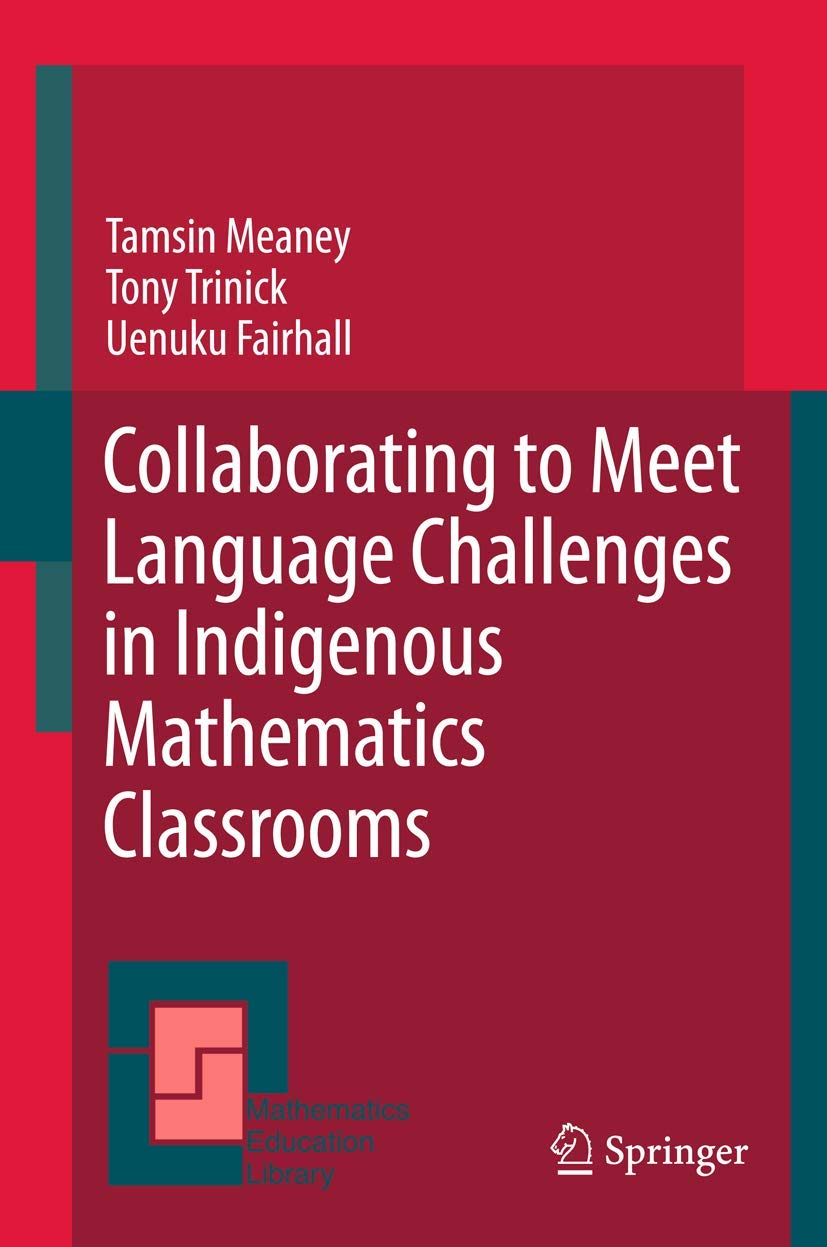
| Title | Collaborating to Meet Language Challenges in Indigenous Mathematics Classrooms |
| Series | Mathematics Education Library, 52 |
| Authors | Tamsin Meaney, Tony Trinick, Uenuku Fairhall |
| Focus | Mathematics register and language challenges in Indigenous classrooms |
| Context | Maori immersion school case study |
| Topics covered | Political, mathematical, community and pedagogical challenges and collaborative solutions |
Our Verdict
Collaborating to Meet Language Challenges in Indigenous Mathematics Classrooms is a valuable, well-grounded resource for educators and leaders working at the intersection of language and mathematics. Its case-study approach and emphasis on collaboration make it good value for practitioners seeking informed strategies rather than ready-made lesson banks.
Frequently Asked Questions
Does this book focus on a specific Indigenous language?
The book examines challenges in a Maori immersion context while addressing issues common to many Indigenous language settings.
Is it a practical teaching guide with lesson plans?
It provides practical examples and collaborative strategies but is not a full lesson-plan workbook.
Who wrote the book?
The authors are Tamsin Meaney, Tony Trinick and Uenuku Fairhall, who bring classroom and research experience to the topic.
Editor's Take
A practical, case-study driven resource for educators in Indigenous language settings, offering collaborative strategies to develop a mathematics register; best for teachers and curriculum leaders rather than those seeking full lesson-plan packs.

Recently viewed
Recently viewed products will appear here as customers browse the store.