

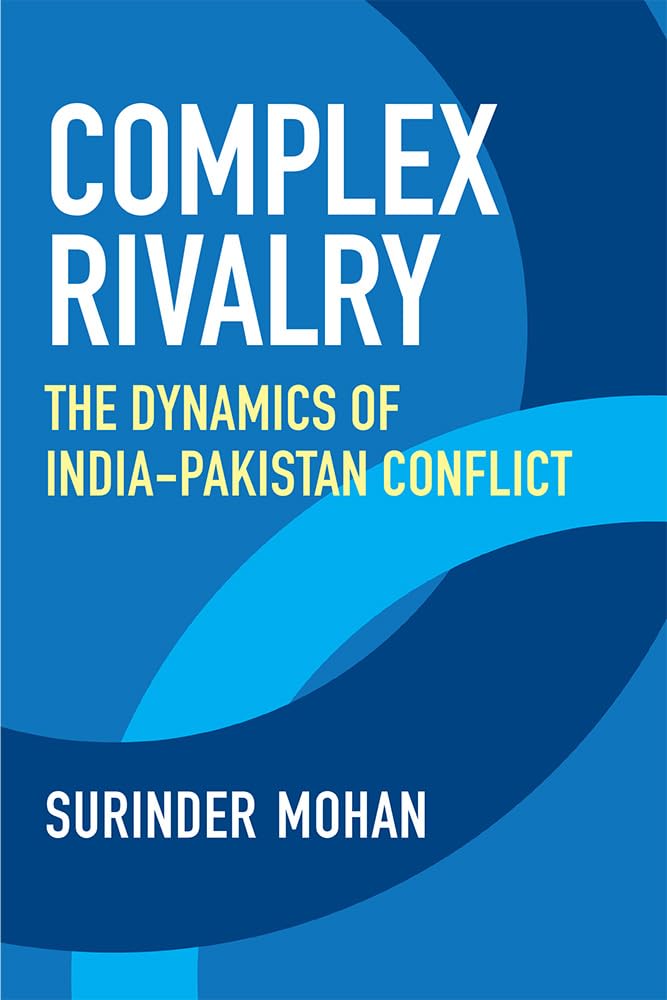
Complex Rivalry: The Dynamics of India-Pakistan Conflict
Complex Rivalry: The Dynamics of India-Pakistan Conflict
Price subject to change. Tap below for current.
Couldn't load pickup availability
In this review of Complex Rivalry: The Dynamics of India-Pakistan Conflict, the reviewer finds the book best suited to readers seeking a systematic, theory-driven account of Indo-Pak relations rather than a simple narrative history. Surinder Mohan presents a complex rivalry model that intentionally avoids dependence on any single international relations paradigm, and the biggest reason to read it is its multivariate framework applied across decades of incidents, offering a clearer explanation of patterns in militarized interactions between 1947 and 2021.
Key Features
- Comprehensive empirical scope: Examines fifty-seven militarized disputes from 1947 to 2021 to map the life cycle of the rivalry in detail.
- Theoretical pluralism: Uses a multivariate framework rather than a single paradigm, allowing the book to reconcile competing explanations.
- Systematic model: Presents the complex rivalry model as a repeatable analytic tool for scholars of international conflict.
- Longitudinal analysis: Traces development and change over seven decades to reveal enduring dynamics and turning points.
- Scholarly focus: Oriented toward readers who want causal explanation and debate rather than a popular narrative.
Who It's For
The book is aimed at graduate students, researchers, and policy analysts in international and world politics who need a rigorous framework to compare episodes of conflict and explore causation. It will also serve instructors seeking a text that situates India-Pakistan rivalry within broader IR debates.
Those looking for a concise popular history or a memoir-style account of leaders and decisions should look elsewhere, as the book prioritizes model-building and multivariate explanation over anecdotal storytelling.
Pros & Cons
Pros
- Offers a distinctive complex rivalry model that expands analytical tools beyond single-paradigm studies.
- Grounded in extensive empirical material spanning 1947-2021, which strengthens causal claims.
- Useful as a teaching resource for comparative conflict analysis and diplomacy studies.
- Bridges theory and case evidence in a way that invites scholarly debate.
Cons
- The focus on theoretical frameworks and multivariate analysis may feel dense to casual readers seeking narrative flow.
- Readers expecting exhaustive diplomatic details or firsthand accounts may find the emphasis more analytical than descriptive.
Specifications
| Title | Complex Rivalry: The Dynamics of India-Pakistan Conflict |
| Author | Surinder Mohan |
| Subject | India-Pakistan rivalry; international relations |
| Scope | Fifty-seven militarized disputes, 1947-2021 |
| Approach | Complex rivalry model; multivariate analysis |
| Audience | Scholars, graduate students, policy analysts |
Our Verdict
Complex Rivalry is a valuable, theory-forward treatment of India-Pakistan conflict that repays careful reading by researchers and instructors; it delivers strong value for those who want a systematic, multivariate explanation of rivalrous dynamics rather than a popular history.
Frequently Asked Questions
Does the book cover recent incidents?
The analysis extends through 2021, so it includes contemporary disputes up to that year.
Is this suitable for beginners?
It is best for readers with some background in international relations; newcomers may find the theoretical focus challenging.
Does the author use a single theoretical lens?
No; the book explicitly avoids reliance on a single paradigm and instead offers a multivariate complex rivalry model.
Editor's Take
A theory-driven and empirically rich study, Complex Rivalry is best for scholars and students seeking a systematic, multivariate framework to understand India-Pakistan conflicts through 1947-2021.

Recently viewed
Recently viewed products will appear here as customers browse the store.