

Computational Methods For Reliability And Risk Analysis - Practical
Computational Methods For Reliability And Risk Analysis - Practical
Price subject to change. Tap below for current.
Couldn't load pickup availability
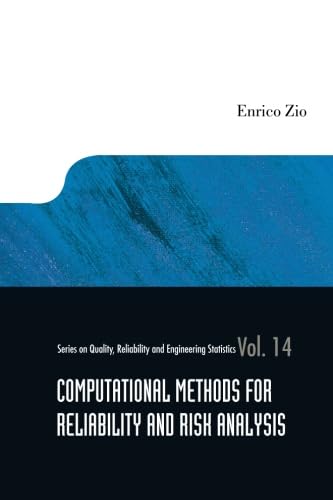
In this review of Computational Methods For Reliability And Risk Analysis the reviewer finds a focused, technical resource aimed at engineers, researchers and graduate students who need computational techniques for reliability and risk problems. The book's single biggest reason to buy is its practical coverage of modelling methods such as Markov and Monte Carlo simulation alongside optimization and uncertainty techniques, which makes it useful when applied analysis and clear examples are required rather than purely theoretical exposition.
Key Features
- Modelling methods: Presents Markov and Monte Carlo simulation approaches that help readers model stochastic failure and repair behaviour in real systems.
- Optimization with genetic algorithms: Introduces Genetic Algorithms tailored for RAMS optimization so practitioners can explore tradeoffs in reliability, availability, maintainability and safety.
- Dependent failures discussion: Covers dependent failures and importance measures, aiding understanding of how component interactions affect system risk.
- Uncertainty analysis: Explains techniques of sensitivity and uncertainty analysis to assess how input uncertainty propagates to reliability metrics.
- Applied focus: Emphasizes computational techniques rather than abstract proofs, making it practical for model implementation and simulation studies.
Who It's For
The book is best for reliability engineers, risk analysts, and advanced students who need hands-on computational approaches to model stochastic systems and evaluate risk with simulation and optimization tools. It is equally useful for researchers looking for a practical primer on RAMS optimization methods that link modelling to decision support.
Those seeking a purely theoretical or introductory statistics textbook should look elsewhere, as the emphasis is on applied methods and computational techniques rather than elementary probability theory or a broad survey of unrelated mathematical topics.
Pros & Cons
Pros
- Clear, applied coverage of Markov and Monte Carlo methods that support realistic failure and repair modelling.
- Relevant introduction to Genetic Algorithms for reliability, making optimization approachable for practitioners.
- Practical treatment of uncertainty, sensitivity analysis and dependent failures that improves real-world risk assessment.
Cons
- Not a beginner's probability text, so readers without prior exposure to stochastic processes may need supplementary material.
Specifications
| Title | Computational Methods For Reliability And Risk Analysis |
| Author / Brand | Enrico Zio |
| Primary focus | Reliability, risk modelling and computational techniques |
| Methods covered | Markov models, Monte Carlo simulation, Genetic Algorithms |
| Topics included | Dependent failures, importance measures, uncertainty and sensitivity analysis |
| Intended audience | Engineers, researchers, graduate students |
Our Verdict
Computational Methods For Reliability And Risk Analysis is a solid, applied reference for professionals and advanced students who need simulation and optimization methods for reliability and risk work. Its practical emphasis on Markov and Monte Carlo methods, plus tailored material on Genetic Algorithms and uncertainty analysis, makes it good value for readers implementing RAMS models and conducting sensitivity studies.
Frequently Asked Questions
Does this book teach Monte Carlo simulation?
Yes. It provides a basic illustration of Monte Carlo simulation for modelling stochastic failure and repair behaviour.
Is there material on optimization for reliability?
Yes. The book introduces Genetic Algorithms specifically tailored to RAMS optimization applications.
Who will benefit most from the book?
Engineers, risk analysts and graduate students working on system reliability modelling and uncertainty analysis will benefit most.
Editor's Take
A practical, applied reference for engineers and graduate students, offering hands-on coverage of Markov and Monte Carlo simulation, Genetic Algorithms for RAMS optimization, and uncertainty analysis.

Recently viewed
Recently viewed products will appear here as customers browse the store.