

Continuous-Time Sigma-Delta A/D Conversion - In-depth Technical
Continuous-Time Sigma-Delta A/D Conversion - In-depth Technical
Price subject to change. Tap below for current.
Couldn't load pickup availability
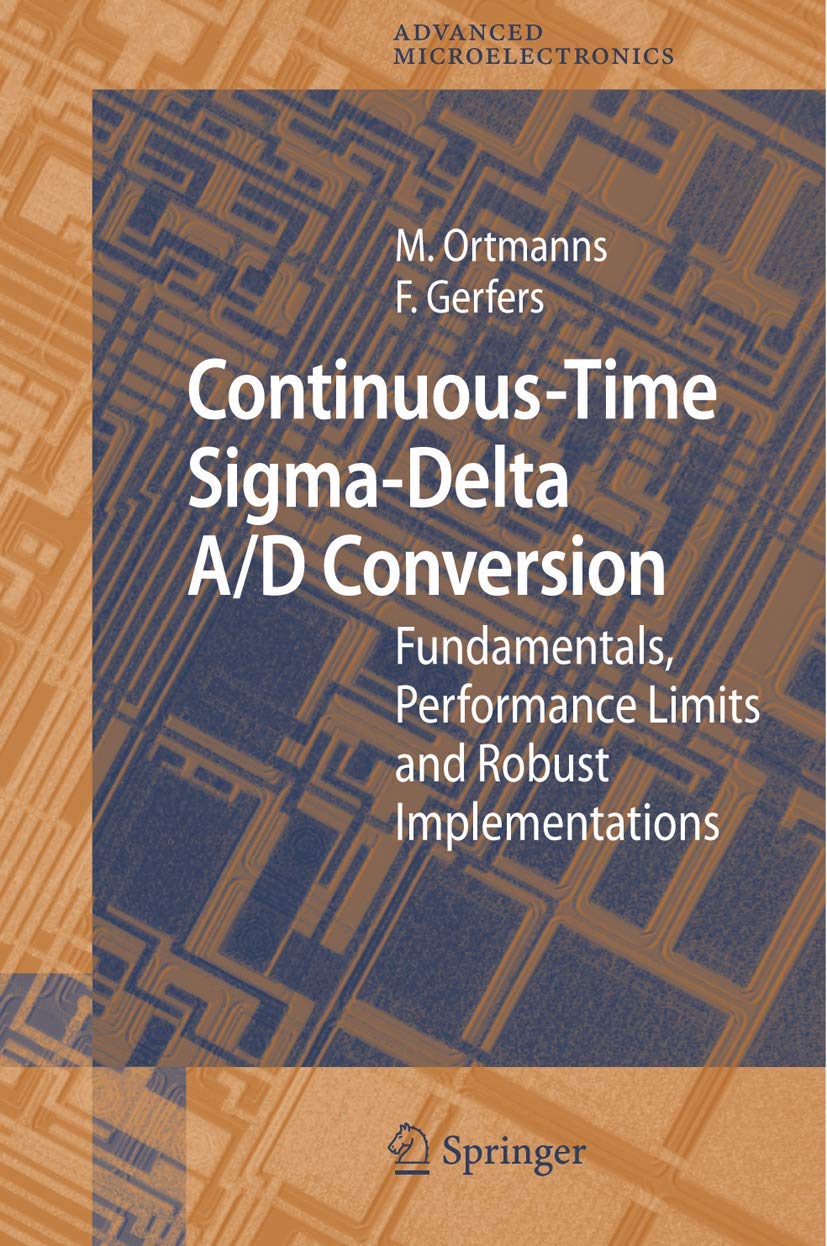
In this review of Continuous-Time Sigma-Delta A/D Conversion: Fundamentals, Performance Limits and Robust Implementations the reviewer finds a dense, research-focused text aimed squarely at practicing designers and graduate students in mixed-signal and analog electronics. The single biggest reason to buy is the book's comprehensive treatment of continuous-time sigma-delta modulators, which compiles years of analysis, modeling and practical implementation guidance into one reference. Readers will appreciate the depth of error analysis and the emphasis on low-power and robust design strategies throughout the text.
Key Features
- Comprehensive analysis: Presents detailed models and analysis of multiple continuous-time sigma-delta modulator architectures so designers can understand trade-offs before simulation.
- Loop filter synthesis: Covers CT/DT loop filter synthesis approaches that help convert theoretical designs into practical implementations with predictable behavior.
- Error analysis: Provides a thorough error analysis of all components, enabling engineers to identify dominant nonidealities and prioritize compensation strategies.
- Compensation schemes: Describes practical compensation and correction schemes for non-ideal behavior to improve robustness in real silicon implementations.
- Low-power guidance: Includes concrete guidance for obtaining low-power consumption, useful for wireless and multimedia front ends where energy budget matters.
- Practical implementations: Presents several real implementation examples that illustrate how the theory maps to silicon practice.
Who It's For
This book is best suited for graduate students, researchers and practicing analog/mixed-signal engineers who need a deep, systems-level understanding of continuous-time sigma-delta modulators and practical guidance on modeling, synthesis and non-ideal compensation. The content assumes familiarity with basic ADC theory, continuous- and discrete-time signal processing, and some background in circuit implementation.
Readers seeking a gentle introduction, a quick tutorial or a hands-on lab workbook with step-by-step beginner exercises should look elsewhere; this is a specialist reference rather than a first textbook. It is also not a general electronics survey-its scope focuses tightly on CT sigma-delta modulators and related implementation issues.
Pros & Cons
Pros
- Authoritative treatment of CT sigma-delta architectures and modeling provides solid theoretical grounding for advanced design work.
- Detailed error and non-ideal behavior analysis helps engineers design robust compensations and corrections.
- Includes practical implementation examples and low-power design guidance directly applicable to wireless and multimedia applications.
Cons
- The material is dense and research-oriented, which may be challenging for readers without prior ADC or signal-processing background.
Specifications
| Title | Continuous-Time Sigma-Delta A/D Conversion |
| Series | Springer Series in Advanced Microelectronics, 21 |
| Subject focus | Continuous-time sigma-delta modulators, analysis and implementation |
| Primary audience | Graduate students, researchers, mixed-signal engineers |
| Topics covered | CT/DT loop filter synthesis, error analysis, compensation schemes, low-power design |
| Use case | Design and simulation of CT sigma-delta ADCs for wireless and multimedia |
Our Verdict
For engineers and advanced students focused on sigma-delta ADC design, this book is a high-value reference that consolidates theoretical results and practical implementation guidance in one place. Its deep analysis of architectures, errors and compensation schemes makes it particularly useful for low-power, robust CT sigma-delta designs, though newcomers should pair it with a more introductory text.
Frequently Asked Questions
Is this book suitable for beginners?
Not really; it is aimed at readers who already have a foundation in ADC theory and mixed-signal design rather than complete beginners.
Does it include practical design examples?
Yes, the text presents several practical implementations and guidance for low-power, robust realizations of CT sigma-delta modulators.
Will it help with compensation of non-idealities?
Yes, a detailed error analysis and described compensation and correction schemes are central features of the book.
Editor's Take
This dense, research-focused reference is ideal for graduate students and mixed-signal engineers needing deep analysis and practical guidance on continuous-time sigma-delta modulators. It consolidates modeling, loop filter synthesis, error analysis and compensation schemes into one valuable resource.

Recently viewed
Recently viewed products will appear here as customers browse the store.