

Criticisms of Classical Political Economy - Historical Analysis
Criticisms of Classical Political Economy - Historical Analysis
Price subject to change. Tap below for current.
Couldn't load pickup availability
Our review of Criticisms of Classical Political Economy argues this scholarly work is best suited for readers seeking a careful historical reassessment of late 19th century debates in economics; the single biggest reason to buy is its original use of seldom seen research by Carl Menger that clarifies the methodological clash between the German Historical School and the early Austrian School. The book reads as a focused academic study rather than a textbook, and it delivers value to anyone tracing how those intellectual contests shaped economics over the following half century.
Key Features
- Original archival research: The book brings together rarely seen materials by Carl Menger that illuminate his criticisms of classical political economy and show his role in founding the Austrian School.
- Comparative historical focus: Campagnolo appraises both the German Historical School and Menger to explain how competing methods influenced the discipline's development.
- Interdisciplinary appeal: The narrative is relevant to history of economic thought, economic methodology, philosophy of science and intellectual history.
- Cohesive scholarly argument: The author constructs a clear account of why this period mattered for economics over the next fifty years, helpful for researchers building on that turn of events.
- Routledge Studies series context: Placed within a recognized history of economics series, the book is framed for academic readership and course adoption.
Who It's For
This book is ideal for graduate students, researchers and lecturers in the history of economic thought who need a rigorous, source-based account of the methodological conflicts around the late 19th century. It will also interest scholars in intellectual history and philosophy of science tracing disciplinary change.
Readers seeking a general introduction to economics or a broad survey of classical political economy should look elsewhere; the tone and depth are aimed at specialist study rather than casual reading or undergraduate overviews.
Pros & Cons
Pros
- Uses rare primary materials to shed new light on Carl Menger's critiques and influence.
- Offers a focused comparative account of the German Historical School and the emerging Austrian School.
- Serves multiple disciplines, making it useful beyond a single departmental readership.
- Well situated in a scholarly series, supporting academic credibility and classroom use.
Cons
- The writing is scholarly and specialized, which may limit accessibility for nonacademic readers.
- The book's narrow historical scope means it is less useful as a general economics primer.
Specifications
| Title | Criticisms of Classical Political Economy |
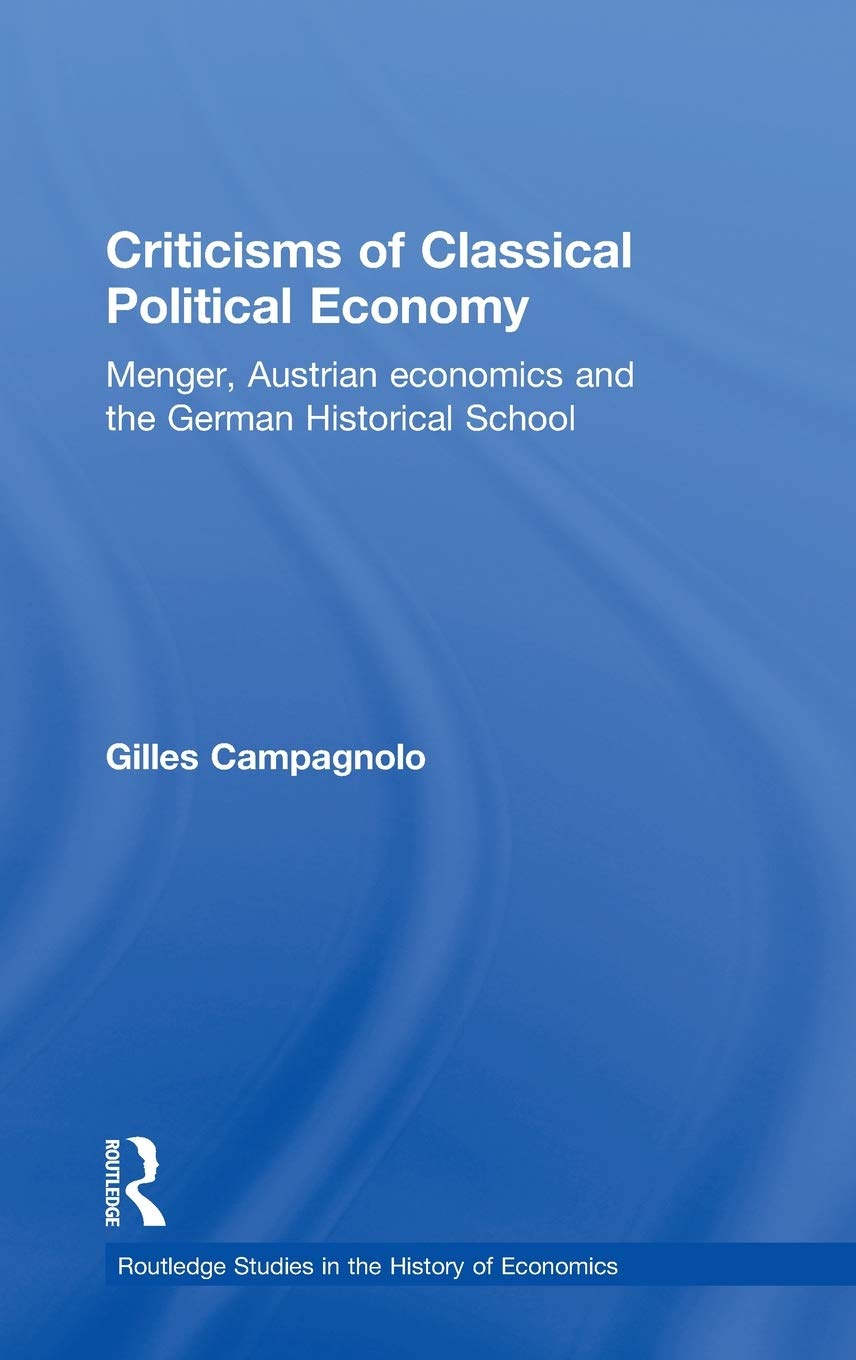
| Author / Editor | Gilles Campagnolo |
| Series | Routledge Studies in the History of Economics |
| Subject focus | German Historical School; Carl Menger; Austrian School |
| Intended audience | Scholars, graduate students, researchers |
| Disciplines | History of economic thought, methodology, philosophy of science |
Our Verdict
Criticisms of Classical Political Economy is a valuable, source-rich contribution for specialists studying the late 19th century formation of economic methods; buy it if you need authoritative archival insights into Carl Menger and the German Historical School, but skip it if you want a broad or introductory treatment of classical political economy.
Frequently Asked Questions
Does this book use primary sources?
Yes. The author makes significant use of rarely seen research by Carl Menger and other contemporary materials.
Is this suitable for undergraduate students?
It is best suited to graduate-level study or researchers; undergraduates seeking an introduction may find it too specialized.
Which disciplines will find this useful?
The book is most relevant to history of economic thought, economic methodology, philosophy of science and intellectual history.
Editor's Take
A source-rich, scholarly study that uses rare Carl Menger materials to clarify the methodological conflict between the German Historical School and the Austrian School; ideal for graduate students and researchers but too specialized for general readers.

Recently viewed
Recently viewed products will appear here as customers browse the store.