

Data Mining for Scientific and Engineering Applications - Workshop
Data Mining for Scientific and Engineering Applications - Workshop
Price subject to change. Tap below for current.
Couldn't load pickup availability
In this review of Data Mining for Scientific and Engineering Applications, the book is recommended for researchers and advanced practitioners who need a focused overview of how data mining techniques apply to scientific datasets. The collection of workshop papers makes the strongest case that scientific data mining differs from commercial practice because of domain-specific issues such as data scale, measurement uncertainty, and interpretability. The bottom line: buy this if you want concrete examples and discussion of methods applied to astronomy, medical imaging, bioinformatics and other research fields rather than a beginner's textbook.
Key Features
- Focused case studies: Each paper presents real applications from fields like astronomy and medical imaging, showing practical challenges when mining scientific datasets.
- Diverse problem coverage: The volume covers a wide range of scientific areas including bio-informatics, remote sensing, and physics, highlighting transferable methods.
- Workshop perspective: Papers are drawn from early workshops, offering insight into active research questions and community priorities at the time.
- Technique and challenge discussion: Contributors contrast scientific and commercial data mining, clarifying issues such as data quality, scale, and domain constraints.
- Interdisciplinary relevance: Many methods are applicable across science and engineering, making the book useful beyond a single discipline.
Who It's For
The book is best for graduate students, research scientists, and engineers who already have a foundation in data analysis and want examples of how techniques are adapted to scientific data. It is particularly useful for readers working in astronomy, bioinformatics, remote sensing, medical imaging or physics who need to understand practical trade-offs when scaling algorithms or dealing with measurement noise.
Those looking for an introductory textbook or step-by-step tutorials on standard algorithms should look elsewhere; this collection assumes familiarity with data mining concepts and emphasizes applied research insights over pedagogical exposition.
Pros & Cons
Pros
- The papers provide concrete, domain-specific examples that illustrate how methods perform on real scientific datasets.
- The volume highlights unique challenges of scientific data mining, such as data scale and uncertainty, which is valuable for researchers.
- Interdisciplinary contributions show how techniques transfer across astronomy, bio-informatics, and other fields.
Cons
- As a collection of workshop papers, the book is not a beginner-friendly tutorial and can feel uneven in depth between chapters.
Specifications
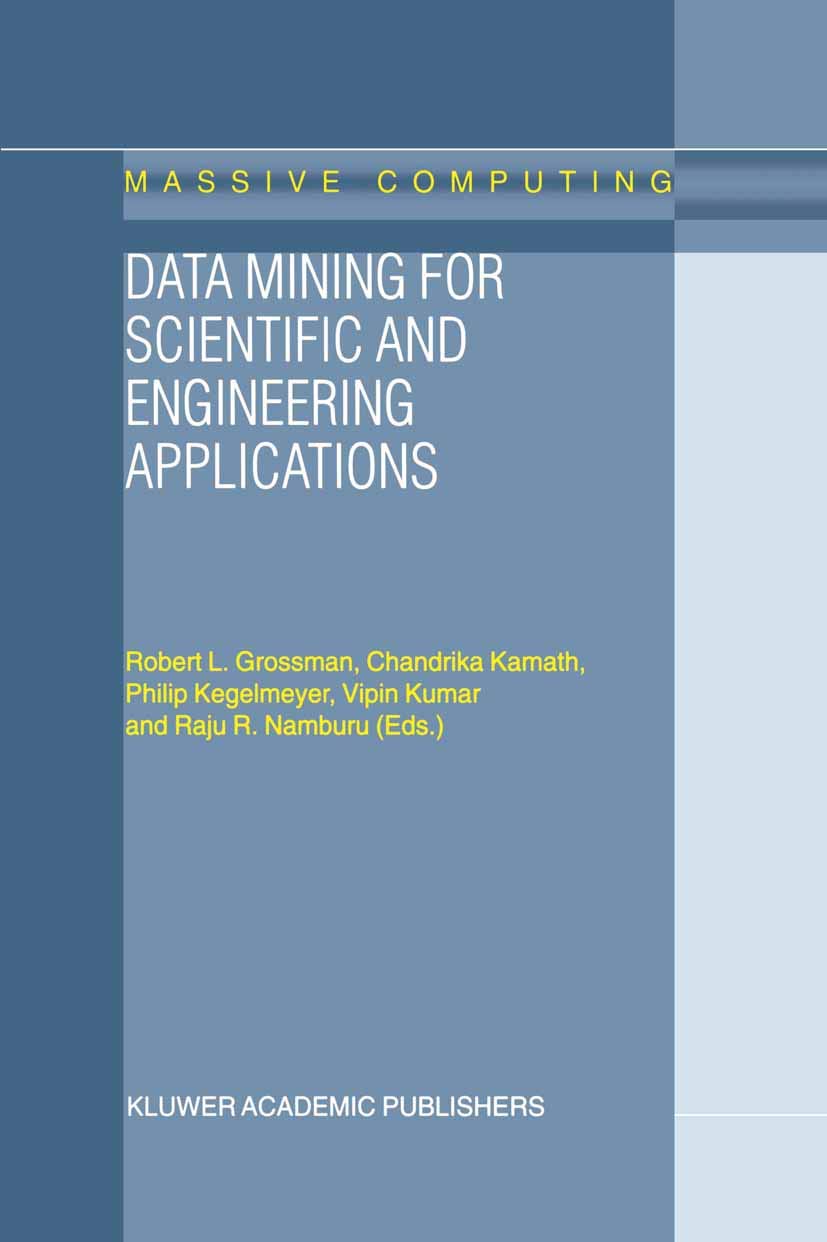
| Title | Data Mining for Scientific and Engineering Applications |
| Series | Massive Computing, 2 |
| Editors / Authors | R.L. Grossman, C. Kamath, P. Kegelmeyer, V. Kumar, R. Namburu |
| Content type | Workshop paper collection |
| Target fields | Astronomy, medical imaging, bio-informatics, remote sensing, physics |
| Focus | Mining scientific datasets and contrasting with commercial data mining |
Our Verdict
Data Mining for Scientific and Engineering Applications is a strong value for researchers who need applied perspectives on mining large scientific datasets. Its workshop-based chapters deliver domain-relevant case studies and an honest discussion of challenges like scale and data quality, making it a worthwhile reference for graduate-level study and research groups rather than for novices seeking introductory material.
Frequently Asked Questions
Does this book cover practical case studies?
Yes, the collection emphasizes real applications across astronomy, medical imaging, bio-informatics and related fields.
Is it suitable for beginners?
No, the book assumes familiarity with data mining concepts and is aimed at researchers and advanced students.
Are the techniques applicable beyond the featured fields?
Yes, many methods and lessons about scale, uncertainty, and interpretation transfer to other scientific and engineering domains.
Editor's Take
A valuable collection for researchers and advanced students, offering practical workshop papers that demonstrate how data mining tackles scale, uncertainty and domain-specific challenges in scientific datasets.

Recently viewed
Recently viewed products will appear here as customers browse the store.