

Deterministic Global Optimization: Geometric Branch-and-bound Methods
Deterministic Global Optimization: Geometric Branch-and-bound Methods
Price subject to change. Tap below for current.
Couldn't load pickup availability
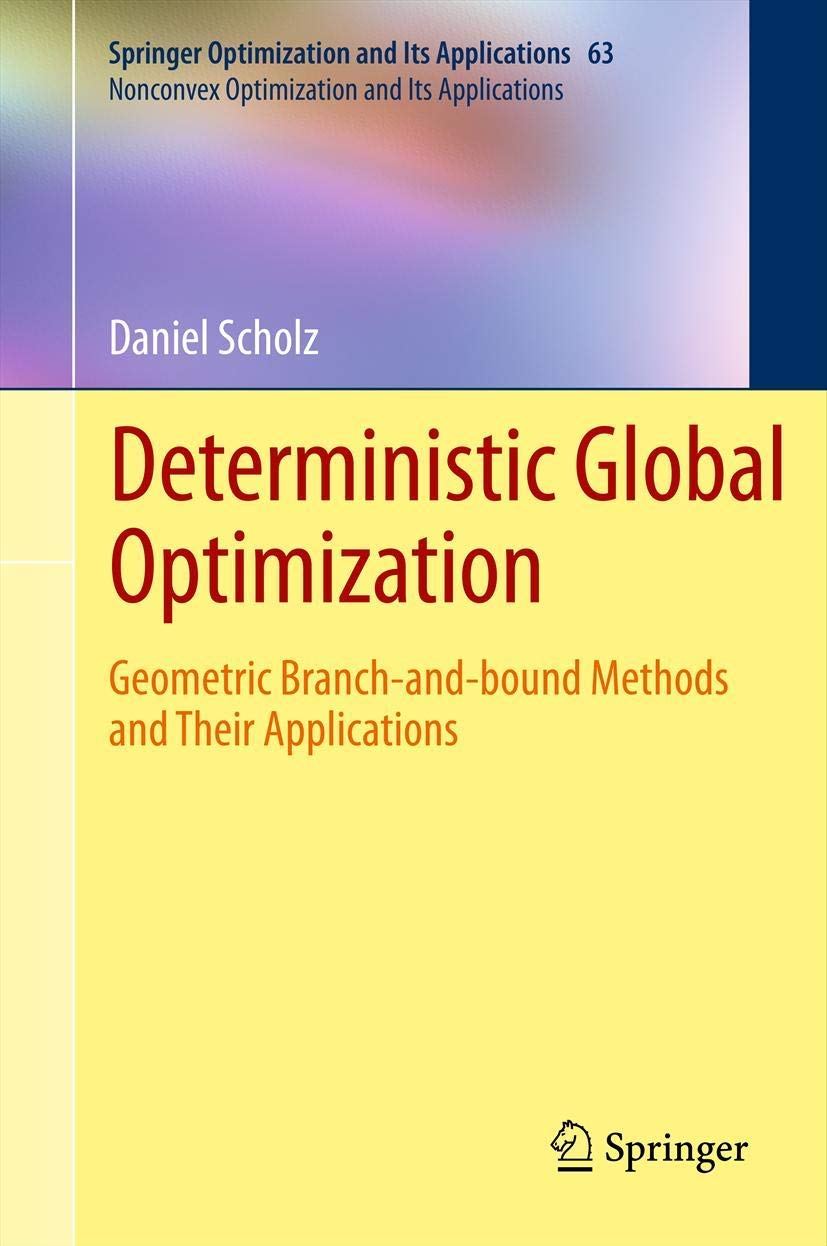
In this review of Deterministic Global Optimization: Geometric Branch-and-bound Methods and their Applications the author presents a focused monograph aimed at researchers and advanced practitioners in mathematical optimization. The single biggest reason to read this work is its clear treatment of geometric branch-and-bound techniques and their role across Lipschitzian optimization, d.c. programming and interval analysis, making it a useful theoretical reference rather than a light textbook for beginners.
Key Features
- Core method coverage: Detailed exposition of geometric branch-and-bound methods clarifies how these algorithms operate and where they apply.
- Convergence analysis: Introduces a new concept for the rate of convergence, which helps readers assess algorithmic performance on nonconvex problems.
- Bounding operations evaluated: Reviews several bounding operations from the literature and compares them both theoretically and empirically for practical insight.
- Algorithm extensions: Considers extensions of a prototype algorithm to multicriteria global optimization and mixed combinatorial problems, illustrating broader applicability.
- Numerical examples: Uses facility location problems and a circle detection application in image processing to support the theoretical development with concrete cases.
Who It's For
This monograph is best suited for graduate students, researchers and engineers who already have a grounding in optimization theory and want a concentrated resource on deterministic global optimization techniques. Specialists working on Lipschitzian optimization, d.c. programming or interval analysis will find the coverage directly relevant to algorithm design and analysis.
Readers seeking an introductory text or a broad survey of optimization for casual study should look elsewhere, as the presentation is compact and assumes familiarity with core mathematical concepts and notation rather than offering tutorial-level exposition.
Pros & Cons
Pros
- Authoritative focus on geometric branch-and-bound methods provides a tight, useful reference for specialists.
- The new rate of convergence concept and comparisons of bounding operations add analytical value for researchers.
- Algorithmic extensions and numerical examples connect theory to applied problems such as facility location and circle detection.
Cons
- Not intended as an introductory textbook; readers without prior optimization background may struggle with the material.
Specifications
| Title | Deterministic Global Optimization: Geometric Branch-and-bound Methods and their Applications |
| Series | Nonconvex Optimization and Its Applications, 63 |
| Primary topic | Geometric branch-and-bound methods in deterministic global optimization |
| Applications discussed | Lipschitzian optimization, d.c. programming, interval analysis, facility location, image circle detection |
| Content highlights | Rate of convergence concept, bounding operations analysis, algorithm extensions |
| Target audience | Researchers, graduate students, advanced practitioners |
Our Verdict
This monograph is a concise, technically rigorous resource that specialists in nonconvex optimization will appreciate for its focused analysis and practical examples. It is good value for those who need a compact reference on geometric branch-and-bound ideas and convergence behavior, but not for readers seeking an introductory or broad survey.
Frequently Asked Questions
Is this book suitable for beginners?
No. It assumes prior knowledge of optimization theory and is aimed at graduate-level readers and researchers.
Does the book include practical examples?
Yes. Numerical examples include facility location problems and an application to circle detection in image processing.
Are algorithmic extensions covered?
Yes. The text considers extensions to multicriteria global optimization and mixed combinatorial optimization problems.
Editor's Take
A concise, technical monograph ideal for researchers and advanced students; valuable for its focused coverage of geometric branch-and-bound methods, convergence analysis and applied examples but not intended for beginners.

Recently viewed
Recently viewed products will appear here as customers browse the store.