

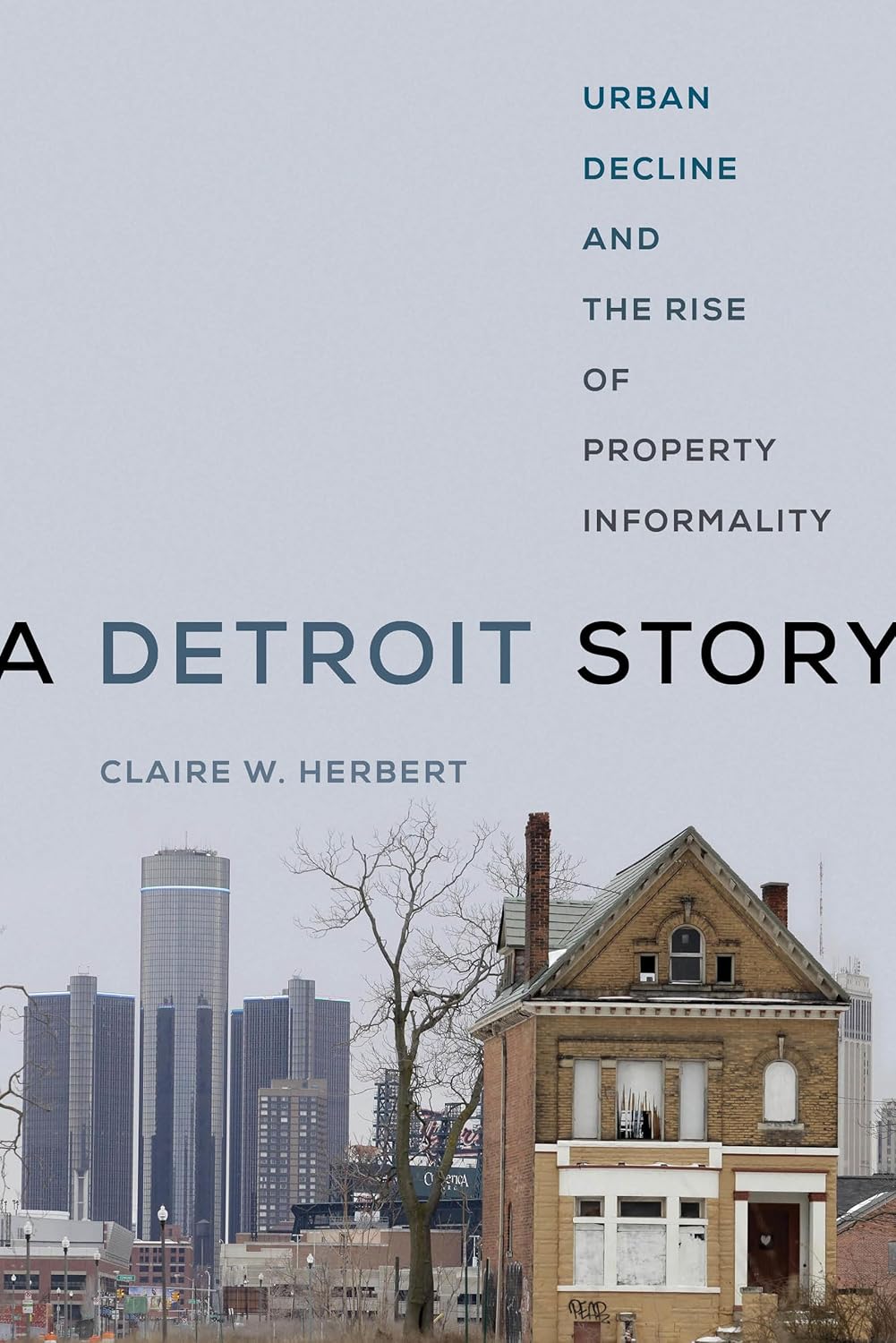
Detroit Story: Urban Decline and the Rise of Property Informality
Detroit Story: Urban Decline and the Rise of Property Informality
Price subject to change. Tap below for current.
Couldn't load pickup availability
In this review of Detroit Story: Urban Decline and the Rise of Property Informality, the reviewer finds a deeply reported, compassionate account useful for urbanists, policy makers, and community organizers interested in how informal property practices reshape cities. Claire W. Herbert spent nearly five years living in Detroit, attending meetings, following scrappers, and visiting squats and gardens, and this book's single biggest strength is its ground-level reporting that connects personal actions to policy outcomes. Readers seeking a close, human-centered study of urban informality will find this work compelling.
Key Features
- Original field research: The book draws on nearly five years of on-the-ground observation and participation to reveal how informal reclamation actually works in Detroit.
- Firsthand interviews: Herbert interviewed residents, protesters, and city actors to show contrasting treatments of different groups.
- Detailed case studies: Following scrappers and visiting squatted houses provides concrete examples that illustrate broader policy patterns.
- Comparative lens: The narrative contrasts how privileged newcomers and long-term, often marginalized residents experience formalization and criminalization.
- Policy relevance: The book links everyday practices to tax foreclosure, planning decisions, and local governance, useful for students of urban policy.
- Clear ethical focus: Herbert highlights issues of race, power, and legitimacy in property practices, prompting reconsideration of common assumptions.
Who It's For
Detroit Story is best for readers interested in urban development, city planning, public affairs, and grassroots activism who want a narrative driven by immersive reporting rather than abstract theory. Graduate students, nonprofit staff, and municipal policymakers will gain concrete insight into how on-the-ground practices conflict with formal policy.
It is less suited to readers seeking a broad, statistical urban history or a how-to manual for redevelopment; those wanting extensive quantitative datasets or prescriptive planning checklists should look elsewhere.
Pros & Cons
Pros
- Rich, firsthand reportage offers vivid scenes and concrete examples of informal property practices.
- Nuanced discussion of race and power shows how different groups are treated by policy and neighbors.
- Useful links between everyday action and formal governance make it relevant for policy debate and community strategy.
Cons
- The focus on qualitative, ground-level observation means readers seeking extensive quantitative analysis may find the approach less satisfying.
Specifications
| Title | Detroit Story: Urban Decline and the Rise of Property Informality |
| Author | Claire W. Herbert |
| Research method | Nearly five years of immersive field research and interviews |
| Focus | Informal reclamation of abandoned property in Detroit |
| Themes | Race, power, property legitimacy, tax foreclosure, community practice |
| Use case | Urban studies, public affairs, city planning discussion |
Our Verdict
Detroit Story is a compelling, well-argued study for anyone wanting a close, human account of how informal property practices intersect with policy and inequality. Its value lies in immersive reporting and ethical clarity, making it a worthwhile purchase for urban practitioners and engaged readers who want evidence grounded in everyday action rather than aggregated statistics.
Frequently Asked Questions
Does this book rely on original reporting?
Yes. Herbert lived in Detroit for almost five years, participating in meetings, protests, and site visits to produce firsthand reporting.
Is the book policy-focused or narrative-driven?
It is narrative-driven but explicitly connects those narratives to policy questions about tax foreclosure, formalization, and legitimacy.
Who will get the most from this book?
Students, city planners, community organizers, and readers interested in race and urban inequality will find it most useful.
Editor's Take
Detroit Story is a compelling, well-argued study grounded in nearly five years of immersive reporting; it is valuable for urban practitioners and readers who want a human-centered account linking informal property practices to policy and inequality.

Recently viewed
Recently viewed products will appear here as customers browse the store.