

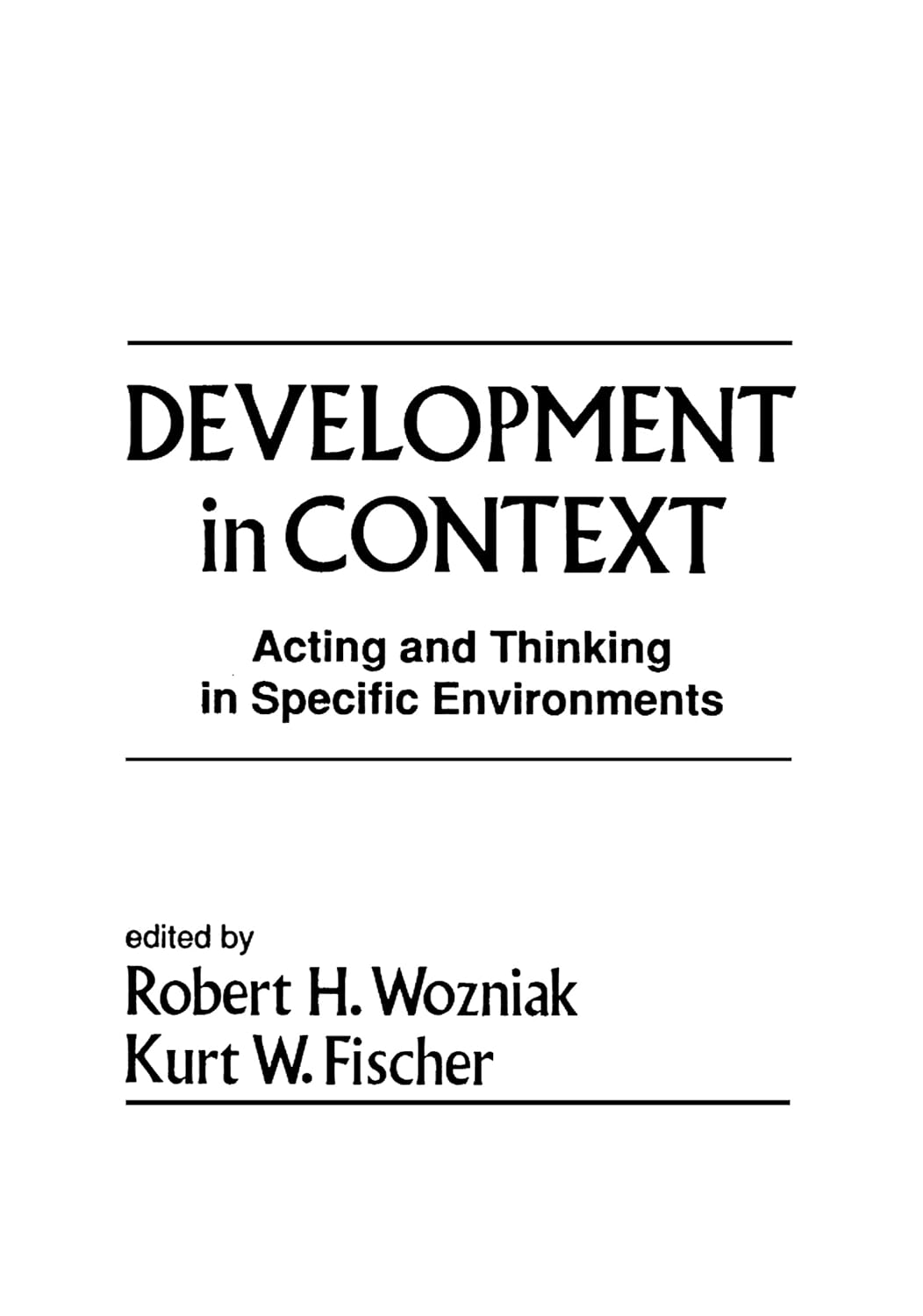
Development in Context: Acting and Thinking in Specific Environments
Development in Context: Acting and Thinking in Specific Environments
Price subject to change. Tap below for current.
Couldn't load pickup availability
In this review of Development in Context: Acting and Thinking in Specific Environments the reviewer finds a focused, academic collection that will appeal to researchers and advanced students interested in how cognition is shaped by real situations. The book assembles essays that bring together theories from Vygotsky, Gibson, and Piaget to show how development unfolds in ecological settings, emphasizing naturally occurring activities and the social construction of knowledge. The bottom line: this volume is best for readers seeking theoretical synthesis and methodological examples of contextual, dynamic approaches rather than a basic textbook.
Key Features
- Theoretical integration: Essays compare and combine Vygotskian, Gibsonian, and Piagetian perspectives to clarify how context guides development.
- Ecological focus: Contributors emphasize analysis of behavior as it occurs in everyday environments, offering concrete study designs and observations.
- Dynamic approach: The volume highlights the changing interaction of body and mind in action, useful for researchers interested in systems and process.
- Social framing: Chapters treat children's construction of knowledge as fundamentally social, providing cases that link interpersonal context to cognitive growth.
- Research variety: The book collects multiple empirical and conceptual studies, giving readers a range of methods for studying development in context.
Who It's For
This book is aimed at developmental psychologists, graduate students, and scholars in cognitive science or education who want a deeper understanding of how thinking is situated in real environments. It works well as a companion text for seminars on developmental theory or ecological methods where readers already have a grounding in Piagetian and Vygotskian ideas.
Readers seeking an introductory overview of child development or a practical parenting guide should look elsewhere; this volume assumes familiarity with theoretical vocabulary and prioritizes scholarly argument and empirical nuance over beginner-friendly summaries.
Pros & Cons
Pros
- Strong comparative framework that links major theorists to contemporary ecological research.
- Practical examples of studying activities in natural contexts that inform research design.
- Emphasis on social construction offers useful perspectives for educational and cultural studies.
Cons
- Not intended as an introductory textbook, so newcomers may find the material dense and specialized.
Specifications
| Title | Development in Context: Acting and Thinking in Specific Environments |
| Series | Jean Piaget Symposia Series |
| Editors/Authors | Robert H. Wozniak, Kurt W. Fischer |
| Focus | Developmental theory, ecological and dynamic approaches |
| Primary perspectives | Vygotsky, Gibson, Piaget |
| Audience | Researchers, graduate students, scholars |
Our Verdict
Development in Context is a valuable scholarly collection for anyone investigating how cognition emerges in real-world settings; it rewards readers who want integrated theory and concrete examples of naturalistic research. For advanced students and researchers it offers good value as a focused, conceptual resource that connects classic theorists to modern ecological and dynamic methods.
Frequently Asked Questions
Is this book suitable for undergraduate courses?
It is most useful in advanced seminars rather than introductory undergraduate classes because it assumes prior theoretical knowledge.
Does the book include empirical studies?
Yes, the volume collects empirical and conceptual work that analyzes behavior and thinking in everyday contexts.
Which theoretical traditions are emphasized?
The contributors explicitly engage Vygotsky, Gibson, and Piaget to examine development in ecological, social, and dynamic terms.
Editor's Take
A focused scholarly collection that links Vygotsky, Gibson, and Piaget to ecological, dynamic approaches; ideal for graduate students and researchers who study cognition in real environments.

Recently viewed
Recently viewed products will appear here as customers browse the store.