

Distributed Manipulation - Practical Distributed Manipulators
Distributed Manipulation - Practical Distributed Manipulators
Price subject to change. Tap below for current.
Couldn't load pickup availability
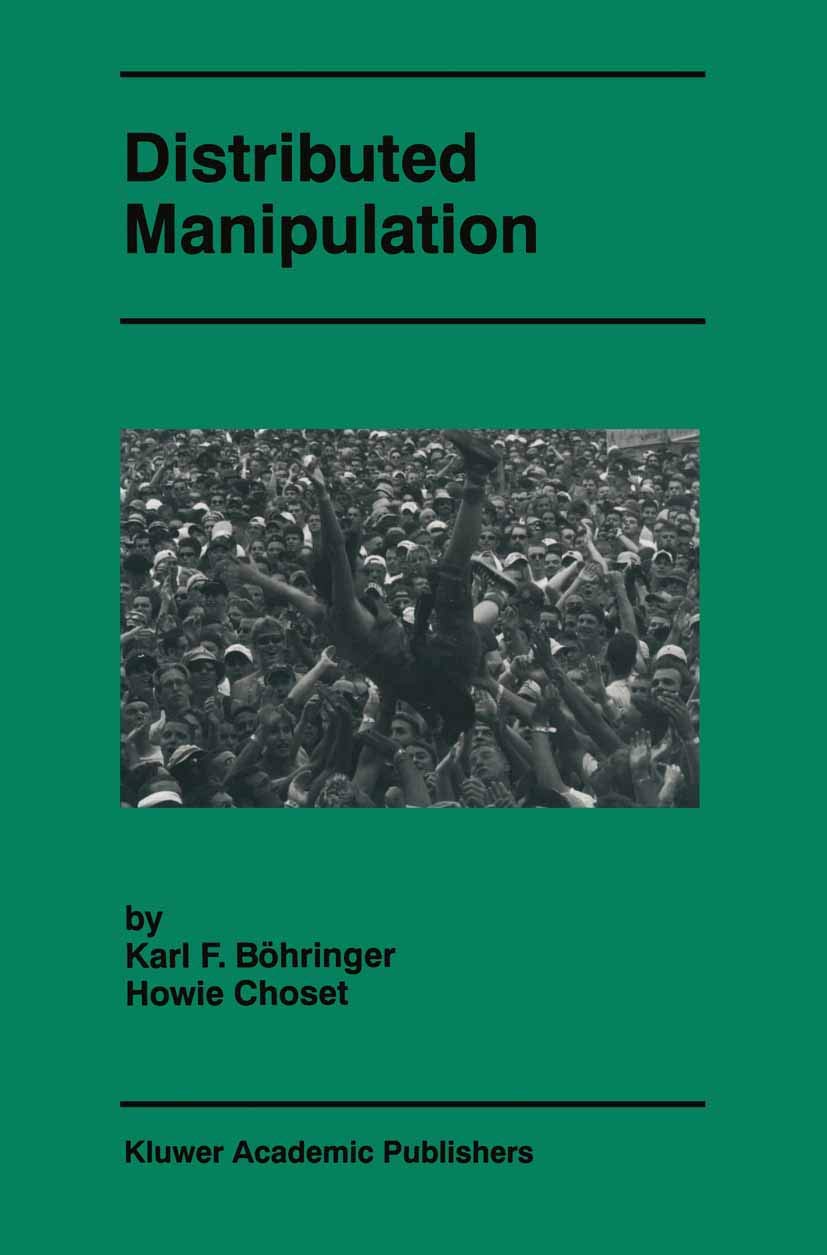
In this review of Distributed Manipulation, the authors explain why arrays of small, simple actuators can move large and heavy objects reliably. This book is for engineers, roboticists, and researchers who want a focused treatment of how many low-cost contact points can combine to perform robust manipulation; its single biggest reason to buy is the clear explanation of fault tolerance and parallel task performance that makes distributed systems attractive for scaled-up handling. The review highlights concepts rather than consumer how-to, so expect a technical, research-oriented perspective.
Key Features
- Distributed contact points: Demonstrates how many small mechanisms working together can move and transport large heavy objects, offering scalable payload capability.
- Fault tolerance: Explains how the system remains functional when individual components fail, enabling resilient operation in real environments.
- Parallel tasking: Shows how distributed manipulators can perform a variety of tasks in parallel, improving throughput for bulk handling.
- Broad mechanism coverage: Describes that distributed manipulation can be implemented with many types of mechanisms at different scales, useful for cross-disciplinary adaptation.
- MEMS relevance: Connects recent MEMS advances to practical feasibility, outlining paths to rapid manufacture of many small actuators.
Who It's For
This book is best for robotics engineers, systems designers, and advanced students working on manipulation, logistics automation, or MEMS-enabled actuator arrays who need a conceptual and practical foundation for distributed handling approaches. It is also useful for researchers evaluating fault-tolerant strategies and parallelized mechanical designs.
It is less suitable for casual readers looking for beginner robotics tutorials or for hobbyists seeking step-by-step construction guides for a single device; the focus is on system-level reasoning and implications rather than basic electronics or construction how-to.
Pros & Cons
Pros
- Clear explanation of how many inexpensive components combine to move heavy objects, making the idea accessible to researchers.
- Emphasis on fault tolerance offers practical value for real-world deployment and resilient designs.
- Coverage of multiple mechanism scales and connection to MEMS shows forward-looking manufacturing feasibility.
Cons
- Not a hands-on DIY manual; readers seeking detailed build instructions may need supplementary materials.
Specifications
| Title | Distributed Manipulation |
| Authors | Karl F. Bohringer, Howie Choset |
| Main concept | Many points of contact move large objects |
| Key benefits | Scalability, fault tolerance, parallel tasking |
| Scale coverage | Multiple mechanism scales including MEMS |
| Intended audience | Engineers, researchers, advanced students |
Our Verdict
Distributed Manipulation is a focused, well-reasoned resource for anyone designing large-scale or resilient manipulation systems; its discussion of scalability, parallelism, and fault tolerance makes it good value for researchers and engineers. Those seeking practical assembly instructions should pair it with hands-on guides, but for system design thinking this book is a concise, useful reference.
Frequently Asked Questions
Does this book explain how distributed manipulators handle failures?
Yes - it emphasizes fault tolerance and how remaining components compensate when individual units fail.
Is the content practical for manufacturing?
The book connects concepts to MEMS advances and discusses feasibility, making it relevant for considering production approaches.
Who will get the most from this book?
Robotics engineers, systems designers, and researchers focused on scalable, robust manipulation will benefit most.
Editor's Take
Distributed Manipulation is a focused, system-level resource explaining how many small actuators can move heavy objects with scalability and fault tolerance; ideal for engineers and researchers, though not a hands-on DIY manual.

Recently viewed
Recently viewed products will appear here as customers browse the store.