

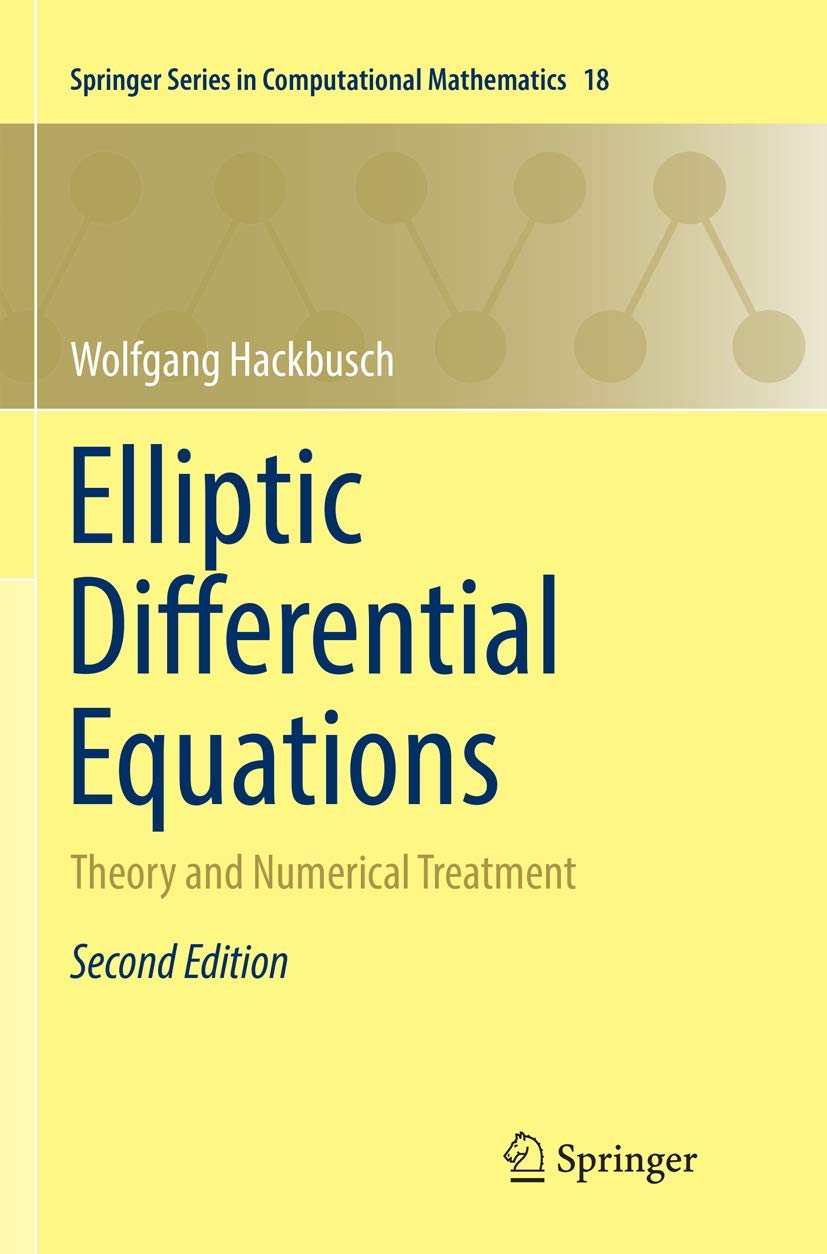
Elliptic Differential Equations: Theory and Numerical Treatment
Elliptic Differential Equations: Theory and Numerical Treatment
Price subject to change. Tap below for current.
Couldn't load pickup availability
In this review of Elliptic Differential Equations: Theory and Numerical Treatment the reviewer finds a rigorous text that bridges the gap between functional analysis and practical discretisation methods; it is best suited to graduate students and practitioners who need a single reference combining theory and numerical techniques. The book's single biggest reason to buy is its integrated presentation of variational theory alongside finite difference and finite element discretisations, which helps the reader understand why numerical methods behave as they do and how to analyse their errors.
Key Features
- Unified theory and numerics: Presents the variational formulation and background from functional analysis so that numerical analysis of discretisations is founded on solid theory.
- Concrete discretisations: Discusses the Laplace equation and its finite difference discretisation to show step-by-step how continuous problems become computable.
- Galerkin and finite element focus: Explores Galerkin and finite-element methods in detail, offering practical tools for implementation and error estimation.
- Advanced regularity theory: Includes a chapter on regularity theory that guides readers from basic existence results to smoothness properties relevant for higher accuracy.
- Special topics covered: Devotes chapters to singularly perturbed problems, elliptic eigenvalue problems and the Stokes problem, giving readers exposure to important applied variants.
Who It's For
Graduate students in applied mathematics, numerical analysis or computational science will find this book particularly useful as a course text or reference, because it combines the necessary functional-analytic background with the discretisation techniques they must master. Researchers and engineers working on finite element implementations will benefit from the clear connection between variational formulations and practical methods.
Undergraduates seeking an introductory textbook or readers wanting a purely computational cookbook should look elsewhere; the text assumes comfort with functional analysis and differential operators and leans toward rigorous treatment rather than introductory pedagogy.
Pros & Cons
Pros
- Comprehensive treatment linking theory to numerical methods gives readers a deep understanding of why discretisations work.
- Detailed chapters on Galerkin and finite-element methods make it valuable for implementation-minded readers.
- Coverage of singular perturbations, eigenvalue problems and the Stokes problem broadens the book's applicability.
Cons
- The book's rigorous, theory-forward style may be challenging if you lack a background in functional analysis.
Specifications
| Title | Elliptic Differential Equations: Theory and Numerical Treatment |
| Series | Springer Series in Computational Mathematics, 18 |
| Author | Wolfgang Hackbusch |
| Subject focus | Elliptic boundary value problems, variational methods, discretisation |
| Numerical methods covered | Finite difference, Galerkin, finite-element methods |
| Special chapters | Regularity theory, singular perturbations, elliptic eigenvalue problems, Stokes problem |
Our Verdict
For graduate students and practitioners who need a rigorous reference that ties functional analysis to numerical discretisation, this book offers excellent value by bringing theory and computational methods into one coherent treatment. It is a solid investment for anyone implementing or analysing finite element and Galerkin methods who accepts the text's mathematically demanding approach.
Frequently Asked Questions
Does this book include numerical implementation details?
Yes; it covers finite difference discretisation and detailed treatments of Galerkin and finite-element methods that support implementation and error analysis.
Is prior functional analysis required?
A working familiarity with functional analysis and variational methods is recommended to follow the rigorous development.
Are applied problems like the Stokes equations included?
Yes; the Stokes problem and its discretisation are presented as an example among other applied topics.
Editor's Take
A rigorous, theory-forward reference that links functional analysis to practical discretisation methods; recommended for graduate students and practitioners implementing finite element and Galerkin methods.

Recently viewed
Recently viewed products will appear here as customers browse the store.