

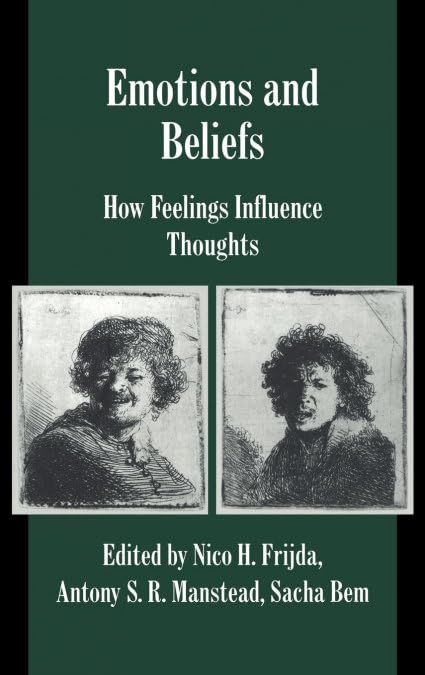
Emotions and Beliefs: How Feelings Influence Thoughts - Scholarly
Emotions and Beliefs: How Feelings Influence Thoughts - Scholarly
Price subject to change. Tap below for current.
Couldn't load pickup availability
In this review of Emotions and Beliefs: How Feelings Influence Thoughts, the book is recommended for psychologists, graduate students and researchers who want a rigorous look at how emotion shapes cognition. The editors gather contributions that combine theory and empirical work to explain why emotions alter the content and strength of beliefs and whether those beliefs resist change. Readers looking for a concise textbook will find dense, theory-driven chapters that aim to develop coherent principles rather than quick, popular summaries.
Key Features
- Interdisciplinary perspectives: Multiple contributors provide varied psychological approaches that broaden understanding of how emotions interact with belief formation.
- Theory paired with research: Chapters combine conceptual frameworks and empirical findings so readers can see how hypotheses about emotion and belief have been tested.
- Focus on belief resistance: The book examines not only how emotions influence belief content but also factors that affect openness to modification.
- Thematic coherence: Editors organize contributions to develop overarching theoretical principles that clarify connections across studies.
- Scholarly depth: The text is suitable for readers seeking advanced analysis rather than introductory treatment.
Who It's For
The book is best for academics, clinicians, and advanced students in psychology, social cognition, and emotion research who need a detailed, theory-driven synthesis of how feelings influence thought. It works well as a supplemental text in graduate seminars where empirical studies are discussed alongside theoretical models.
People seeking a brief, popular overview of emotions and beliefs or a practical self-help guide should look elsewhere, since the chapters favor scholarly argumentation and research detail over accessible summaries or application-focused advice.
Pros & Cons
Pros
- Comprehensive theoretical coverage gives readers a strong conceptual framework for researching emotion-belief interactions.
- Empirical contributions demonstrate how theories have been operationalized and tested in varied contexts.
- Editors curate complementary perspectives that help form coherent principles across chapters.
Cons
- The academic tone and depth can be demanding for non-specialist readers seeking an easy introduction.
Specifications
| Title | Emotions and Beliefs: How Feelings Influence Thoughts |
| Series | Studies in Emotion and Social Interaction |
| Editors/Authors | Nico H. Frijda, Antony S. R. Manstead, Sacha Bem |
| Subject focus | Relationship between emotions and beliefs; theoretical and empirical analysis |
| Intended audience | Researchers, graduate students, clinicians |
| Approach | Combination of theory and research to develop coherent principles |
Our Verdict
Emotions and Beliefs is a valuable, theory-rich volume for specialists who want a rigorous account of how feelings shape thought and belief stability. Its strength lies in combining theoretical clarity with empirical work, making it a sound investment for graduate courses or research libraries, though casual readers may find the style demanding.
Frequently Asked Questions
Is this book suitable for undergraduate students?
The material is advanced and best suited to graduate-level courses or readers with prior background in psychology.
Does the book include empirical studies?
Yes, contributors pair theory with empirical research to show how concepts about emotion and belief are tested.
Will this help with practical clinical techniques?
The focus is theoretical and research-oriented, so it informs clinical understanding but does not provide step-by-step clinical interventions.
Editor's Take
Emotions and Beliefs is a theory-rich, research-oriented volume ideal for researchers and graduate students seeking a rigorous account of how emotions shape belief content and resistance to change.

Recently viewed
Recently viewed products will appear here as customers browse the store.