

Entropy and Information Theory - Classic Text for Engineers
Entropy and Information Theory - Classic Text for Engineers
Price subject to change. Tap below for current.
Couldn't load pickup availability
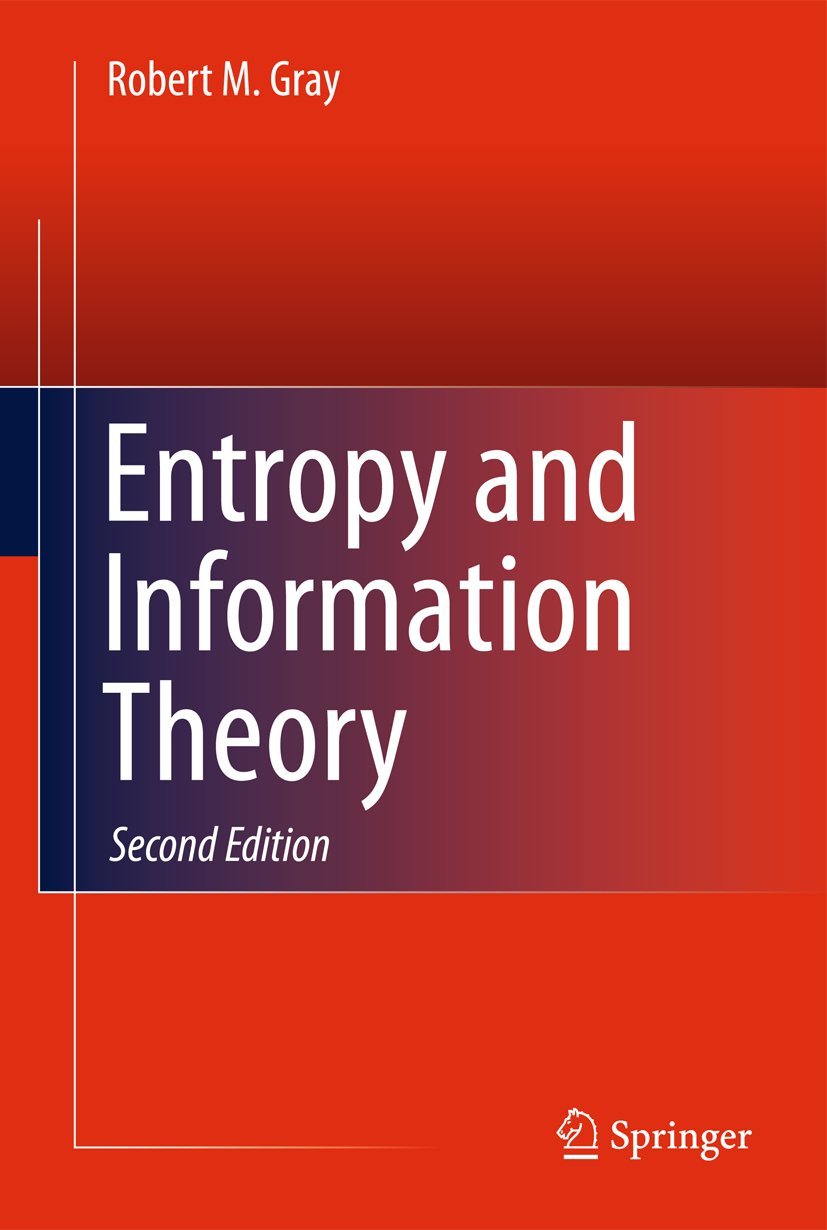
In this review of Entropy and Information Theory the reviewer finds a rigorous, updated textbook best suited to advanced students and practitioners who need a deep theoretical foundation. The single biggest reason to buy is its comprehensive treatment of both Shannon source and channel coding theorems alongside newer material on stationary codes and information versus distortion tradeoffs, which makes it especially useful as a reference for research or graduate-level study.
Key Features
- Updated edition: Includes expanded discussion of stationary and sliding-block codes to clarify relations between block codes and more general coding schemes.
- Shannon theorems coverage: Roughly one-third of the book is devoted to the Shannon source and channel coding theorems, providing a clear foundation for information theory work.
- Ergodic theory material: Newer sections collect results from ergodic theory that are directly relevant to information theory applications and proofs.
- B-processes treatment: Presents expanded treatment of B-processes formed by stationary coding of memoryless sources, useful for stochastic process analysis.
- Information-distortion tradeoffs: Adds material on trading off information and distortion, including the Marton inequality, which is helpful for lossy coding and rate-distortion study.
Who It's For
This book is ideal for graduate students in electrical engineering, computer science researchers working on coding and compression, and practitioners who require a mathematically precise reference on sources, channels, and codes. Its emphasis on proofs and theoretical properties makes it a strong classroom text or a desk reference for analytical work.
Those seeking a gentle or application-first introduction should look elsewhere; this edition assumes mathematical maturity and background in probability and signal processing, and it is not a quick-start manual for hobbyists or nontechnical readers.
Pros & Cons
Pros
- Comprehensive coverage of foundational Shannon source and channel coding theorems, useful for rigorous study.
- Expanded sections on stationary codes and B-processes deepen the theoretical scope beyond the original edition.
- New material on information versus distortion and properties of optimal source codes aids research in rate-distortion theory.
Cons
- Dense, proof-oriented style means readers without strong mathematical background may struggle.
Specifications
| Title | Entropy and Information Theory |
| Author | Robert M. Gray |
| Edition | Updated edition with new material |
| Core topics | Shannon theorems, sources, channels, codes |
| New material highlights | Stationary/sliding-block codes, ergodic theory, B-processes, Marton inequality |
| Intended audience | Graduate students, researchers, engineers |
Our Verdict
Entropy and Information Theory is a rigorous, value-for-money reference for anyone needing deep theoretical coverage of coding and rate-distortion topics. Advanced students and researchers will benefit most from the expanded material on stationary codes, ergodic theory, and information-distortion tradeoffs; novices should choose a more introductory text first.
Frequently Asked Questions
Does this edition add new theoretical material?
Yes, it expands treatment of stationary and sliding-block codes, ergodic theory results, B-processes, and information-distortion topics including the Marton inequality.
Is the book suitable for beginners?
No, the book is proof-oriented and assumes mathematical maturity; it is best for graduate-level study or professional reference.
Will this help with practical coding implementations?
It focuses on theoretical foundations and properties of optimal codes, which informs practical work but is not an implementation guide.
Editor's Take
A rigorous, updated reference ideal for graduate students and researchers; strong coverage of Shannon theorems, stationary codes, ergodic theory and information-distortion tradeoffs, but not for beginners.

Recently viewed
Recently viewed products will appear here as customers browse the store.