

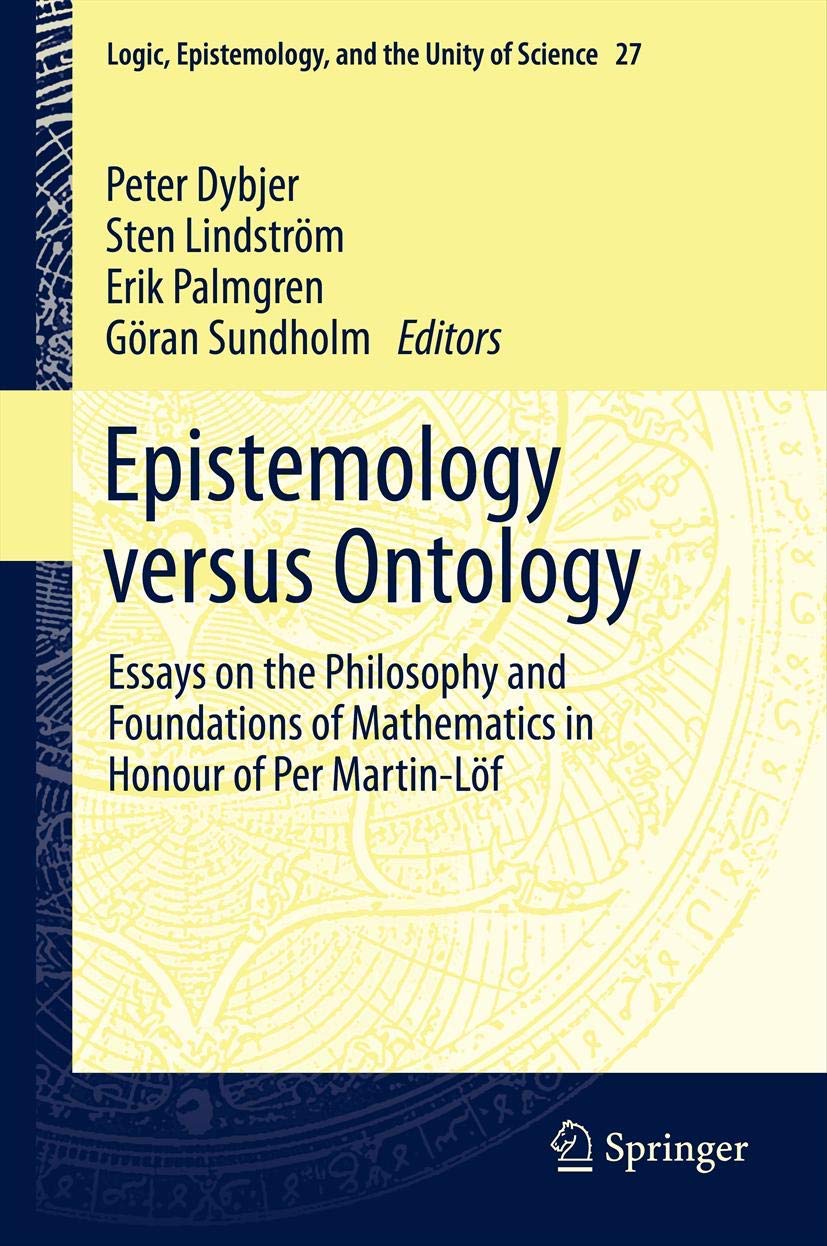
Epistemology versus Ontology: Essays on the Philosophy and Foundations
Epistemology versus Ontology: Essays on the Philosophy and Foundations
Price subject to change. Tap below for current.
Couldn't load pickup availability
In this review of Epistemology versus Ontology readers will find a collected volume aimed at specialists who want rigorous, philosophically informed perspectives on the foundations of mathematics. The book gathers essays by philosophers, mathematicians and logicians and its single biggest reason to buy is the depth of engagement with the tension between classical mathematics and constructivist programmes such as Martin-Lof type theory. This is a reflective, academic collection best suited for researchers, graduate students and university libraries rather than casual readers.
Key Features
- Interdisciplinary contributors: Essays draw on philosophy, mathematics and logic to confront foundational questions from multiple scholarly angles.
- Focus on constructivism: The volume presents thorough discussion of predicativistic constructivism and its relation to Martin-Lof type theory, useful for readers studying alternatives to ZFC.
- Philosophical framing: Several chapters place mathematical foundations in the context of meaning theories in the Wittgenstein and Dummett traditions, clarifying epistemological commitments.
- Critical engagement with ZFC: Contributors examine philosophical difficulties of classical logic and set theory with the axiom of choice, offering reasoned critiques and alternatives.
- Edited collection format: The essays provide varied perspectives that together map contemporary debates rather than presenting a single unified thesis.
Who It's For
Scholars and advanced students of mathematical logic, philosophy of mathematics, and foundations will find this volume rewarding as it addresses concrete tensions between ontological commitments and epistemological stances. Those researching Martin-Lof type theory or predicativistic constructivism will appreciate the focused essays and the dialogue between technical and philosophical viewpoints.
Undergraduate readers or general interest audiences should look elsewhere for a more introductory or pedagogical treatment, since the book presumes familiarity with foundational debates and does not aim to teach basics of set theory or type theory from scratch.
Pros & Cons
Pros
- Contributors produce informed, well-argued essays that deepen the reader's grasp of foundational issues.
- The focus on Martin-Lof type theory offers a valuable alternative perspective to the dominant ZFC framework.
- Philosophical context connects technical foundations to meaning theories, enriching interpretation.
Cons
- The edited volume format means coverage varies by essay and there is no single, cohesive textbook-style narrative.
- Not suitable as an introductory textbook for readers new to logic or set theory.
Specifications
| Title | Epistemology versus Ontology: Essays on the Philosophy and Foundations of Mathematics |
| Series | Logic, Epistemology, and the Unity of Science, 27 |
| Editors / Brand | P. Dybjer, Sten Lindstrom, Erik Palmgren, B.G. Sundholm |
| Subject areas | Philosophy, Mathematics, Logic, Foundations of Mathematics |
| Primary themes | Constructivism, Classical mathematics, Martin-Lof type theory, Meaning theories |
| Intended audience | Researchers, graduate students, academic libraries |
Our Verdict
Epistemology versus Ontology is a substantial, specialist collection that rewards readers interested in the philosophical underpinnings of mathematical foundations. For researchers and advanced students investigating the constructivism versus classical debate or exploring Martin-Lof type theory, the essays offer durable insight and useful critique, making this a good-value addition to academic collections despite the unevenness inherent in edited volumes.
Frequently Asked Questions
Does this volume include technical discussions of Martin-Lof type theory?
Yes, several essays engage directly with predicativistic constructivism and Martin-Lof type theory alongside philosophical analysis.
Is this book suitable for beginners in logic?
No, it assumes prior familiarity with foundational debates and is best for graduate-level readers or researchers.
Who edited the book?
The volume is edited by P. Dybjer, Sten Lindstrom, Erik Palmgren and B.G. Sundholm.
Editor's Take
A specialist, well-argued collection that rewards researchers and advanced students interested in constructivism and Martin-Lof type theory; valuable for academic libraries despite uneven coverage.

Recently viewed
Recently viewed products will appear here as customers browse the store.