

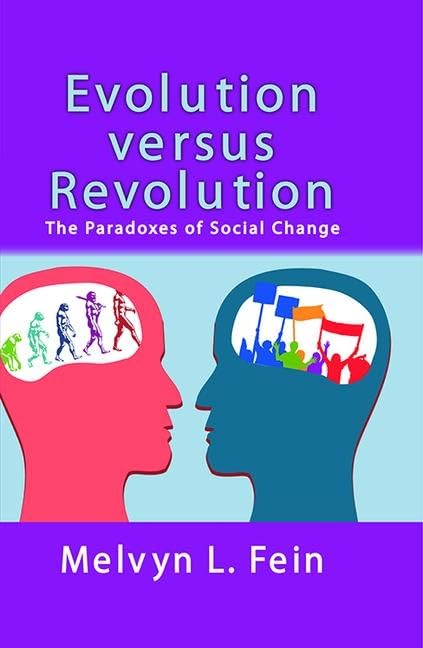
Evolution Versus Revolution: The Paradoxes of Social Change
Evolution Versus Revolution: The Paradoxes of Social Change
Price subject to change. Tap below for current.
Couldn't load pickup availability
In this review of Evolution Versus Revolution: The Paradoxes of Social Change the reviewer finds a thoughtful, theory-driven exploration best suited to readers who want a measured alternative to radical accounts of social transformation. Melvyn L. Fein argues for an integrated model of social evolution that acknowledges conflict, power, and moral constraints; the single biggest reason to read it is its sustained effort to reconcile flexibility and stability through a clear problem, what Fein calls the social generalist dilemma. This book is a careful, analytical work rather than a manifesto, and the reviewer recommends it for readers who prefer nuanced explanation over polemic.
Key Features
- Integrated model: Presents a multi-dimensional approach that attempts to synthesize evolutionary and revolutionary perspectives to explain complex social change.
- Conflict-aware analysis: Emphasizes that major social changes are saturated in conflict and shaped by power and moral considerations rather than automatic decisions.
- Social generalist dilemma: Explores the tension between flexibility and stability and why non-rational mechanisms can be necessary to reconcile them.
- Inverse force rule: Describes an inverse force rule as part of the explanation for how social dynamics produce particular directions of change.
- Scholarly tone: Maintains an analytical, explanatory voice appropriate for readers who want careful conceptual work rather than prescriptive politics.
Who It's For
This book is aimed at students and readers of political sociology, social philosophy, and comparative social theory who want a reasoned alternative to revolutionary narratives. It suits academics and thoughtful general readers looking for a framework that accounts for inconclusiveness, impediments, and the moral and power-laden nature of change.
Readers seeking a short popular primer, a prescriptive political program, or a vividly anecdotal history of particular revolutions should look elsewhere; Feins emphasis is on conceptual clarity and structural explanation rather than shorthand advocacy or storytelling.
Pros & Cons
Pros
- Clear case for evolutionary mechanisms gives readers a coherent alternative to purely revolutionary explanations.
- Attention to conflict and power provides a realistic account of why major changes are rarely simple or automatic.
- Introduces useful concepts, such as the social generalist dilemma, that help frame debates about stability and flexibility.
Cons
- The books analytical tone and conceptual density may feel abstract to readers seeking narrative or prescriptive guidance.
Specifications
| Title | Evolution Versus Revolution: The Paradoxes of Social Change |
| Author | Melvyn L. Fein |
| Approach | Integrated social evolution model |
| Key concepts | Social generalist dilemma; inverse force rule |
| Main emphasis | Conflict, power, and moral control of change |
| Tone | Analytical and conceptual |
Our Verdict
Feins book is a solid, conceptually rich contribution for readers who want a disciplined, conflict-aware account of social change; it is good value for students and scholars who need a framework that explains why evolution, not sudden rupture, often best describes durable social transformation.
Frequently Asked Questions
Does this book argue against all revolutionary change?
Not categorically; it argues that evolutionary explanations better account for complexity, conflict, and the role of power in most major social transformations.
Is the book accessible to nonacademic readers?
It is written in an analytical style that suits informed general readers, but those wanting light, anecdotal accounts may find it dense.
What is the social generalist dilemma?
Feins term for the tension between societies need for both flexibility and stability and the non-rational mechanisms that can resolve that tension.
Editor's Take
Feins book offers a conceptually rich defense of evolutionary explanations for social change, useful to students and scholars who want a conflict-aware framework rather than prescriptive polemic.

Recently viewed
Recently viewed products will appear here as customers browse the store.