

Explicit Brauer Induction: Canonical Algebraic Method
Explicit Brauer Induction: Canonical Algebraic Method
Price subject to change. Tap below for current.
Couldn't load pickup availability
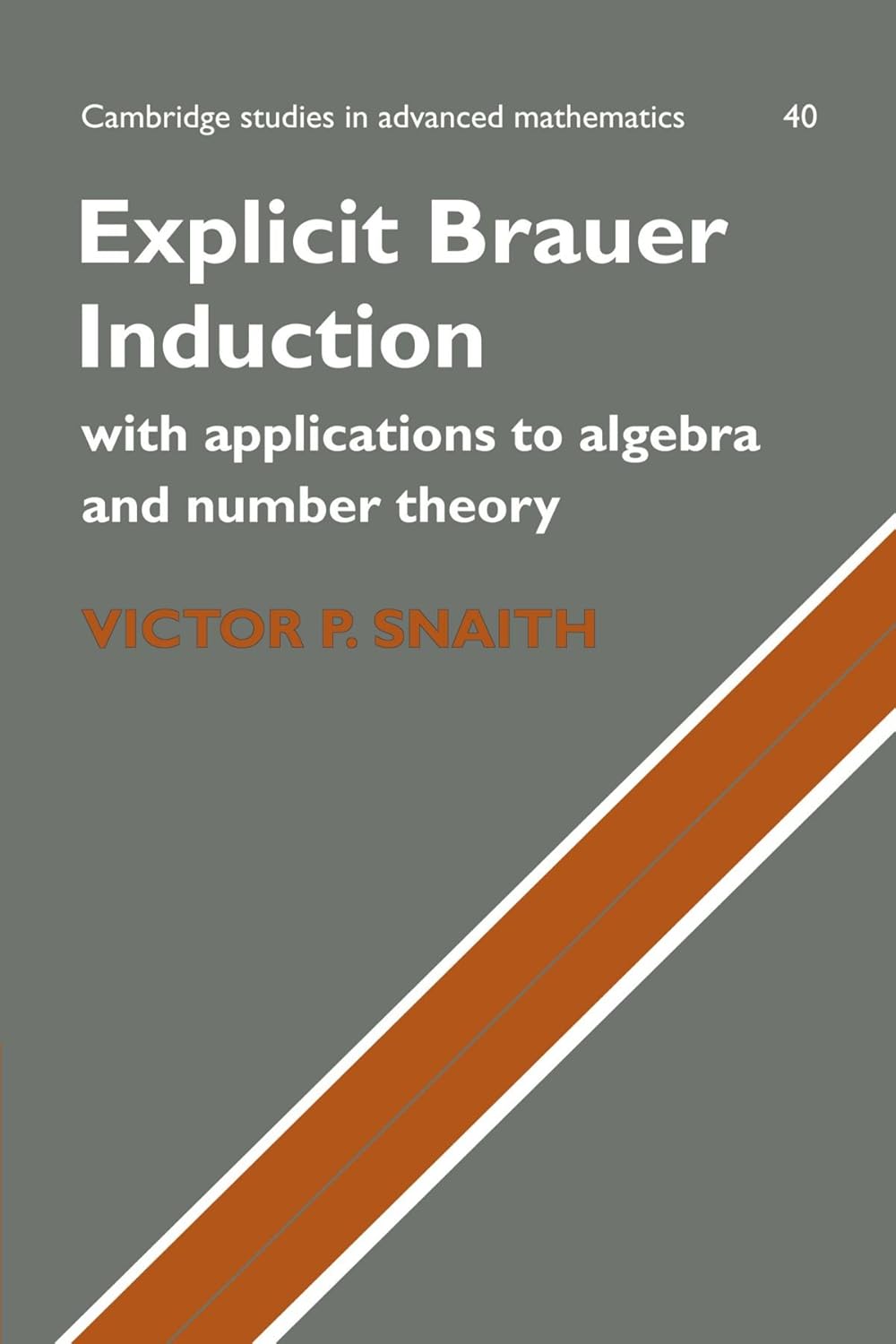
In this review of Explicit Brauer Induction readers will find a focused assessment for research algebraists and graduate students. Victor P. Snaith presents a canonical, algebraic derivation of a technique first uncovered in 1986, and the book's single biggest strength is that it translates a previously topological method into a form usable by algebraists, making the material directly applicable in number theory and group-ring problems. The review concentrates on clarity of exposition, the significance of the canonical formula for Brauer's induction theorem, and practical illustrations of the method.
Key Features
- Canonical formula: Presents a clear algebraic derivation of Brauer's induction formula so readers can apply it directly without topological prerequisites.
- Algebraic method: Adapts a method of R. Boltje to make the technique accessible to those trained in pure algebra rather than topology.
- Applications: Uses the technique to reprove known results and to resolve outstanding problems, demonstrating practical reach in algebra and number theory.
- Concrete illustration: Shows how the method improves constructions such as the Oliver-Taylor group-ring logarithm, giving a tangible payoff for the abstract development.
- Research orientation: Designed to introduce research algebraists to the possibilities of the technique and to stimulate further work in the area.
Who It's For
The book is best suited to research algebraists, advanced graduate students in algebra and number theory, and mathematicians interested in representation theory and group rings who want a canonical algebraic form of Brauer's induction theorem. Its focus on algebraic derivation makes it particularly valuable for readers who prefer algebraic methods over topological ones.
Those looking for an introductory textbook or elementary treatments of group theory will find the material dense; readers new to representation theory or without graduate-level background in algebra should look for more introductory texts before tackling this volume.
Pros & Cons
Pros
- Provides a canonical algebraic formulation of a classical theorem, making a delicate result usable in algebraic contexts.
- Makes a previously topological technique accessible through an algebraic pathway, broadening the audience.
- Includes worked applications that reprove important results and settle specific outstanding problems, illustrating utility.
Cons
- Density and research-level focus mean it is not a gentle introduction for beginners; prior graduate-level background is effectively required.
Specifications
| Title | Explicit Brauer Induction: With Applications to Algebra and Number Theory |
| Series | Cambridge Studies in Advanced Mathematics, Series Number 40 |
| Author / Brand | Victor P. Snaith |
| Origin of technique | Discovered by the author in 1986; previously topological |
| Methodological basis | Algebraic derivation following a method of R. Boltje |
| Illustrative application | Improved construction of the Oliver-Taylor group-ring logarithm |
Our Verdict
Explicit Brauer Induction is a valuable, research-focused contribution that algebraists and number theorists should consider when they need a canonical, algebraic form of Brauer's induction theorem. It repackages a topological technique into a usable algebraic method and offers concrete applications, making it good value for readers who already have graduate-level preparation and want tools for further research.
Frequently Asked Questions
Does this book require topology background?
No; the book's goal is to present an algebraic derivation so that algebraists without a topology background can apply the technique.
Is this suitable for beginners in algebra?
Not really; the text is research-oriented and suited to advanced graduate students or researchers rather than beginners.
What notable applications are included?
The book illustrates applications such as an improved construction of the Oliver-Taylor group-ring logarithm and reproves several known results using the new technique.
Editor's Take
Explicit Brauer Induction repackages a topological technique into a canonical algebraic method, offering concrete applications and value for research algebraists and advanced graduate students.

Recently viewed
Recently viewed products will appear here as customers browse the store.