

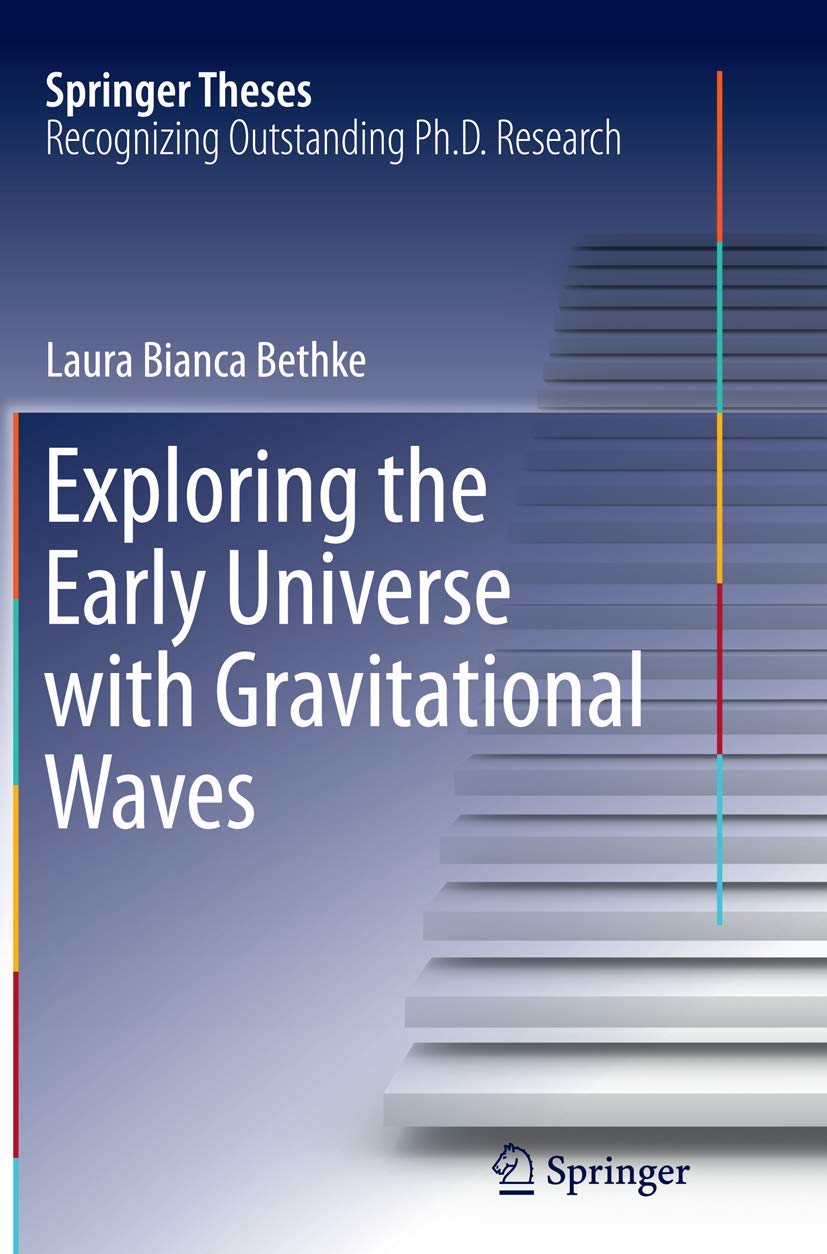
Exploring the Early Universe with Gravitational Waves - Thesis
Exploring the Early Universe with Gravitational Waves - Thesis
Price subject to change. Tap below for current.
Couldn't load pickup availability
In this review of Exploring the Early Universe with Gravitational Waves (Springer Theses), the reviewer finds a focused, technical study aimed at researchers and advanced students interested in early-universe cosmology and quantum gravity. The book's single biggest reason to read it is its detailed analysis showing how gravitational wave spectra differ when loop quantum gravity inspired corrections are included, offering a concrete pathway from theory to potentially observable signatures. This review highlights how the work frames predictions for future experiments and why it matters to anyone tracking theory-driven observational forecasts.
Key Features
- Focused theoretical scope: The text concentrates on gravitational wave production during inflation and preheating, providing clear calculations rather than broad survey material.
- Loop quantum gravity inspired model: Presents a modified inflationary scenario that leads to a distinct gravitational wave spectrum, which could inform searches for quantum gravity effects.
- Preheating analysis: Demonstrates that preheating generates an anisotropic cosmic gravitational wave background, highlighting a measurable imprint for future detectors.
- Connection to observation: Emphasizes potentially observable features and how they differ from standard general relativity predictions, making the work useful for experimental planning.
- Scholarly depth: Offers rigorous derivations and discussion suitable for graduate-level readers and researchers developing gravitational wave forecasts.
Who It's For
The book is best for graduate students, postdoctoral researchers, and active theorists working on cosmology, gravitational waves, or quantum gravity who need a compact but rigorous study linking theoretical models to observational consequences. It assumes familiarity with inflationary cosmology and perturbation theory, so readers should be comfortable with advanced mathematics and cosmological perturbation methods.
Those seeking an introductory overview of gravitational waves or a broad textbook on cosmology should look elsewhere; this work is narrowly focused and most valuable to readers seeking technical results and model-specific predictions rather than general pedagogy.
Pros & Cons
Pros
- Clear presentation of how a loop quantum gravity inspired model alters the gravitational wave spectrum relative to general relativity.
- Detailed treatment of preheating that reveals anisotropies in the cosmic gravitational wave background useful for experimental forecasts.
- Concise, research-oriented format that makes it straightforward to extract calculations and predictions for further study.
Cons
- The material is specialized and assumes advanced background, which limits accessibility for general readers.
Specifications
| Title | Exploring the Early Universe with Gravitational Waves (Springer Theses) |
| Author | Laura Bianca Bethke |
| Primary topics | Gravitational wave production during inflation and preheating |
| Approach | Loop quantum gravity inspired inflation model and preheating analysis |
| Observable focus | Distinct gravitational wave spectrum and anisotropic background |
| Audience | Graduate students and researchers in cosmology and quantum gravity |
Our Verdict
Exploring the Early Universe with Gravitational Waves is a focused, technically rigorous thesis that rewards readers seeking model-specific predictions linking quantum gravity inspired inflationary modifications and preheating to observational signatures. It is good value for researchers and advanced students who want a compact source of derivations and testable consequences, though it is not intended as an introductory text.
Frequently Asked Questions
Does this work make observational predictions?
The thesis identifies potentially observable differences in the gravitational wave spectrum and anisotropies that could inform future experiments.
Is this suitable for beginners?
No, the book assumes advanced background in inflationary cosmology and perturbation theory and is aimed at graduate-level readers and researchers.
What specific scenarios are studied?
It studies inflation in a loop quantum gravity inspired model and gravitational wave production during preheating at the end of inflation.
Editor's Take
A focused, technically rigorous thesis that links loop quantum gravity inspired inflation and preheating to potentially observable gravitational wave signatures; ideal for graduate students and researchers seeking model-specific predictions.

Recently viewed
Recently viewed products will appear here as customers browse the store.