

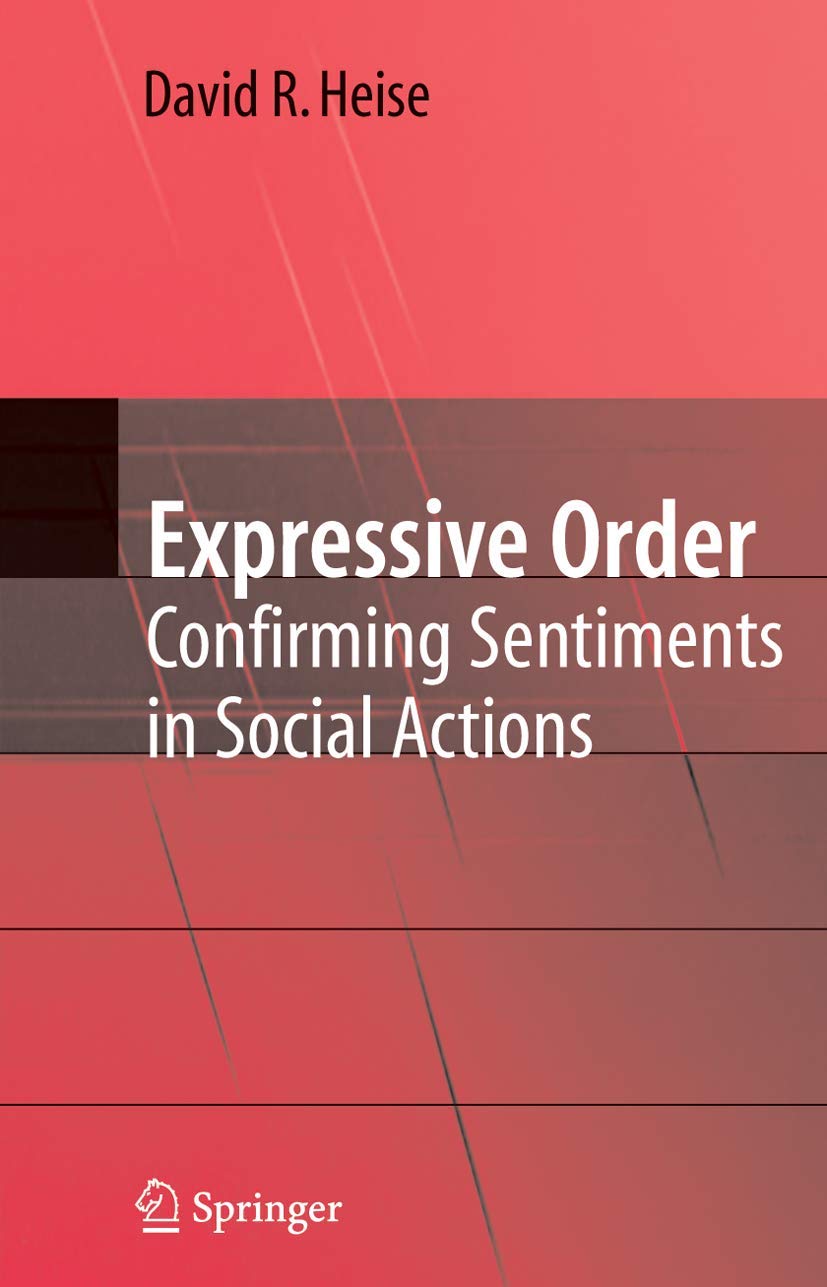
Expressive Order: Confirming Sentiments in Social Actions - Accessible
Expressive Order: Confirming Sentiments in Social Actions - Accessible
Price subject to change. Tap below for current.
Couldn't load pickup availability
Our review of Expressive Order: Confirming Sentiments in Social Actions explains why this book matters to readers curious about how emotions and identity guide behavior. David R. Heise writes for both the interested layperson and the specialist, and the book's clearest strength is its two-part structure: a plain-language exposition that illuminates everyday interactions, followed by rigorous mathematical derivations that formalize those insights. For anyone wanting a readable introduction to affect control theory with technical depth available if desired, this volume is the single best choice on that topic.
Key Features
- Plain-language exposition: Part 1 presents complex ideas in accessible prose so non-specialists can grasp how sentiments shape social action.
- Interpretive analyses: Numerous everyday examples and analyses help readers apply the theory to familiar social situations.
- Mathematical derivations: Part 2 gives the formal equations and solutions that define sentiment-confirming behavior, supporting readers who want theoretical precision.
- Theory to practice link: The combination of interpretation and math demonstrates how institutions and emotions jointly produce social outcomes.
- Dual-audience design: The book is structured to be engaging for general readers while still useful as a technical reference for sociology specialists.
Who It's For
The book is well suited to sociology students, social scientists, and thoughtful general readers who want a coherent framework for understanding how identities, behaviors, and settings interact: the first part makes the ideas approachable and interesting, while the second part supplies the formal apparatus professionals need.
Readers seeking only a light pop-sociology read or an overview without equations may find the mathematical sections denser than necessary; those uninterested in formal models should focus on Part 1 and expect to skip Part 2.
Pros & Cons
Pros
- Clear, accessible writing in Part 1 makes affect control theory understandable to non-specialists.
- Concrete interpretive analyses ground abstract ideas in everyday situations for easy application.
- Rigorous mathematical derivations provide a reliable technical foundation for researchers and advanced students.
- The two-part format bridges popular exposition and formal theory in a single volume.
Cons
- The mathematical sections may be challenging for readers who lack a quantitative background.
Specifications
| Title | Expressive Order: Confirming Sentiments in Social Actions |
| Author | David R. Heise |
| Content structure | Part 1: plain-language exposition; Part 2: mathematical derivations |
| Main topic | Affect control theory and social interaction |
| Audience | Lay readers and sociology specialists |
| Focus | Sentiment-confirming behavior, labeling, attribution, and emotion |
Our Verdict
Expressive Order is a rare combination of readable social theory and formal rigor, making it a strong buy for students and researchers who want both interpretation and mathematical clarity. The book represents good value for those prepared to engage with its quantitative portion, and it remains accessible enough in Part 1 to inform curious general readers.
Frequently Asked Questions
Is this book suitable for beginners?
Yes: Part 1 is explicitly written for lay readers and introduces the core ideas in plain language.
Does the book include formal math?
Yes: Part 2 presents the mathematical derivations that define sentiment-confirming behavior, for readers who want technical detail.
Can it be used in coursework?
Yes: the dual format makes it a useful classroom text for courses bridging theory and methods in sociology.
Editor's Take
Expressive Order combines an accessible exposition with rigorous mathematical derivations, making it ideal for students and researchers who want both intuitive examples and formal theory.

Recently viewed
Recently viewed products will appear here as customers browse the store.