

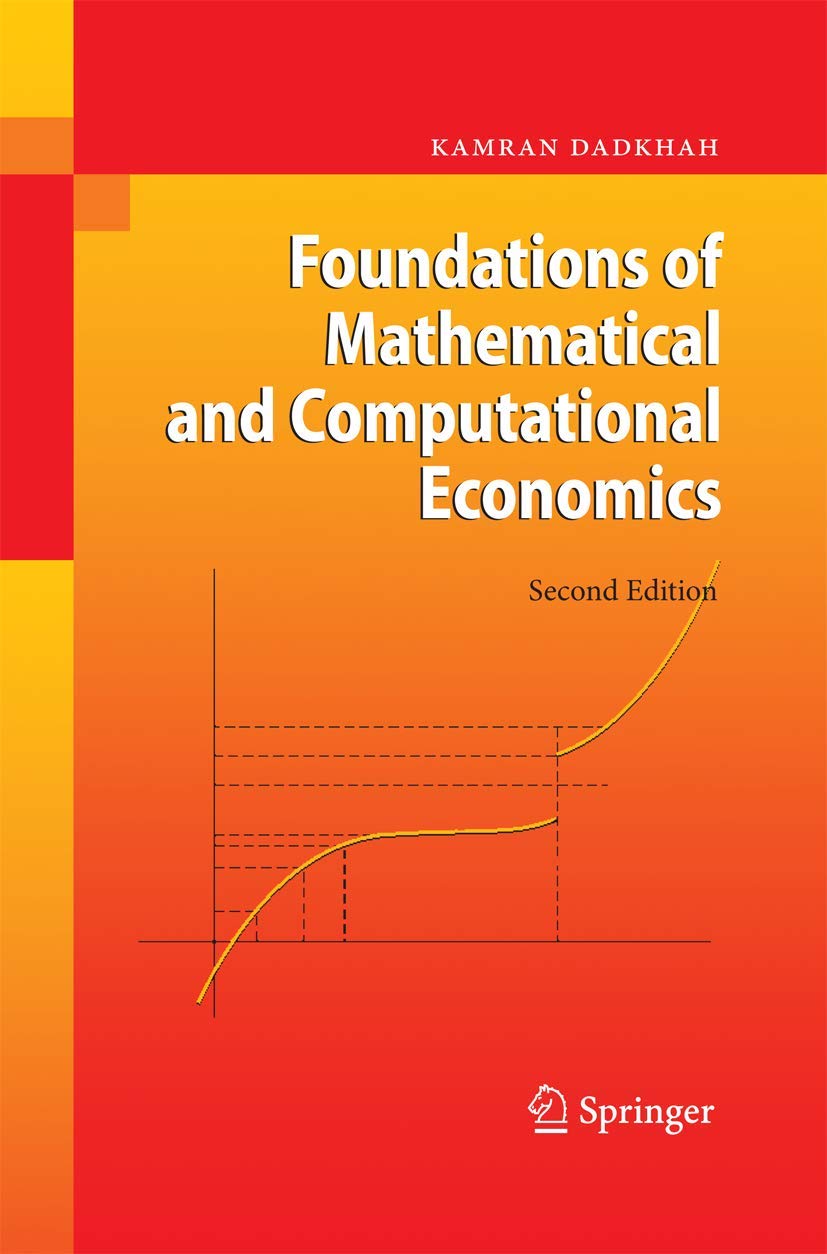
Foundations of Mathematical and Computational Economics - Practical
Foundations of Mathematical and Computational Economics - Practical
Price subject to change. Tap below for current.
Couldn't load pickup availability
In this review of Foundations of Mathematical and Computational Economics the reviewer finds a deliberate, classroom-ready text aimed at students and practitioners who need a clear bridge between mathematical theory and hands-on computation. The single biggest reason to buy is the book's emphasis on practical numerical methods and worked examples that pair mathematical analysis with real computational tools, making it useful for coursework or self-study in applied economics. It reads as a methodical introduction rather than a reference for specialists.
Key Features
- Foundational coverage: Presents core mathematical concepts used in economics so readers can follow modern theoretical and applied work.
- Numerical analysis focus: Introduces numerical methods that help solve problems where analytical solutions are impractical, permitting applied work in econometrics and theory.
- Software integration: Demonstrates the use of Matlab and Excel to carry out computations, enabling readers to replicate and extend examples.
- Maple for analysis: Devotes sections to Maple for symbolic and analytical tasks, useful for learning formal manipulation alongside numerical work.
- Worked examples and exercises: Uses recent contributions in economic theory and econometrics and end of chapter exercises to reinforce concepts and build practical skills.
Who It's For
This book is primarily for advanced undergraduates, graduate students, and practitioners in economics who need a compact yet thorough introduction to mathematical techniques and computational tools. It suits readers who plan to use Matlab, Excel, or Maple to implement models, run simulations, or perform numerical estimation.
Those seeking an exhaustive mathematical treatise or a specialist reference in numerical methods may want a more advanced text after mastering these foundations; similarly, complete beginners with no calculus background should pair this book with a basic calculus primer.
Pros & Cons
Pros
- Clear linkage between mathematics and software tools, making it straightforward to move from theory to computation.
- Balanced treatment of numerical analysis with practical examples drawn from economic theory and econometrics.
- End of chapter exercises that reinforce learning and encourage hands-on application.
Cons
- Not intended as a comprehensive reference for advanced numerical methods, so readers needing deep numerical theory will need supplemental texts.
Specifications
| Title | Foundations of Mathematical and Computational Economics |
| Author | Kamran Dadkhah |
| Scope | Basics of mathematics and computation for economics |
| Software covered | Matlab, Excel, Maple |
| Includes | Numerical analysis, worked examples, end of chapter exercises |
| Audience | Students and practitioners in economics |
Our Verdict
Foundations of Mathematical and Computational Economics is a well-structured introduction that pairs mathematical concepts with practical computation, making it good value for students and applied researchers who need to implement models and computations in Matlab, Excel, or Maple. It is recommended for those who want a compact, application-minded foundation before moving to more specialized numerical texts.
Frequently Asked Questions
Does the book teach software use?
The text includes worked demonstrations and guidance for using Matlab, Excel, and Maple to perform computations and symbolic analysis.
Is this suitable for beginners?
It is suitable for readers with basic mathematical background; complete beginners should supplement with elementary calculus material.
Are there exercises to practice?
Yes, each chapter contains end of chapter exercises based on examples from economic theory and econometrics.
Editor's Take
A practical, classroom-ready introduction that pairs core mathematical concepts with Matlab, Excel and Maple examples; recommended for students and practitioners seeking hands-on computational skills.

Recently viewed
Recently viewed products will appear here as customers browse the store.