

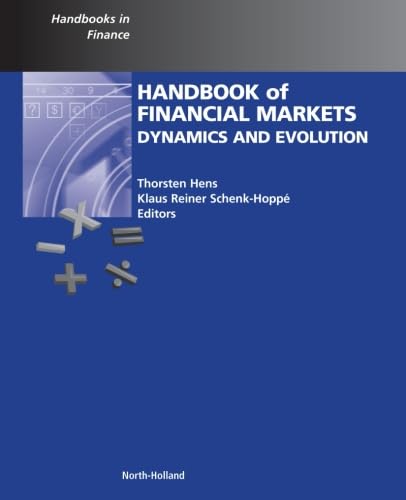
Handbook of Financial Markets: Dynamics and Evolution - In-depth
Handbook of Financial Markets: Dynamics and Evolution - In-depth
Price subject to change. Tap below for current.
Couldn't load pickup availability
In this review the Handbook of Financial Markets: Dynamics and Evolution is evaluated for readers who need a rigorous, research-oriented treatment of asset price behavior and portfolio selection. The volume stands out because it combines analytical, empirical, and numerical approaches to explain market dynamics under explicit assumptions of investor heterogeneity. For practitioners and theorists who want models that are both descriptive and normative, this handbook provides concentrated, technical discussion rather than introductory exposition.
Key Features
- Model diversity: Presents several different modeling approaches that show how varied assumptions produce distinct asset price dynamics, helping readers compare frameworks directly.
- Analytical depth: Includes formal portfolio selection models that clarify the theoretical underpinnings of market selection hypotheses and investor behavior.
- Empirical and numerical techniques: Offers empirical tests and numerical implementations that make theoretical results tangible and applicable to data-driven work.
- Heterogeneous investor focus: Explicitly assumes investor heterogeneity, which allows the models to be both descriptive of real markets and useful for normative evaluation.
- Targeted audience value: Written to serve finance theorists and financial practitioners who need detailed, model-based discussion rather than survey-level content.
Who It's For
The handbook is best suited to graduate students, academic researchers, and quantitative practitioners who already have a solid grounding in asset pricing and portfolio theory and who want to explore the state of debate on market selection and dynamics. Its emphasis on analytical and numerical methods makes it particularly useful as a reference for model development and for work that connects theory to empirical testing.
Readers seeking an introductory primer, a broad popular overview of markets, or light practical how-to trading advice should look elsewhere; the book assumes familiarity with advanced concepts and focuses on theoretical and empirical model comparison rather than beginner instruction.
Pros & Cons
Pros
- Comprehensive treatment of competing models gives readers a clear sense of where debates stand.
- Balance of analytical, empirical, and numerical methods supports both theoretical insight and practical implementation.
- Focus on investor heterogeneity provides a realistic foundation for descriptive and normative conclusions.
Cons
- Not intended as an introductory text, so less suitable for readers without a background in finance theory.
Specifications
| Title | Handbook of Financial Markets: Dynamics and Evolution |
| Editor / Brand | Thorsten Hens |
| Focus | Portfolio selection and asset price dynamics |
| Approach | Analytical, empirical, and numerical techniques |
| Model assumption | Investor heterogeneity |
| Audience | Finance theorists and financial practitioners |
Our Verdict
The Handbook of Financial Markets is a strong choice for readers who need a technically rigorous, model-centered resource on asset price dynamics and market selection. It delivers value through its comparative modeling approaches and mixture of theory and empirical tools, making it a worthwhile reference for researchers and quantitative practitioners who will apply or extend the models.
Frequently Asked Questions
Is this book suitable for beginners?
No. It assumes prior knowledge of asset pricing and portfolio theory and is aimed at advanced students, researchers, and practitioners.
Does the book include empirical work?
Yes. It presents empirical and numerical techniques alongside analytical models to test and implement theoretical results.
What is the central perspective of the volume?
The volume emphasizes models that assume investor heterogeneity, focusing on both descriptive and normative implications for market dynamics.
Editor's Take
The handbook is a technically rigorous, model-focused resource that combines analytical, empirical, and numerical approaches; it is best for researchers and quantitative practitioners who need in-depth treatment of asset price dynamics and market selection.

Recently viewed
Recently viewed products will appear here as customers browse the store.