

Highly Linear Integrated Wideband Amplifiers - Design & Analysis
Highly Linear Integrated Wideband Amplifiers - Design & Analysis
Price subject to change. Tap below for current.
Couldn't load pickup availability
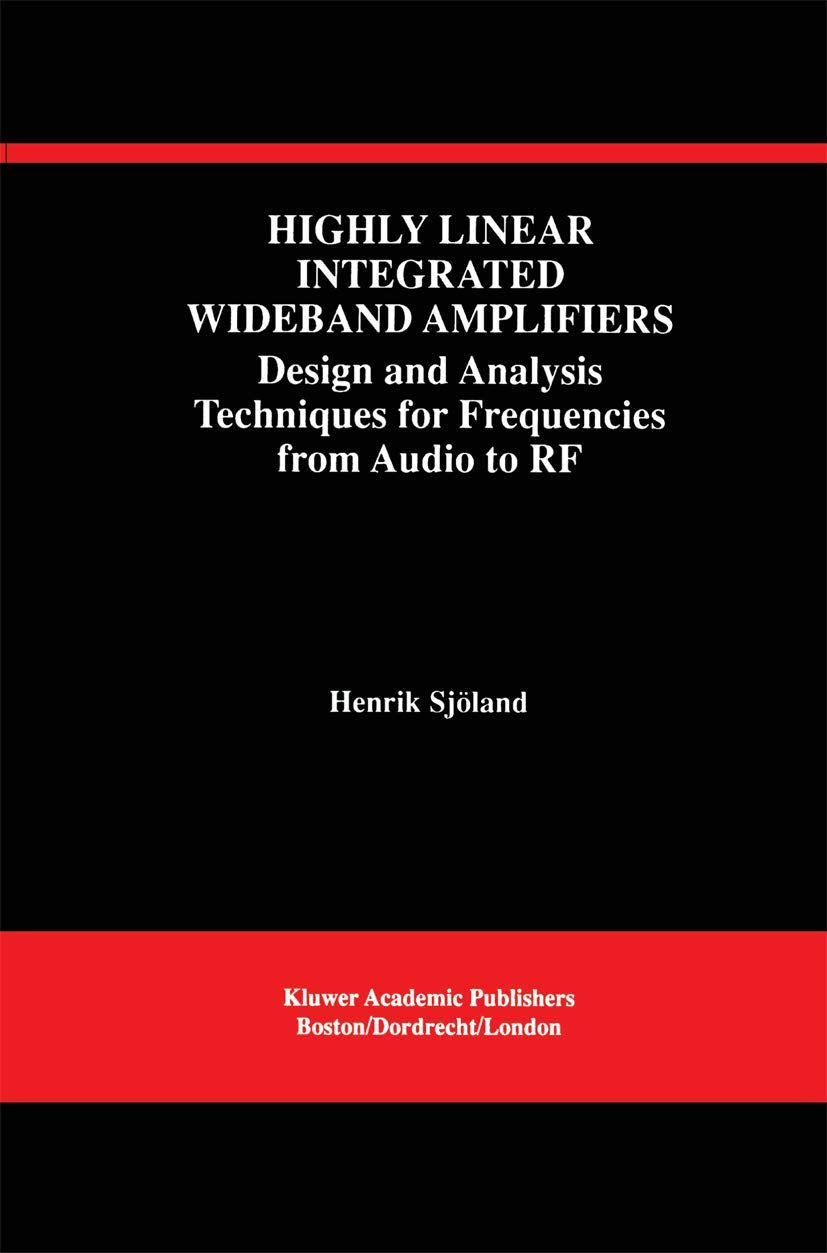
In this review of Highly Linear Integrated Wideband Amplifiers, the book is assessed as a targeted technical resource for engineers and advanced students working on amplifier design across audio to RF bands. The single biggest reason to buy is the book's focus on practical methods for achieving low distortion in wideband integrated amplifiers, including new topologies and a novel estimation technique for intermodulation distortion. This review examines how the text balances theory, worked designs, and statistical methods useful to practicing circuit designers.
Key Features
- Coverage of wideband frequencies: The book addresses amplifier design from audio through RF, providing context for designers who must span multiple frequency ranges in one product.
- High-linearity topologies: New circuit topologies are presented to reduce distortion, giving readers concrete approaches to improve linearity in integrated designs.
- Intermodulation estimation method: A novel method for estimating intermodulation distortion of wideband signals helps translate complex measurements into design decisions.
- Feedback boosting technique: An enhanced feedback configuration is introduced that demonstrates very low distortion in practical amplifier examples.
- Statistical relation to THD: The text explains a statistical method relating wideband intermodulation distortion to single-tone total harmonic distortion, aiding validation and testing.
Who It's For
This book is best for professional analog and RF engineers, graduate students in electrical engineering, and circuit designers who need practical design techniques for high-linearity wideband amplifiers. It assumes familiarity with amplifier fundamentals and some experience with integrated circuit concepts.
Readers seeking an introductory primer on electronics or a general survey of RF systems should look elsewhere, as the material is technical and focused on specialized design and analysis techniques rather than basic electronics education.
Pros & Cons
Pros
- Provides concrete high-performance amplifier designs that illustrate the theoretical points in a practical way.
- The novel intermodulation estimation method makes it easier to predict wideband behavior from measurable quantities.
- Introduces feedback boosting, a useful configuration for achieving very low distortion in integrated amplifiers.
Cons
- The content is specialized and assumes prior technical knowledge, limiting accessibility for novices.
Specifications
| Title | Highly Linear Integrated Wideband Amplifiers |
| Focus | Design and analysis techniques from audio to RF |
| Key topics | High-linearity topologies, intermodulation estimation, feedback boosting |
| Intended audience | Engineers and graduate students in electrical and RF design |
| Approach | Practical designs and statistical methods relating IMD to THD |
| Format | Technical engineering text in the Springer series |
Our Verdict
For practicing analog and RF designers who need advanced, practical guidance on achieving low-distortion wideband integrated amplifiers, this book is a strong value. Its combination of new topologies, a practical intermodulation estimation method, and the feedback boosting concept make it a useful reference to carry into complex design projects.
Frequently Asked Questions
Does the book cover RF as well as audio frequency design?
Yes, it addresses amplifier design across audio to RF frequencies and discusses techniques applicable across that range.
Is the material suitable for beginners?
The content is technical and geared to readers with prior knowledge of amplifier and circuit design, so beginners may find it challenging.
Does it include practical circuit examples?
Yes, the book demonstrates principles using a number of high-performance designs and practical configurations like feedback boosting.
Editor's Take
For practicing analog and RF designers, this technical guide offers practical methods-new topologies, intermodulation estimation, and feedback boosting-that make it a valuable reference for achieving low-distortion wideband integrated amplifiers.

Recently viewed
Recently viewed products will appear here as customers browse the store.