

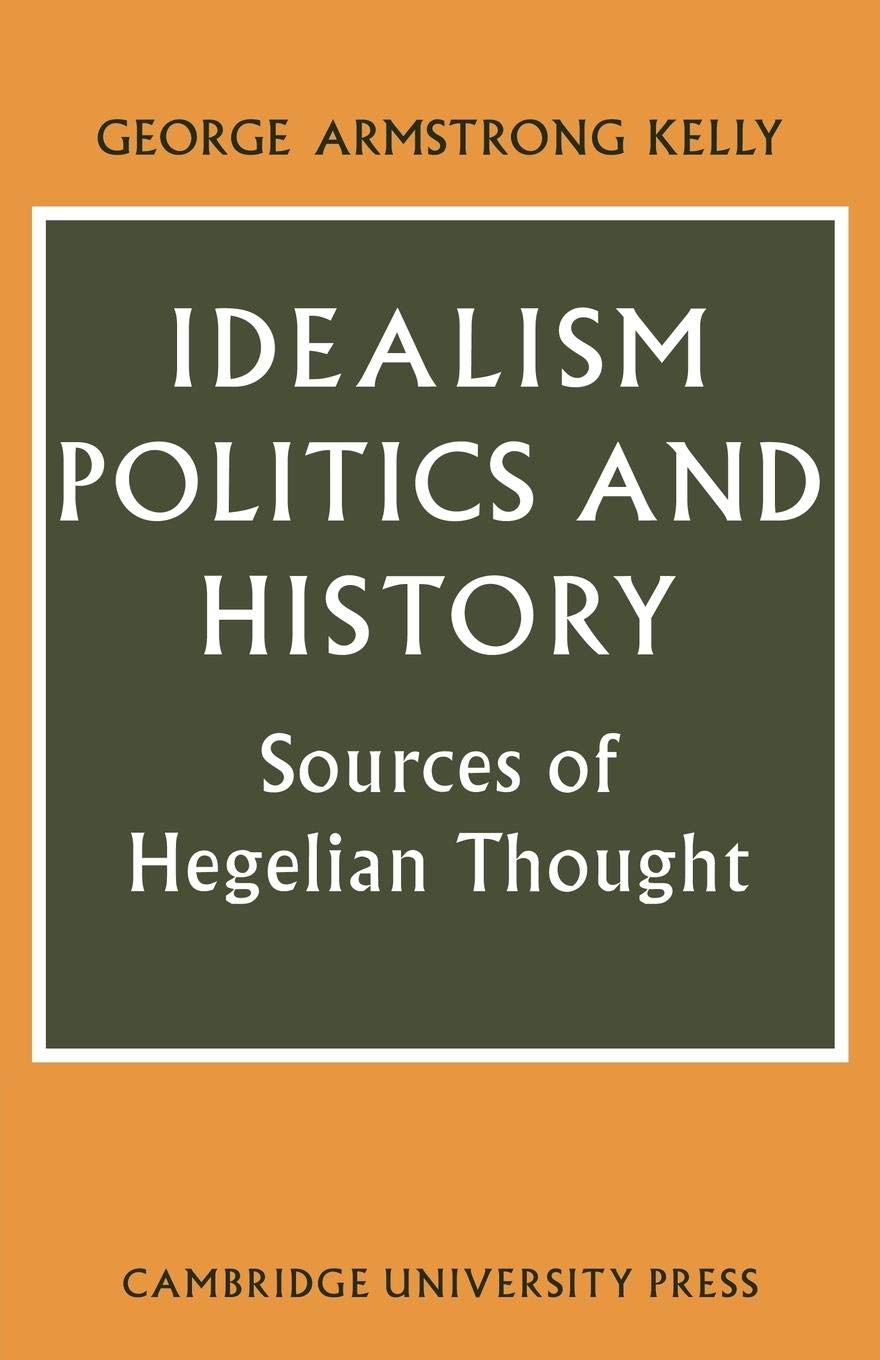
Idealism, Politics and History: Sources of Hegelian Thought
Idealism, Politics and History: Sources of Hegelian Thought
Price subject to change. Tap below for current.
Couldn't load pickup availability
In this review of Idealism, Politics and History, the reviewer finds a rigorous, scholarly study aimed at readers who want a deeper grasp of Hegel by tracing ideas back to Rousseau, Kant and Fichte. George Armstrong Kelly offers linked essays that situate Hegel within the intellectual currents of the French Revolutionary period, with the single biggest reason to read this book being its careful connection between historical perception and political theory. The tone is academic rather than introductory, so the book serves best as a thoughtful companion for serious students of political philosophy.
Key Features
- Historical focus: Traces intellectual and moral perceptions of history to clarify late Age of Reason political philosophy.
- Close readings: Provides linked studies of Rousseau, Kant, Fichte and Hegel that illuminate the development of Hegelian thought.
- Contextual interpretation: Reinterprets Hegel by placing his system within the wider context of revolutionary era ideas and debates.
- Scholarly rigour: Each essay stands alone as a contribution to the history of political ideas, useful for citation and classroom discussion.
- Thematic coherence: Cumulative essays furnish a clear context in which Hegel's system can be clarified and reinterpreted.
Who It's For
This book is ideal for graduate students, academics, and readers with prior familiarity with modern European philosophy who want a focused analysis of how historical perception shaped political theory in the Revolutionary era. It is particularly useful for those studying political philosophy, intellectual history, or the history of ideas.
Readers seeking a beginner's introduction to Hegel or a light survey of political theory should look elsewhere; the essays assume some background and reward careful, patient reading rather than offering an accessible primer.
Pros & Cons
Pros
- Well-researched essays that provide a strong historical framework for understanding Hegel's political philosophy.
- Insightful close readings of Rousseau, Kant and Fichte that illuminate continuities and contrasts with Hegel.
- Each chapter functions as a substantive contribution to the history of political ideas and is useful for advanced study.
Cons
- The tone and density make it less suitable for casual readers or those new to modern philosophy.
Specifications
| Title | Idealism, Politics and History: Sources of Hegelian Thought |
| Series | Cambridge Studies in the History and Theory of Politics |
| Author | George Armstrong Kelly |
| Subject focus | Rousseau, Kant, Fichte and Hegel; history and political systems |
| Approach | Linked scholarly essays tracing intellectual and moral perceptions of history |
Our Verdict
Idealism, Politics and History is a valuable scholarly resource for readers who want to understand Hegel in historical context; its linked essays offer careful reinterpretation and original insight that make it good value for advanced students and researchers of political thought.
Frequently Asked Questions
Does this book cover primary texts by Hegel?
Answer. The book analyzes Hegel by situating his system within the work of Rousseau, Kant and Fichte rather than reproducing primary Hegelian texts.
Is this suitable for undergraduate courses?
Answer. It can be assigned in advanced undergraduate seminars but is best suited to graduate-level study due to its scholarly density.
Are the essays standalone?
Answer. Yes; each essay contributes independently to the history of political ideas while cumulatively clarifying Hegelian thought.
Editor's Take
A rigorous scholarly collection that clarifies Hegelian political thought by tracing ideas through Rousseau, Kant and Fichte; best for advanced students and researchers.

Recently viewed
Recently viewed products will appear here as customers browse the store.