

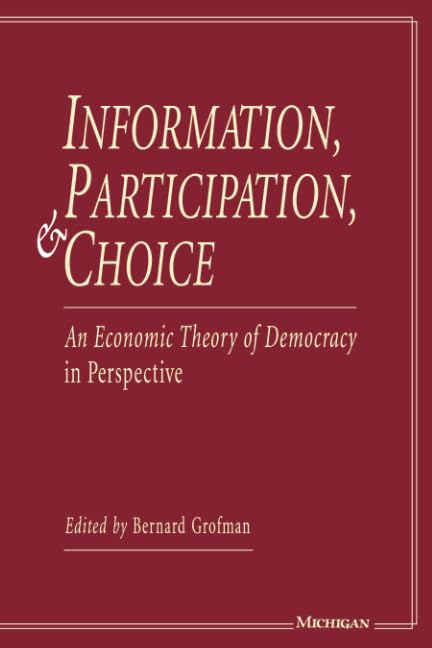
Information, Participation, and Choice - Perspective on Downs
Information, Participation, and Choice - Perspective on Downs
Price subject to change. Tap below for current.
Couldn't load pickup availability
In this review of Information, Participation, and Choice, Bernard Norman Grofman offers a thoughtful perspective on Anthony Downs's influential An Economic Theory of Democracy. The book is best for readers who want a scholarly tracing of how Downs's ideas about voter behavior, party competition, and political ignorance reshaped political science; the single biggest reason to read it is the clear map it draws from the 1957 original to decades of subsequent research in the United States and beyond. This review highlights its value as a critical, historically informed synthesis rather than a beginner primer.
Key Features
- Historical tracing: Follows Downs's 1957 arguments through later scholarship to show concrete intellectual influence on voters, candidates, and parties.
- Theoretical focus: Examines the contrast between a public-choice model and a traditional civic-minded model to clarify core debates in political science.
- Comparative reach: Considers research not only in the United States but also in other contexts, making the analysis useful for comparative students.
- Clarifies concepts: Revisits key phrases like tweedledum and tweedledee politics to explain how they have been used and critiqued since publication.
- Scholarly synthesis: Brings together threads of voter rationality, political ignorance, and nonparticipation in a single narrative useful for researchers.
Who It's For
This book is aimed at graduate students, scholars, and advanced undergraduates in political science, particularly those studying political behavior, party competition, or public-choice theory. It suits readers who already know Downs's original work and want a concise, critical account of its academic legacy.
Readers seeking a practical handbook for campaigning or a basic introduction to voting for a general audience should look elsewhere, since the emphasis here is on intellectual lineage and theoretical debate rather than prescriptive advice or introductory exposition.
Pros & Cons
Pros
- Provides a focused, scholarly tracing of Downs's influence, making complex debates accessible to specialists.
- Useful comparative perspective that extends beyond US politics, broadening its appeal to international scholars.
- Clear discussion of core concepts such as political ignorance and nonparticipation, useful for classroom discussion.
Cons
- The book is oriented toward readers familiar with the original 1957 work and related literature, so novices may find it dense.
Specifications
| Title | Information, Participation, and Choice: An Economic Theory of Democracy in Perspective |
| Author/Editor | Bernard Norman Grofman |
| Focus | Tracing influence of Anthony Downs's An Economic Theory of Democracy |
| Core topics | Voters, candidates, parties, political ignorance, nonparticipation |
| Geographic scope | United States and comparative contexts |
| Intended audience | Scholars, graduate students, advanced undergraduates |
Our Verdict
Information, Participation, and Choice is a valuable, concise synthesis for anyone studying the theoretical legacy of Downs; it offers good value for scholars who need a guided account of how ideas about rational voter behavior and party competition evolved. Those seeking an introductory primer or practical guidance on campaigning will not find this the right fit, but for academic readers it is a worthwhile, well-focused perspective.
Frequently Asked Questions
Does this book summarize Anthony Downs's original arguments?
It traces and interprets Downs's 1957 arguments rather than serving as a point-by-point summary of the original text.
Is this suitable for classroom use?
Yes, it works well as a companion reading for graduate seminars or upper-level courses that cover public-choice theory and the history of political science.
Is prior knowledge of political theory required?
Prior familiarity with Downs and basic concepts in political science will help readers get the most from the book.
Editor's Take
A concise, scholarly synthesis tracing Anthony Downs's influence on voter behavior and party competition; recommended for graduate students and researchers seeking a focused interpretation of post-1957 debates.

Recently viewed
Recently viewed products will appear here as customers browse the store.