

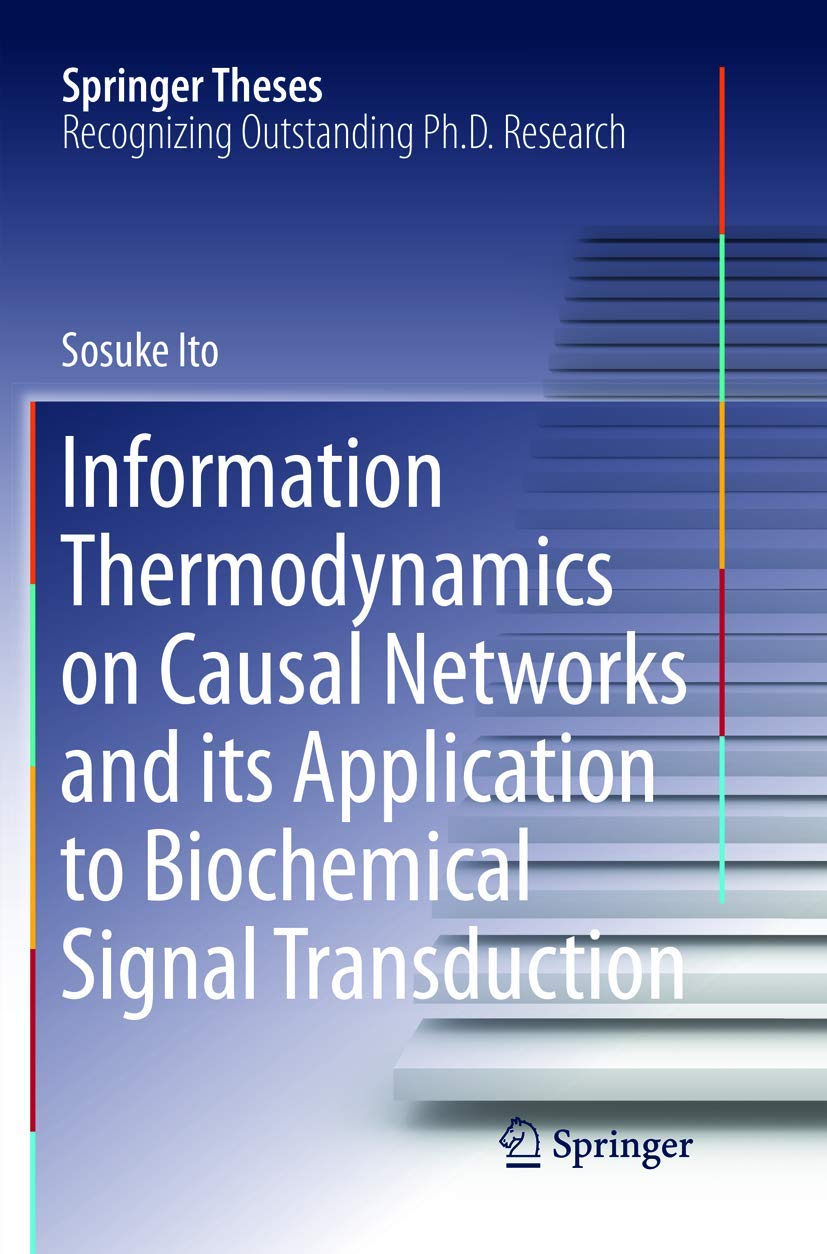
Information Thermodynamics on Causal Networks - Clear of Theory
Information Thermodynamics on Causal Networks - Clear of Theory
Price subject to change. Tap below for current.
Couldn't load pickup availability
In this review of Information Thermodynamics on Causal Networks and its Application to Biochemical Signal Transduction, the reviewer finds the book best suited for researchers and advanced students seeking a rigorous, formal treatment of nonequilibrium thermodynamics that explicitly incorporates information flows. The single biggest reason to buy is the book's clear generalization of stochastic thermodynamics using a graphical, causal-network approach, which makes it particularly valuable for those studying information transfer in fluctuating systems and biochemical signaling.
Key Features
- General formalism: Presents a unified framework for nonequilibrium thermodynamics that incorporates complex information flows among interacting stochastic systems.
- Graphical theory: Uses causal networks to express information relationships, making abstract information terms concrete and easier to track across system components.
- Generalized second law: Derives a novel extension of the second law of thermodynamics that accounts for information exchanges in a broad class of stochastic dynamics.
- Wide applicability: Applies the formalism to diverse cases such as interacting Brownian particles, autonomous biochemical reactions, and time-delayed feedback control.
- Research relevance: Frames results in a way that advances theoretical understanding of Maxwells demon scenarios and information-driven processes.
Who It's For
This book is ideal for theoretical physicists, computational biologists, and graduate students already comfortable with stochastic processes and thermodynamics who want a rigorous, mathematically driven treatment of information in nonequilibrium systems. It is also useful for researchers developing models of biochemical signal transduction where causal structure and information transfer are central concerns.
Beginners or readers seeking an introductory or highly applied lab manual should look elsewhere, because the text focuses on formal derivations and conceptual generalizations rather than step-by-step experimental protocols or elementary introductions to thermodynamics.
Pros & Cons
Pros
- Provides a clear, general formalism that integrates information with nonequilibrium thermodynamics for complex interacting systems.
- Graphical causal-network approach helps visualize and formalize information flows among components.
- Applies theory to several practical classes of dynamics, including biochemical reactions and time-delayed feedback.
- Advances theoretical understanding relevant to Maxwells demon and information-driven phenomena.
Cons
- The material is dense and assumes strong background in stochastic thermodynamics, making it less accessible to novices.
- The treatment is formal and conceptual, so readers seeking experimental protocols will need supplementary resources.
Specifications
| Title | Information Thermodynamics on Causal Networks |
| Subtitle | Its Application to Biochemical Signal Transduction (Springer Theses) |
| Author / Brand | Sosuke Ito |
| Scope | Nonequilibrium thermodynamics with information flows |
| Theoretical approach | Stochastic thermodynamics generalized via graphical causal networks |
| Applications discussed | Brownian particles, biochemical reactions, time-delayed feedback |
| Key result | Generalized second law including information terms |
Our Verdict
Information Thermodynamics on Causal Networks is a rigorous, conceptually rich work that is worth purchasing for advanced students and researchers focused on the intersection of information theory and nonequilibrium physics. Its graphical formulation and generalized second law provide long-term value for theoretical work on biochemical signaling and information-driven dynamics, though novices will need a solid prior background to make full use of the material.
Frequently Asked Questions
Does this book require advanced math background?
Yes. The text is formal and assumes familiarity with stochastic thermodynamics and probabilistic methods.
Is experimental lab guidance included?
No. The book focuses on theoretical formalism and conceptual applications rather than experimental protocols.
Can the methods be applied to biochemical signaling models?
Yes. The author explicitly applies the causal-network formalism to biochemical signal transduction and related stochastic dynamics.
Editor's Take
A rigorous, formally driven work valuable to advanced researchers studying information in nonequilibrium thermodynamics; its causal-network approach and generalized second law make it a strong reference despite being demanding for beginners.

Recently viewed
Recently viewed products will appear here as customers browse the store.