

Introduction To Practical Peridynamics - Practical Computational Guide
Introduction To Practical Peridynamics - Practical Computational Guide
Price subject to change. Tap below for current.
Couldn't load pickup availability
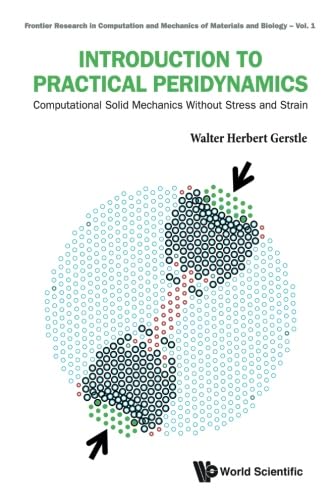
Our review of Introduction To Practical Peridynamics finds it a focused graduate-level textbook and working reference for engineers and researchers who need a computable alternative to classical continuum mechanics. The book's single biggest reason to buy is its practical, state-based peridynamic lattice model that is described with an emphasis on direct solvability on a computer, making it immediately useful for simulation of elasticity, damage, fracture, and large deformations. This review highlights who will benefit most and what to expect from Walter Herbert Gerstle's treatment.
Key Features
- Peridynamic lattice model: Presents a state-based lattice formulation that can be implemented directly on particle lattices for numerical solution without invoking stress and strain.
- Computable focus: Emphasizes models and methods that are directly solvable on a computer, reducing the gap between theory and practical simulation work.
- Applications to structural problems: Includes guidance for solving realistic structural engineering problems, with particular attention to reinforced concrete behavior under damage and fracture.
- Scope across material responses: Covers elasticity, plasticity, damage, fracture, and large deformations to support a wide range of solid mechanics problems.
- Theoretical foundation: Provides the necessary mathematical and historical background so readers can understand the conceptual departure from classical stress and strain.
Who It's For
This book is best for graduate students, computational mechanics researchers, and practicing structural engineers who want a practical, implementable introduction to peridynamics and a route to modeling fracture and damage without classical continuum constructs. It suits readers who already have some background in solid mechanics and numerical methods and who need a treatise that bridges theory and code-ready models.
Those looking for an introductory text to basic mechanics or a step-by-step programming tutorial for beginners may want a more elementary resource first. It is not a beginner's physics primer or a language-specific coding workbook; instead, it assumes comfort with mathematical formulation and computational simulation.
Pros & Cons
Pros
- Provides a directly solvable peridynamic model aimed at practical computation rather than abstract theory.
- Addresses a wide range of material responses, including fracture and damage, useful for structural engineering applications.
- Balances historical context with modern state-based formulation to explain why the approach departs from stress and strain.
Cons
- Not intended as a beginner's programming guide, so readers new to computational implementation may need supplementary coding resources.
Specifications
| Title | Introduction To Practical Peridynamics: Computational Solid Mechanics Without Stress And Strain |
| Author | Walter Herbert Gerstle |
| Subject | Peridynamics; computational solid mechanics |
| Scope | Elasticity, plasticity, damage, fracture, large deformations |
| Audience | Graduate students, researchers, structural engineers |
| Approach | State-based peridynamic lattice model, computable implementations |
Our Verdict
Introduction To Practical Peridynamics is a valuable, practical resource for readers who need a computable alternative to continuum stress-and-strain formulations. It is good value for advanced students and practitioners who want a treatise that leads directly to implementable models for damage and fracture analysis, though those seeking beginner-level coding tutorials should supplement it with programming materials.
Frequently Asked Questions
Does this book include implementation guidance?
The text emphasizes models that are directly solvable on a computer and guides practical use of the state-based lattice model, but it is not a step-by-step beginner coding manual.
What kinds of problems does it target?
It targets realistic structural engineering problems, particularly issues in reinforced concrete, covering elasticity, plasticity, damage, fracture, and large deformations.
Who should consider a different resource first?
Readers without a background in solid mechanics or numerical methods may prefer a more introductory mechanics or programming text before tackling this treatise.
Editor's Take
Introduction To Practical Peridynamics is a practical, graduate-level resource that presents a computable state-based lattice model for modeling elasticity, damage, and fracture; it is best for readers with prior mechanics and numerical background who need implementable simulation methods.

Recently viewed
Recently viewed products will appear here as customers browse the store.