

Introduction to the Physics of Electrons in Solids - Clear Historical
Introduction to the Physics of Electrons in Solids - Clear Historical
Price subject to change. Tap below for current.
Couldn't load pickup availability
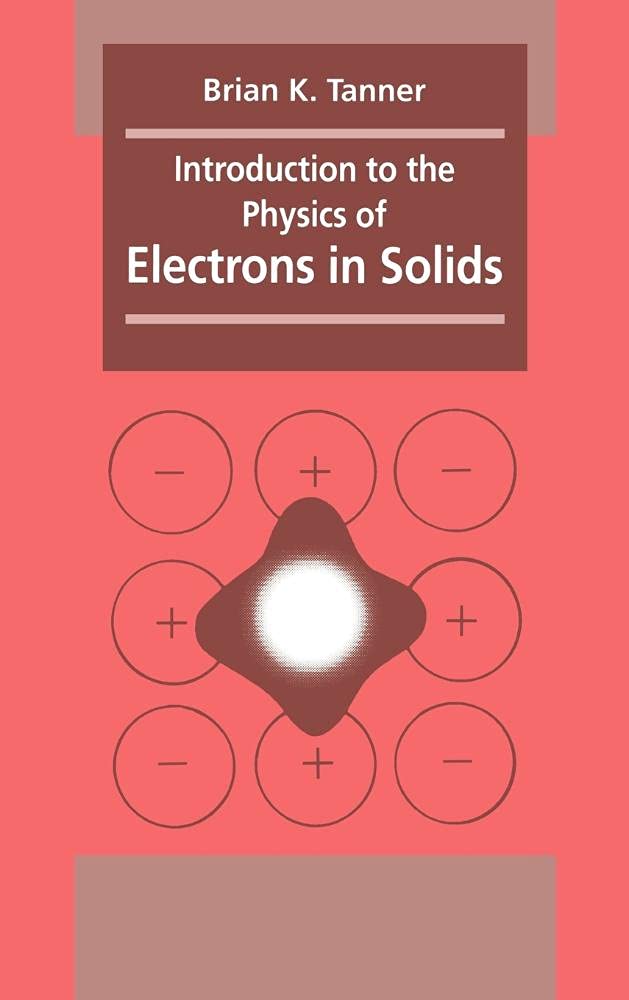
In this review of Introduction to the Physics of Electrons in Solids, the bottom line is that this upper-level text is best for physics students and self-directed readers who want a historically grounded, concept-first introduction to electronic behavior in materials. Professor Tanner avoids starting with heavy crystallography and instead builds understanding from the simplest free electron model, making the book a focused resource for learning how quantum mechanics explains conductivity, magnetism and superconductivity.
Key Features
- Simple-to-complex progression: The text starts with a free electron in a box and only adds complexity when needed, helping readers master fundamentals before confronting real-world complications.
- Historical narrative: Concepts are introduced through their historical development so readers see why each idea arose and how quantum mechanics became central to solid state physics.
- Quantum foundations: Emphasis on quantum mechanics gives a clear explanation of electronic properties and why classical pictures fail in solids.
- Collective phenomena coverage: The book examines consequences of collective electron behavior, including focused discussions on magnetism and superconductivity.
- Practice problems included: Examples and problems throughout provide opportunities to test understanding and apply the models introduced in each chapter.
Who It's For
Students in upper-level undergraduate or beginning graduate physics courses who want a conceptual pathway into solid state physics will find this book particularly useful. Its model-first approach suits readers who learn best by building from simple solvable cases to more realistic situations.
Those seeking an encyclopedic reference of crystallography or a handbook of experimental techniques should look elsewhere; this book deliberately minimizes early crystallographic detail to preserve a clear focus on electron behavior and quantum foundations.
Pros & Cons
Pros
- Clear pedagogical progression that helps readers internalize why quantum mechanics is required for solids.
- Readable historical approach that places ideas in context and motivates mathematical developments.
- Dedicated sections on magnetism and superconductivity tie single-particle models to collective phenomena.
Cons
- Not a substitute for a detailed crystallography or materials science reference, since those topics are de-emphasized.
Specifications
| Title | Introduction to the Physics of Electrons in Solids |
| Author | Brian K. Tanner |
| Level | Upper-level undergraduate / beginning graduate |
| Approach | Model-first; starts with free electron in a box |
| Key Topics | Quantum mechanics, magnetism, superconductivity, electron behavior |
| Includes | Examples and practice problems |
Our Verdict
Introduction to the Physics of Electrons in Solids is a focused, concept-driven text well suited to students who want to understand electronic behavior without being overwhelmed by early crystallography. Its historical framing and problem sets make it good value for readers seeking a clear, quantum-mechanical grounding in conductivity, magnetism and superconductivity.
Frequently Asked Questions
Is this book suitable for first-year undergraduates?
No. It is aimed at upper-level undergraduates or beginning graduate students familiar with basic quantum mechanics.
Does the book cover experimental techniques?
Not in depth; the book emphasizes models and theory rather than laboratory methods.
Are there exercises to practice?
Yes. The text includes examples and problems to reinforce concepts and calculations.
Editor's Take
A focused, concept-driven text that builds quantum-mechanical understanding from simple models to collective phenomena, ideal for upper-level students seeking clarity on electron behavior in solids.

Recently viewed
Recently viewed products will appear here as customers browse the store.