

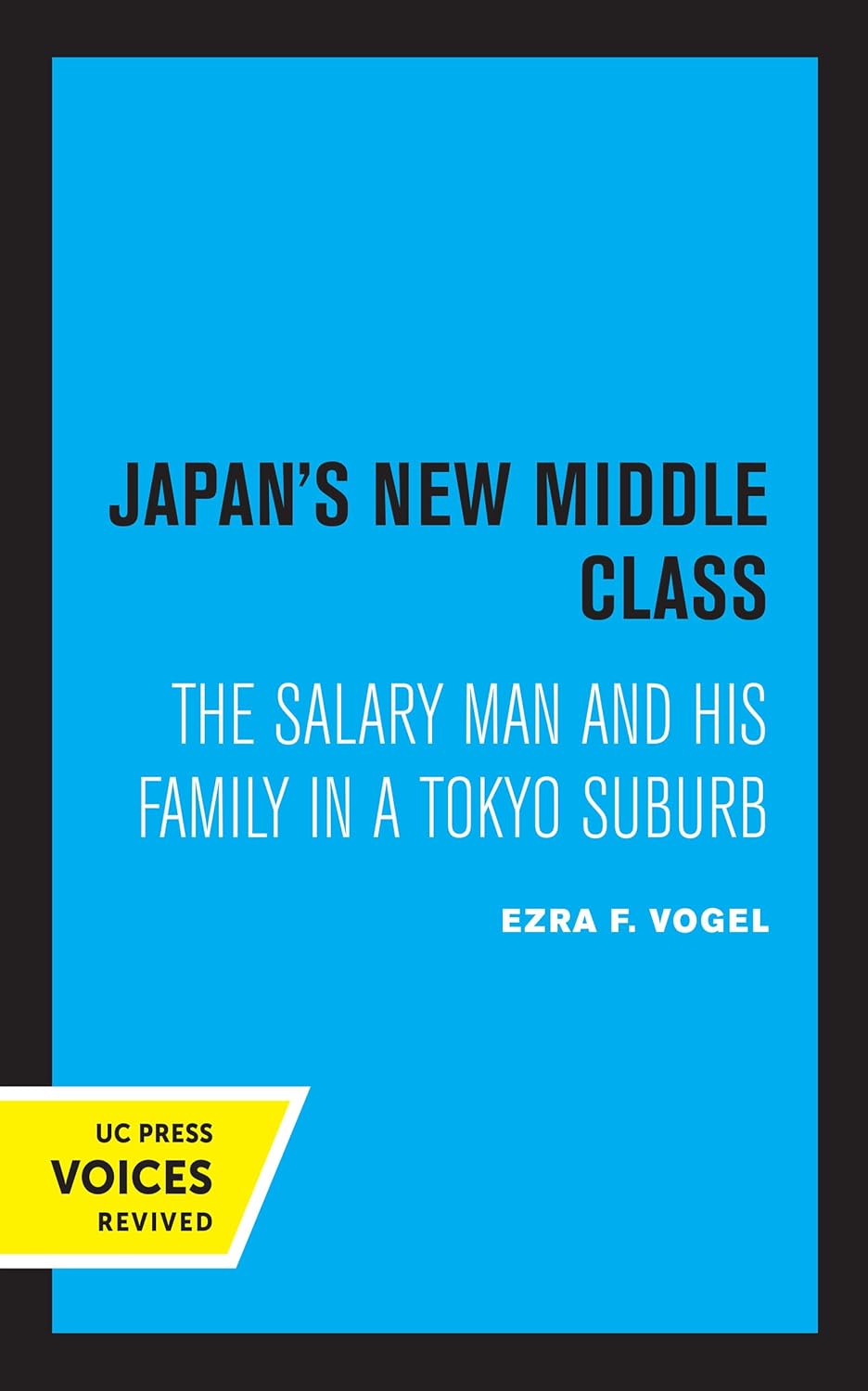
Japan's New Middle Class: The Salary Man and His Family
Japan's New Middle Class: The Salary Man and His Family
Price subject to change. Tap below for current.
Couldn't load pickup availability
In this review of Japan's New Middle Class: The Salary Man and His Family in a Tokyo Suburb, the bottom line is clear: this reissued classic offers a disciplined academic window into postwar Japanese urban life that remains valuable for students and general readers seeking historical social analysis. Ezra F. Vogel's study, originally published in 1963 and now available again through UC Press's Voices Revived program, is best bought for its thoughtful ethnographic detail and historical perspective rather than for contemporary policy prescriptions.
Key Features
- Historical ethnography: Detailed observations of a Tokyo suburb provide a grounded view of daily life and family structure in the early 1960s.
- Scholarly rigor: Peer-reviewed scholarship ensures the work reflects careful research and academic standards appropriate for courses and serious readers.
- Reprint accessibility: The Voices Revived print-on-demand edition makes a previously hard-to-find backlist title available again without altering the original text.
- Contextual insight: The book situates the salary man and his family within broader social and economic changes, useful for cultural and political studies.
- Compact focus: A concentrated case study of a Tokyo suburb allows readers to examine social patterns at a human scale rather than through abstract national statistics.
Who It's For
This edition is aimed at undergraduate and graduate students in anthropology, sociology, Asian studies, and history who need primary-source case studies on postwar urban Japan. It also suits general readers and librarians looking to fill gaps in classic social-science literature.
Readers seeking up-to-the-minute contemporary analysis of Japan's workforce should look elsewhere; this is a historical text and best used as a foundation for understanding mid-20th century transformations rather than as a guide to 21st century trends.
Pros & Cons
Pros
- Well-documented fieldwork gives concrete, relatable portraits of family life in a Tokyo suburb.
- The peer-reviewed academic quality makes it reliable for coursework and citations.
- The Voices Revived reprint restores access to an important backlist title for researchers and libraries.
Cons
- As a historical study from 1963, it cannot reflect recent social or economic developments in Japan.
Specifications
| Title | Japan's New Middle Class: The Salary Man and His Family in a Tokyo Suburb |
| Author | Ezra F. Vogel |
| Original publication | 1963 |
| Edition | Voices Revived print-on-demand reissue (UC Press backlist) |
| Subject areas | Anthropology, Cultural studies, Politics & Social Sciences |
Our Verdict
Japan's New Middle Class remains a worthwhile purchase for students and readers who need a primary historical case study of postwar Japanese urban life; its scholarly voice and restored availability make it good value for academic libraries and anyone building a foundational reading list in social sciences.
Frequently Asked Questions
Is this the original text or a revised edition?
This is a Voices Revived print-on-demand reissue that preserves the original 1963 text rather than offering a modern revision.
Who edited the reprint?
The reissue is part of University of California Press's Voices Revived program, which republishes backlist titles from the UC Press catalog using print-on-demand.
Is the book suitable for classroom use?
Yes. Its peer-reviewed scholarship and focused case study make it appropriate for undergraduate and graduate courses in anthropology, history, and Asian studies.
Editor's Take
A valuable reissue of a classic 1963 ethnography, this book is recommended for students and libraries as a foundational, peer-reviewed study of postwar Japanese urban family life.

Recently viewed
Recently viewed products will appear here as customers browse the store.