

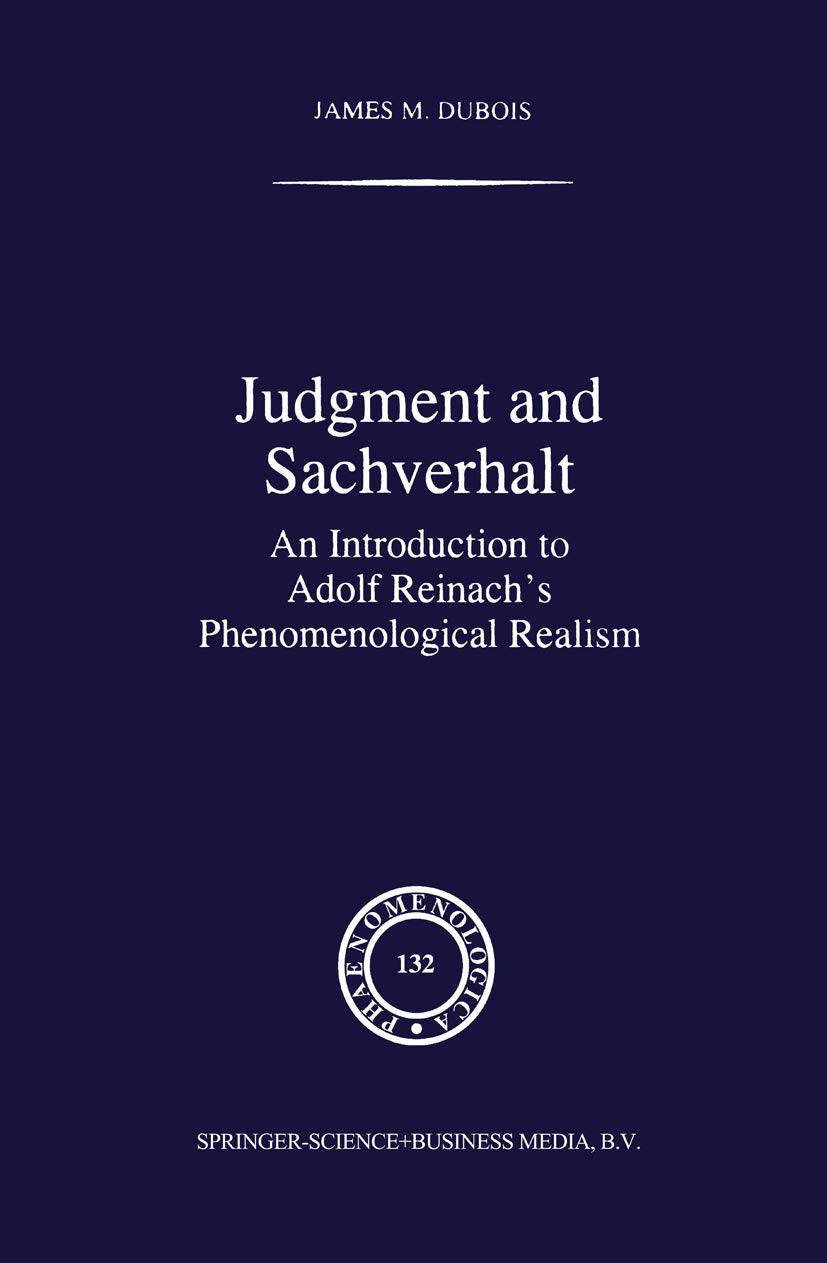
Judgment and Sachverhalt: An Introduction to Adolf Reinach's
Judgment and Sachverhalt: An Introduction to Adolf Reinach's
Price subject to change. Tap below for current.
Couldn't load pickup availability
Our review of Judgment and Sachverhalt explains why J.M. DuBois's study is essential reading for anyone exploring early 20th century phenomenology. The book reconstructs Adolf Reinach's attempt to ground a realist ontology and epistemology through close textual analysis and argumentation, making it most valuable for graduate students, scholars, and serious readers of phenomenology who want clear exposition rather than fragmentary primary texts. The single biggest reason to buy is the book's sustained case that Reinach's work-often neglected because of his early death-offers a coherent realist alternative to other phenomenological projects.
Key Features
- Comprehensive reconstruction: DuBois draws from numerous Reinach texts and the work of his students to present a continuous account of Reinach's thought, helping readers see the structure of his realist claims.
- Clarity of argument: The study emphasizes rigorous argumentation and phenomenological elucidation, making complex ideas accessible to readers already familiar with phenomenological terms.
- Historical context: Coverage of the Munich and G47ttingen circles and Reinach's relation to Husserl situates the philosophy within its intellectual milieu, aiding scholars of history of ideas.
- Comparative perspective: By engaging followers like Roman Ingarden and Dietrich von Hildebrand, the book shows how Reinach influenced later realist developments in phenomenology.
- Concise guidance: The author emphasizes the strongest evidence for Reinach's realism, giving readers a focused roadmap for further study rather than a voluminous commentary.
Who It's For
This book is aimed at graduate students, academic philosophers, and advanced undergraduates who have some grounding in Husserlian phenomenology and want a careful introduction to Reinach's realist program. Readers preparing seminars or research on the history of phenomenology will find DuBois's selection of texts and interpretive moves especially useful.
It is less suitable for casual readers or beginners with no previous exposure to phenomenological vocabulary; those readers should seek a more general introduction to phenomenology before tackling this focused historical and philosophical study.
Pros & Cons
Pros
- Provides a clear, sustained reconstruction of Reinach's realist ontology that clarifies his relation to Husserl.
- Draws on a wide set of sources, including work by Reinach's students, to support interpretive claims.
- Balances historical context with philosophical argument, useful for both historians and theorists.
- Concise and sharply argued rather than diffuse, aiding focused study.
Cons
- The book presumes familiarity with phenomenological concepts, which may challenge newcomers without prior background.
Specifications
| Title | Judgment and Sachverhalt: An Introduction to Adolf Reinach's Phenomenological Realism |
| Author | J.M. DuBois |
| Subject | Adolf Reinach, phenomenological realism, Husserlian circle |
| Focus | Reconstruction of Reinach's realist ontology and epistemology |
| Scope | Textual analysis and historical context from Munich and G47ttingen circles |
| Use | Graduate study, research, seminar reading |
Our Verdict
Judgment and Sachverhalt is a focused, well-argued introduction that makes a persuasive case for taking Adolf Reinach seriously as a realist phenomenologist. For readers with some background in Husserl and phenomenology, it offers clear value as both a historical study and a philosophical intervention; its clarity and selective emphasis make it a worthwhile purchase for scholars and students seeking a concise, rigorous guide to Reinach's thought.
Frequently Asked Questions
Does this book outline Reinach's main texts?
Yes. DuBois draws from numerous Reinach writings and related work by his students to reconstruct the core arguments and positions.
Is prior knowledge of phenomenology required?
Some familiarity with Husserlian concepts is helpful; newcomers may find the terminology demanding without an introductory text.
Who benefits most from this study?
Graduate students, researchers, and instructors in phenomenology or history of philosophy will gain the most from its focused reconstruction and argumentation.
Editor's Take
A focused and well-argued introduction that convincingly presents Adolf Reinach's realist phenomenology; best for readers with some background in Husserl and phenomenology.

Recently viewed
Recently viewed products will appear here as customers browse the store.