

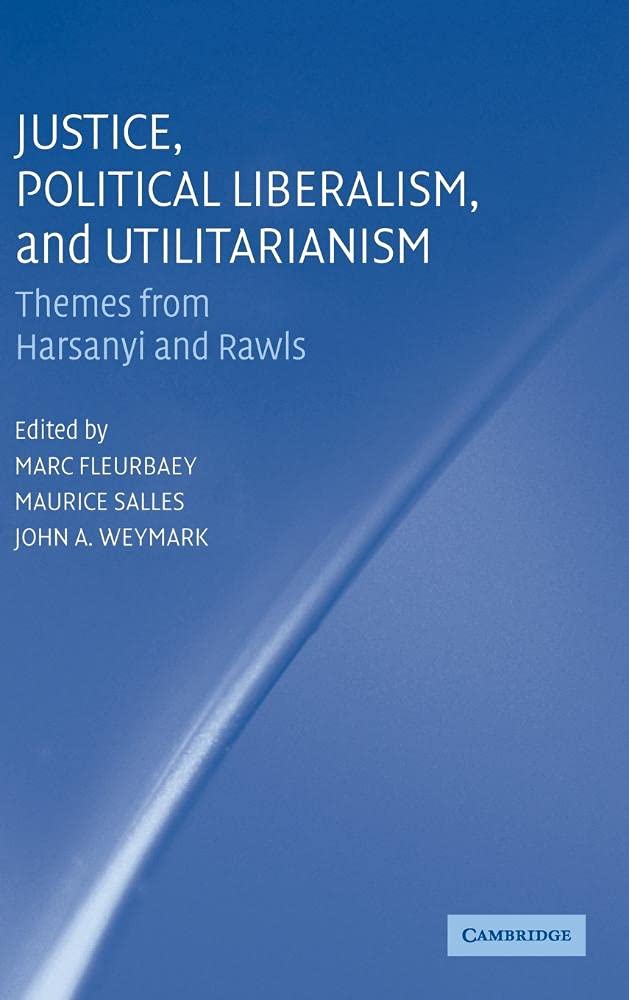
Justice, Political Liberalism, and Utilitarianism - Interdisciplinary
Justice, Political Liberalism, and Utilitarianism - Interdisciplinary
Price subject to change. Tap below for current.
Couldn't load pickup availability
In this review of Justice, Political Liberalism, and Utilitarianism the editors present a focused, interdisciplinary tribute to John Harsanyi and John Rawls that will appeal to scholars and advanced students exploring theories of social justice. The single biggest reason to read this volume is its comparative approach: contributors use the work of both Harsanyi and Rawls as springboards to extend debates about liberal egalitarianism and utilitarian evaluation, making the book valuable for anyone seeking nuanced theoretical dialogue rather than a simple summary of positions.
Key Features
- Interdisciplinary focus: Essays bring together perspectives from economics, philosophy, and political theory to illuminate how different disciplines treat questions of social justice.
- Comparative dialogue: Contributors explicitly compare Harsanyi's utilitarian reasoning with Rawls's liberal egalitarian framework, clarifying contrasts and complementarities.
- Theoretical depth: Several chapters probe familiar issues from new angles, offering rigorous arguments useful for researchers and advanced students.
- Scholarly tribute: The volume collects work aimed at honoring two influential figures in modern justice theory, preserving context for ongoing scholarly conversation.
- Point-of-departure essays: Some contributions use Harsanyi and Rawls as starting points for developing new evaluative theories of social justice, stimulating future research.
Who It's For
This book is best suited to academics, graduate students, and serious undergraduates in philosophy, political theory, and welfare economics who want a deep comparative examination of utilitarianism and liberal egalitarianism. It is also useful for researchers looking to position new normative arguments in relation to the well-known positions of Harsanyi and Rawls.
Readers seeking a brief introduction to either thinker or a light, popular account should look elsewhere, since the essays assume familiarity with core concepts in moral and political philosophy and do not simplify debates for a general audience.
Pros & Cons
Pros
- Thoughtful interdisciplinary essays clarify tensions between utilitarian and Rawlsian approaches to social justice.
- Several chapters develop original arguments that can serve as catalysts for future theoretical work.
- The volume honors two major figures while advancing substantive scholarly debate rather than offering mere homage.
Cons
- Not intended as an introductory text, so non-specialist readers may find some chapters dense and theoretical.
Specifications
| Title | Justice, Political Liberalism, and Utilitarianism |
| Editors/Authors | Marc Fleurbaey, Maurice Salles, John A. Weymark |
| Subject | Social justice; political liberalism; utilitarianism |
| Approach | Interdisciplinary essays in philosophy and economics |
| Audience | Scholars, graduate students, advanced undergraduates |
| Content focus | Comparative analysis of Harsanyi and Rawls, theory development |
Our Verdict
For readers with a strong background in political philosophy or welfare economics, this volume is a worthwhile investment: it offers rigorous, comparative essays that both honor Harsanyi and Rawls and push debates forward. The book delivers good value for scholars seeking substantive, theory-driven contributions rather than introductory exposition.
Frequently Asked Questions
Does this book compare Harsanyi and Rawls directly?
Yes; many contributors use the two thinkers as points of comparison to highlight contrasts and possible syntheses between utilitarian and liberal egalitarian positions.
Is the book suitable for classroom use?
It can be used in advanced seminars on political philosophy or welfare economics, though instructors should expect to supplement with introductory materials for less-prepared students.
Who edited the volume?
The collection is edited by Marc Fleurbaey, Maurice Salles, and John A. Weymark, who assemble interdisciplinary essays on justice theory.
Editor's Take
This interdisciplinary volume offers rigorous comparative essays on Harsanyi and Rawls, making it valuable for scholars and advanced students who want theory-driven progress in debates about social justice.

Recently viewed
Recently viewed products will appear here as customers browse the store.