

Karanapaddhati of Putumana Somayaji - Scholarly for Historians
Karanapaddhati of Putumana Somayaji - Scholarly for Historians
Price subject to change. Tap below for current.
Couldn't load pickup availability
Our review of Karanapaddhati of Putumana Somayaji finds it a focused, scholarly work best suited to readers interested in the history of Indian astronomy and the Kerala school of mathematics. This edition presents the text as a study of the paddhati or rationale behind computational manuals rather than a karana or recipe book, and that distinction is the single biggest reason to seek this volume: it explains the theoretical basis for the vakya system and how methods are chosen for producing a karana for a specific epoch.
Key Features
- Historical context: The book situates Karanapaddhati within the Kerala school, clarifying why the work likely dates to the 16th century and how it differs from typical karana manuals.
- Theoretical focus: It lays out the rationale for algorithm selection rather than presenting only computational recipes, which helps readers understand the logic behind traditional methods.
- Vakya system explained: The text demonstrates how true planetary longitudes can be obtained directly using vakyas, making complex calendrical computations more transparent.
- Audience-aware presentation: The book is explicitly addressed to manual makers rather than almanac makers, guiding readers toward its intended practical and theoretical uses.
- Academic value: Editors and translators provide enough context for readers to place the work within Indian astronomical tradition, aiding further research and comparison.
Who It's For
This edition will appeal to historians of science, mathematicians with a strong interest in historical algorithms, and graduate students studying South Asian astronomy who need a clear exposition of methodological foundations. It is especially useful for anyone researching the Kerala school and the development of computational shortcuts in premodern astronomy.
Readers who want a beginner's primer on basic astronomical computation or a modern step-by-step karana manual should look elsewhere; this book assumes some familiarity with traditional Indian astronomical terms and with the distinction between karana texts and theoretical paddhatis.
Pros & Cons
Pros
- Provides clear explanation of the paddhati concept, clarifying why algorithm choice matters for epoch-based manuals.
- Illuminates the vakya system and its practical application to planetary longitude computations.
- Places the work in historical context, offering valuable material for comparative study of the Kerala school.
Cons
- Not a step-by-step karana manual, so practitioners seeking ready-to-use computational tables may find it too theoretical.
Specifications
| Title | Karanapaddhati of Putumana Somayaji |
| Subject | History of Indian astronomy and mathematics |
| Focus | Theoretical paddhati for vakya-based computation |
| Tradition | Kerala school of astronomy |
| Probable date | 16th century |
| Intended reader | Manual makers and scholars |
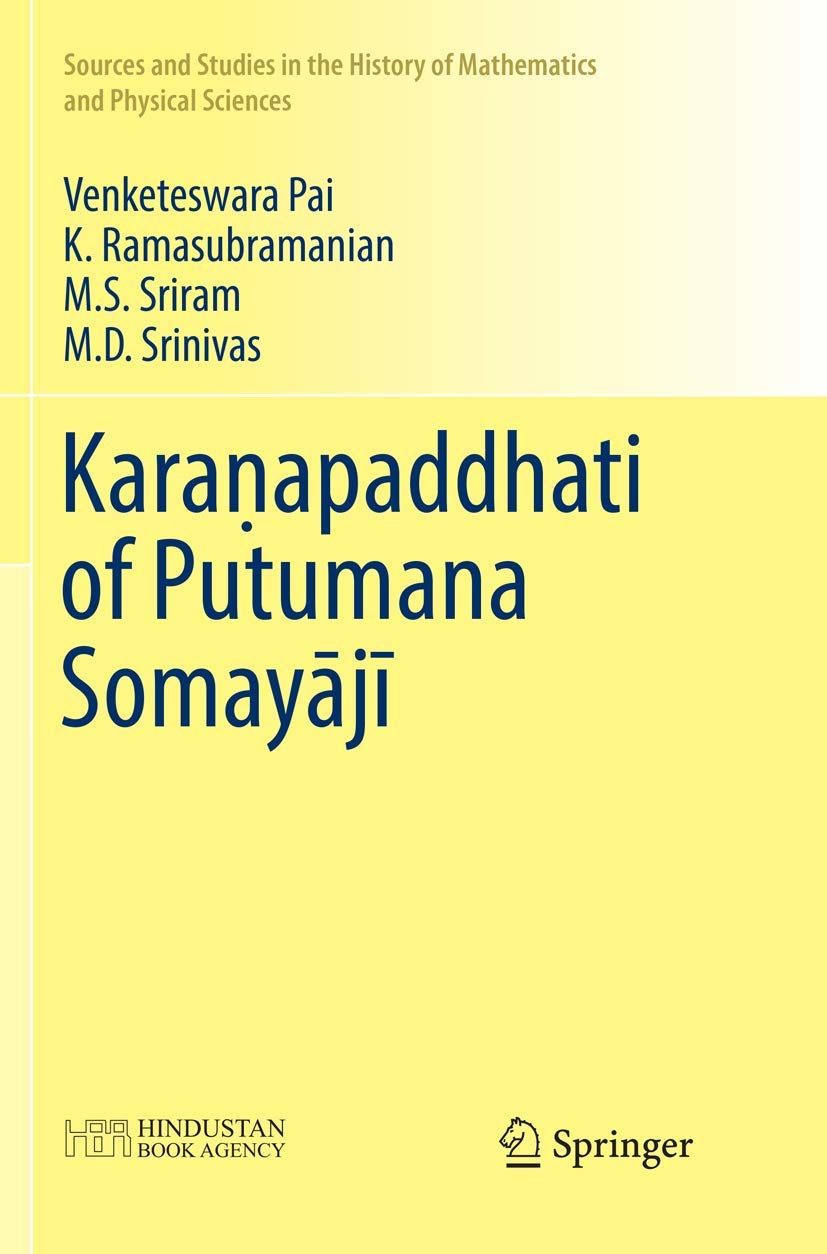
| Editors/Translators | Venketeswara Pai, K. Ramasubramanian, M.S. Sriram, M.D. Srinivas |
Our Verdict
Karanapaddhati is a strong academic resource for scholars and advanced students who want to understand the reasoning behind traditional Indian computational methods rather than a quickreference cookbook of formulas. Its value lies in making the vakya system and paddhati logic accessible, so those studying historical algorithms will find it excellent value.
Frequently Asked Questions
Is this a practical karana handbook?
This work is not a karana text; it explains the theoretical rationale for choosing algorithms used in karana manuals.
What period does the text represent?
The work is associated with the Kerala school and is probably composed in the 16th century.
Who prepared this edition?
The edition lists Venketeswara Pai, K. Ramasubramanian, M.S. Sriram, and M.D. Srinivas as editors or contributors.
Editor's Take
Karanapaddhati is a focused scholarly resource that explains the paddhati and the vakya system, making it valuable for historians and advanced students of Indian astronomy who want the theoretical basis behind computational manuals.

Recently viewed
Recently viewed products will appear here as customers browse the store.