

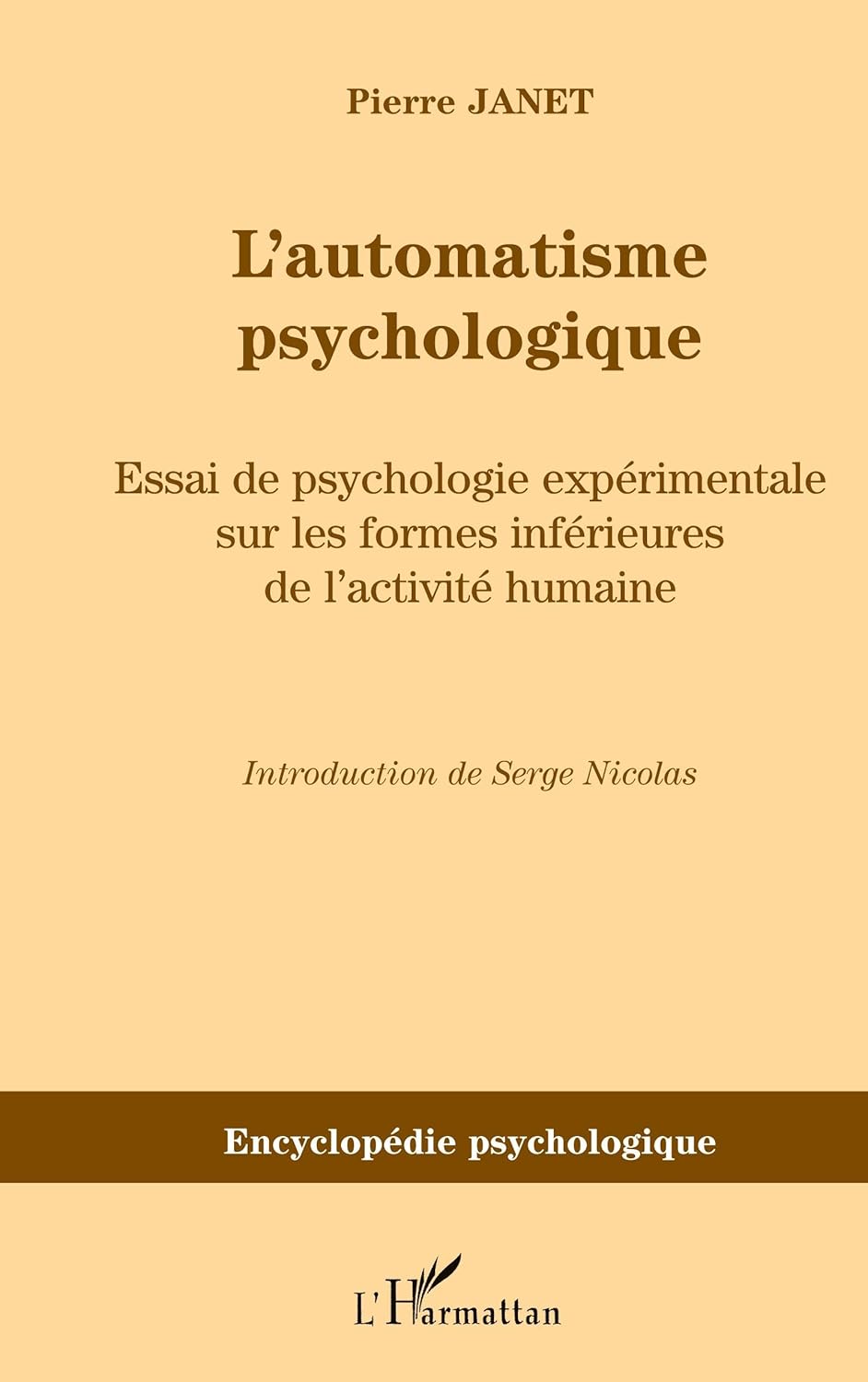
L'automatisme psychologique: Essai de psychologie experimentale
L'automatisme psychologique: Essai de psychologie experimentale
Price subject to change. Tap below for current.
Couldn't load pickup availability
In this review of L'automatisme psychologique, the reviewer finds Pierre Janet's 1889 essay essential for readers interested in the historical foundations of clinical psychology and the study of automatic mental processes. The book contrasts two fundamental activities of the mind, the activity of synthesis and the conservative activity, and explains how their balance governs mental health; this focus makes the volume valuable for scholars, clinicians curious about historical theory, and advanced students seeking primary sources. Our review highlights the clear argument about how everyday automatic acts become pathological when they dominate consciousness.
Key Features
- Historical theory: Presents Pierre Janet's distinction between consciousness and automatism, clarifying a foundational debate in experimental psychology.
- Clinical relevance: Explores how imbalance between synthesis and automatism relates to disorders, useful for understanding early clinical approaches.
- Concise argument: Focuses on a limited set of concepts so readers can follow Janet's reasoning without extraneous material.
- Primary source value: Serves as a direct look at late 19th-century psychological thought for researchers and historians.
- French edition: Preserves the original language and phrasing, important for accurate interpretation of Janet's terms.
Who It's For
This work is best suited to advanced students of psychology, historians of science, and clinicians with an interest in the origins of concepts like automaticity and dissociation. Those studying the intellectual history of psychiatry will find Janet's framing of automatic processes and their clinical consequences particularly instructive.
Readers looking for a modern textbook, step-by-step clinical manual, or translated, contemporary commentary should look elsewhere; the essay is a historical primary text and assumes familiarity with older scientific language and clinical concepts.
Pros & Cons
Pros
- Provides a clear, early formulation of the distinction between consciousness and automatism that influenced later theories in psychology.
- Valuable as a primary historical text for research and teaching in psychological history.
- The focused scope makes the central thesis accessible to readers prepared for classical scientific prose.
Cons
- The language and clinical framing are dated, so contemporary readers may need supplemental modern interpretation.
Specifications
| Title | L'automatisme psychologique: Essai de psychologie experimentale |
| Author | Pierre Janet |
| Original year | 1889 |
| Language | French |
| Primary topics | Consciousness, automatism, experimental psychology |
| Audience | Scholars, clinicians, advanced students |
Our Verdict
Janet's essay is a compact but influential historical work that belongs in the library of anyone studying the roots of clinical and experimental psychology. It offers good value as a primary source for researchers and teachers, though contemporary readers should pair it with modern commentary to translate older terminology into current clinical use.
Frequently Asked Questions
Is this work a modern textbook?
Answer. No, it is a late 19th-century primary essay focused on theoretical and clinical ideas of its time.
What language is the edition in?
Answer. This edition is in French, preserving Janet's original wording and nuance.
Who benefits most from reading it?
Answer. Historians of psychology, clinicians interested in theoretical origins, and advanced students will get the most from this text.
Editor's Take
Janet's 1889 essay offers a concise, influential account of consciousness versus automatism and is valuable as a primary historical text for scholars and clinicians, though modern commentary is recommended.

Recently viewed
Recently viewed products will appear here as customers browse the store.