

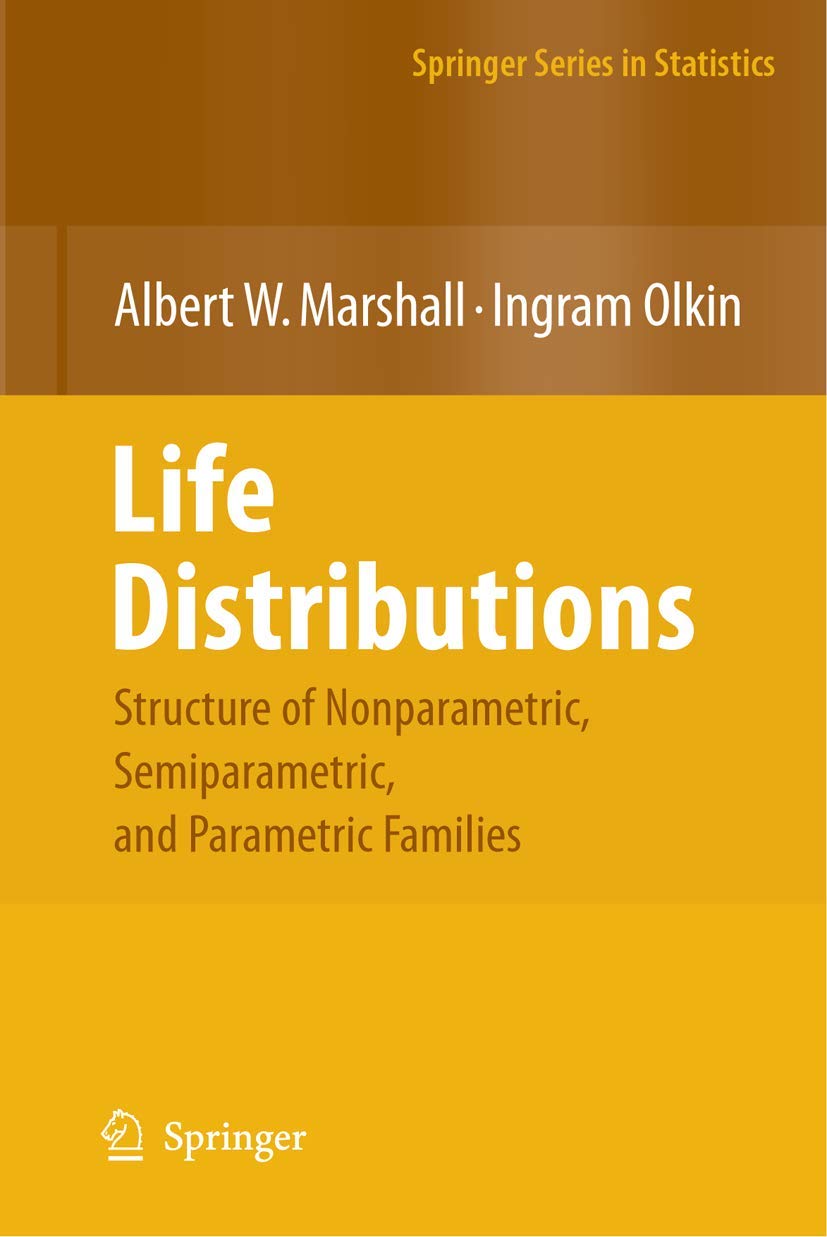
Life Distributions: Structure of Nonparametric, Semiparametric
Life Distributions: Structure of Nonparametric, Semiparametric
Price subject to change. Tap below for current.
Couldn't load pickup availability
In this review of Life Distributions: Structure of Nonparametric, Semiparametric, and Parametric Families, the reviewer finds a rigorous, methodical treatment best suited for statisticians and advanced applied researchers. The book's single biggest reason to buy is its unified approach to introducing and classifying distribution families, which clarifies how parameters shape model behavior and supports more intelligent model selection in practice. Readers seeking a practitioner's guide to the structure and relationships among nonparametric, semiparametric and parametric families will find substantial value here.
Key Features
- Comprehensive coverage: The book surveys a wide variety of distribution families, both well known and lesser known, giving readers a broad map of available model choices.
- Unified methodology: A developed methodological approach explains how parameters are introduced into families, helping users understand the implications of model choices.
- Focus on structure: Emphasis on relationships and origins of families aids in recognizing commonalities and derivations between models.
- Practical orientation: Results and clarifications about parameter properties provide tools for intelligent selection of models for data analysis.
- Scholarly depth: Presented as part of a statistics series, the text is detailed and suitable for advanced study or reference in research contexts.
Who It's For
The book is aimed primarily at statisticians, applied mathematicians, and advanced graduate students who need a rigorous foundation in distribution families for research or complex data analysis. Its emphasis on structures and parameter roles makes it particularly useful for those developing new models or comparing families across applications.
Practitioners who need quick, cookbook-style model recipes or introductory-level primers should look elsewhere, as the material assumes familiarity with statistical theory and is written at a scholarly level rather than as a casual tutorial.
Pros & Cons
Pros
- Extensive discussion of many families helps readers spot connections that are often omitted in shorter references.
- The unified methodological approach makes it easier to understand how parameters influence distribution behavior.
- Useful as a reference for researchers needing to justify model choices or explore less common families.
Cons
- The book's depth and scholarly tone make it less approachable for casual learners or those without a solid theoretical background.
Specifications
| Title | Life Distributions: Structure of Nonparametric, Semiparametric, and Parametric Families |
| Series | Springer Series in Statistics |
| Author | Albert W. Marshall |
| Scope | Nonparametric, semiparametric and parametric distribution families |
| Focus | Relationships, origins and structures of distribution families |
| Intended audience | Statisticians, advanced students, applied researchers |
Our Verdict
Life Distributions is a strong, academically rigorous resource for anyone who needs a deep understanding of distribution family structure and parameter effects. It is good value for researchers and advanced practitioners because it consolidates broad material into a coherent methodological framework that supports informed model selection and further development.
Frequently Asked Questions
Is this book suitable for beginners?
It is not ideal for beginners; the text assumes a solid background in statistical theory and is aimed at advanced students and researchers.
Does it cover practical model selection guidance?
Yes, it provides methodological tools and clarifications about parameter properties that support intelligent model choice, though it is theoretical rather than a step-by-step primer.
Who is the author and series publisher?
The book is authored by Albert W. Marshall and appears in the Springer Series in Statistics.
Editor's Take
A rigorous, methodical resource that consolidates nonparametric, semiparametric and parametric distribution families into a unified framework; best for statisticians and advanced researchers who need a deep, scholarly reference on how parameters shape model behavior.

Recently viewed
Recently viewed products will appear here as customers browse the store.