

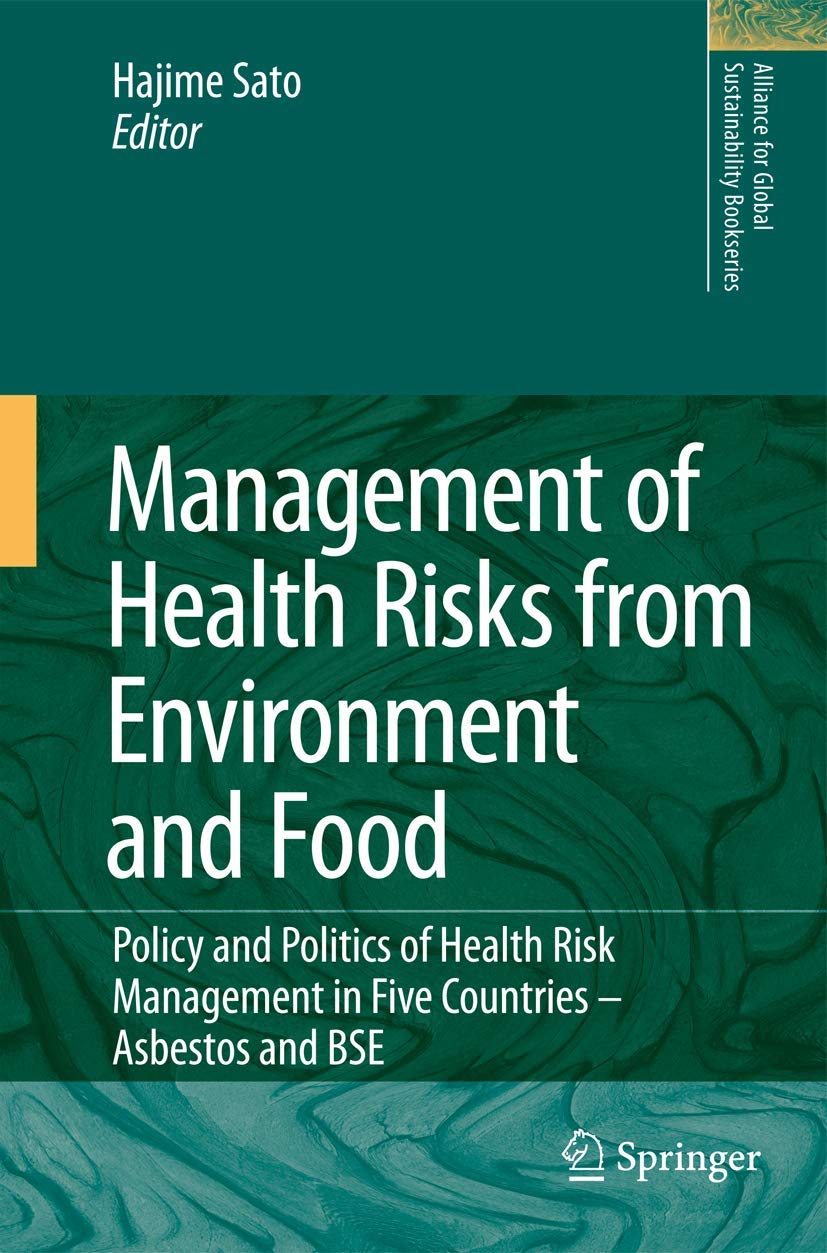
Management of Health Risks from Environment and Food - Policy
Management of Health Risks from Environment and Food - Policy
Price subject to change. Tap below for current.
Couldn't load pickup availability
In this review of Management of Health Risks from Environment and Food, Hajime Sato presents a careful comparative study of two contested public health topics that remain relevant to policy makers, scholars and health professionals. The book's single biggest reason to buy is its disciplined political science approach to how societies handled asbestos and BSE/CJD, making it a practical reference for anyone interested in how agendas form and how safety and reassurance are pursued. This review assesses clarity, scope and usefulness for research and policy work.
Key Features
- Comparative framework: Uses political science analytical frameworks to explain how health risks like asbestos and BSE/CJD emerged and were prioritized across countries.
- Case study depth: Presents detailed national case studies from Japan, the UK, France, the USA and Korea to show how different systems chose policy alternatives.
- Policy focus: Traces how agendas were set and policies implemented, offering concrete lessons for policymakers and public health officials.
- Focus on public reassurance: Explores the interaction of safety measures and public communication efforts to understand successes and failures.
- Cross-national lessons: Highlights transferable elements and contrasts that help scholars generalize about governance of environmental and food risks.
Who It's For
This book is best suited to graduate students, public health researchers and policy analysts who need a structured, comparative account of how environmental and food risks are governed. Practitioners in government and health agencies will also find the attention to agenda setting and policy implementation particularly useful.
Readers seeking a clinical or laboratory primer on asbestos pathology or prion biology should look elsewhere; this volume emphasizes political analysis and policy outcomes rather than medical diagnostics or treatment protocols.
Pros & Cons
Pros
- Provides a clear comparative methodology that helps explain divergent national responses.
- Case studies from five countries give breadth and useful contrasts for cross-national learning.
- Focus on both environmental and food-borne risks offers a rare paired treatment of asbestos and BSE/CJD in one volume.
- Emphasizes practical policy lessons about safety and public reassurance that are relevant today.
Cons
- Not a technical medical text, so those wanting clinical detail on CJD pathology or asbestos pathogenesis will need a different reference.
Specifications
| Title | Management of Health Risks from Environment and Food |
| Subtitle | Policy and Politics of Health Risk Management in Five Countries |
| Author / Editor | Hajime Sato |
| Topics covered | Asbestos, Bovine Spongiform Encephalitis (BSE), Creutzfeldt-Jakob Disease (CJD) |
| Countries studied | Japan, United Kingdom, France, United States, Korea |
| Approach | Comparative political science case studies |
Our Verdict
Management of Health Risks from Environment and Food is a focused, well-constructed comparative study that is worth acquiring for policy researchers and public health professionals who want evidence-based insight into how difficult health risks are managed. It offers good value for those seeking lessons on agenda setting, policy choice and public reassurance across multiple national contexts.
Frequently Asked Questions
Does this book explain the science behind BSE and CJD?
The book emphasizes policy and political analysis rather than detailed biomedical mechanisms; basic scientific context is provided but not in depth.
Which countries are compared in the case studies?
Case studies examine Japan, the UK, France, the USA and Korea to highlight cross-national differences in policy responses.
Is this suitable for policymakers?
Yes, the book is written with a focus on agenda setting and implementation, making it useful for policymakers and public health officials.
Editor's Take
A focused comparative study offering practical lessons on how five countries managed asbestos and BSE/CJD risks; recommended for policy researchers and public health professionals seeking evidence-based governance insights.

Recently viewed
Recently viewed products will appear here as customers browse the store.