

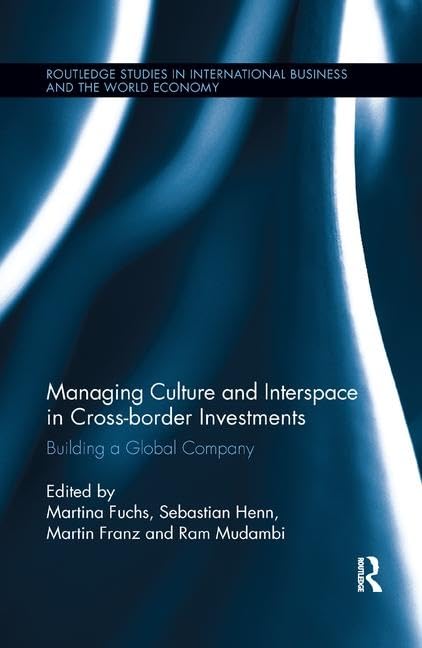
Managing Culture and Interspace in Cross-border Investments
Managing Culture and Interspace in Cross-border Investments
Price subject to change. Tap below for current.
Couldn't load pickup availability
In this review of Managing Culture and Interspace in Cross-border Investments the authors examine how organisational and cultural distances shape cross-border deals and regional outcomes. This book is for graduate students, researchers and practitioners who need a rigorous, conceptually rich account of how M&A and greenfield investments confront local contexts and contested terrains. The single biggest reason to read it is its focus on the dialectic between spatio-organisational gaps and regional learning processes, which offers a sustained framework for understanding why cross-border investments succeed or struggle.
Key Features
- Focus on interspatial investments: Explains how mergers & acquisitions and greenfield investments are shaped by organisational and cultural otherness, helping readers recognise project-specific tensions.
- Dialectical framework: Presents a theoretical lens linking spatio-organisational gaps to local contexts, useful for framing empirical research or case analysis.
- Regional learning emphasis: Shows how contested terrain triggers learning among both firms and regional actors, clarifying dynamics of adaptation and capability building.
- Context sensitivity: Emphasises economic, political and socio-cultural linkages that attract cross-border investment and support market success.
- Cross-disciplinary relevance: Offers insights valuable to international business, economic geography and corporate strategists seeking to integrate culture with investment strategy.
Who It's For
This book suits doctoral students and academic researchers who need a focused theoretical treatment of how cultural and organisational distances interact with local regional structures in cross-border transactions. It is also valuable for corporate strategists and policymakers who want to understand the broader conditions that influence the success of foreign direct investment and M&A.
Readers looking for a practical how-to manual, step-by-step deal checklists or transaction templates should look elsewhere, since the book emphasises conceptual analysis and regional learning rather than transactional process details.
Pros & Cons
Pros
- Provides a clear theoretical account of spatio-organisational gaps that advances understanding of cross-border investments.
- Highlights the role of local economic, political and socio-cultural linkages in shaping investment outcomes.
- Usefully frames learning processes for both firms and regional actors within contested terrains.
Cons
- The book is conceptually dense and does not provide practical, stepwise implementation guidance for dealmakers.
Specifications
| Title | Managing Culture and Interspace in Cross-border Investments |
| Series | Routledge Studies in International Business and the World Economy |
| Authors / Editors | Martina Fuchs, Sebastian Henn, Martin Franz, Ram Mudambi |
| Scope | Cross-border investments, M&A, greenfield investments and regional contexts |
| Key themes | Spatio-organisational gaps, cultural otherness, regional learning |
| Audience | Researchers, graduate students, policymakers, corporate strategists |
Our Verdict
Managing Culture and Interspace in Cross-border Investments is a strong, theory-driven contribution for readers who need to connect cultural distance and organisational structure to regional investment outcomes. It offers good value for academics and strategy professionals seeking a conceptual foundation for studying M&A and greenfield investments, though practitioners seeking tactical checklists may find it less directly actionable.
Frequently Asked Questions
Does this book cover both M&A and greenfield investments?
Yes, it explicitly discusses interspatial investments including mergers & acquisitions and greenfield investments and how they relate to local contexts.
Who are the primary authors or editors?
The work is by Martina Fuchs, Sebastian Henn, Martin Franz and Ram Mudambi, presented within the Routledge Studies in International Business and the World Economy series.
Is the book practical for dealmakers?
It is primarily conceptual and analytical, so it is more useful for understanding dynamics and frameworks than for hands-on transactional checklists.
Editor's Take
A theory-driven, conceptually rich analysis useful for researchers and strategy professionals who need to link cultural distance and organisational gaps to cross-border investment outcomes; less suited to readers seeking practical transaction checklists.

Recently viewed
Recently viewed products will appear here as customers browse the store.