

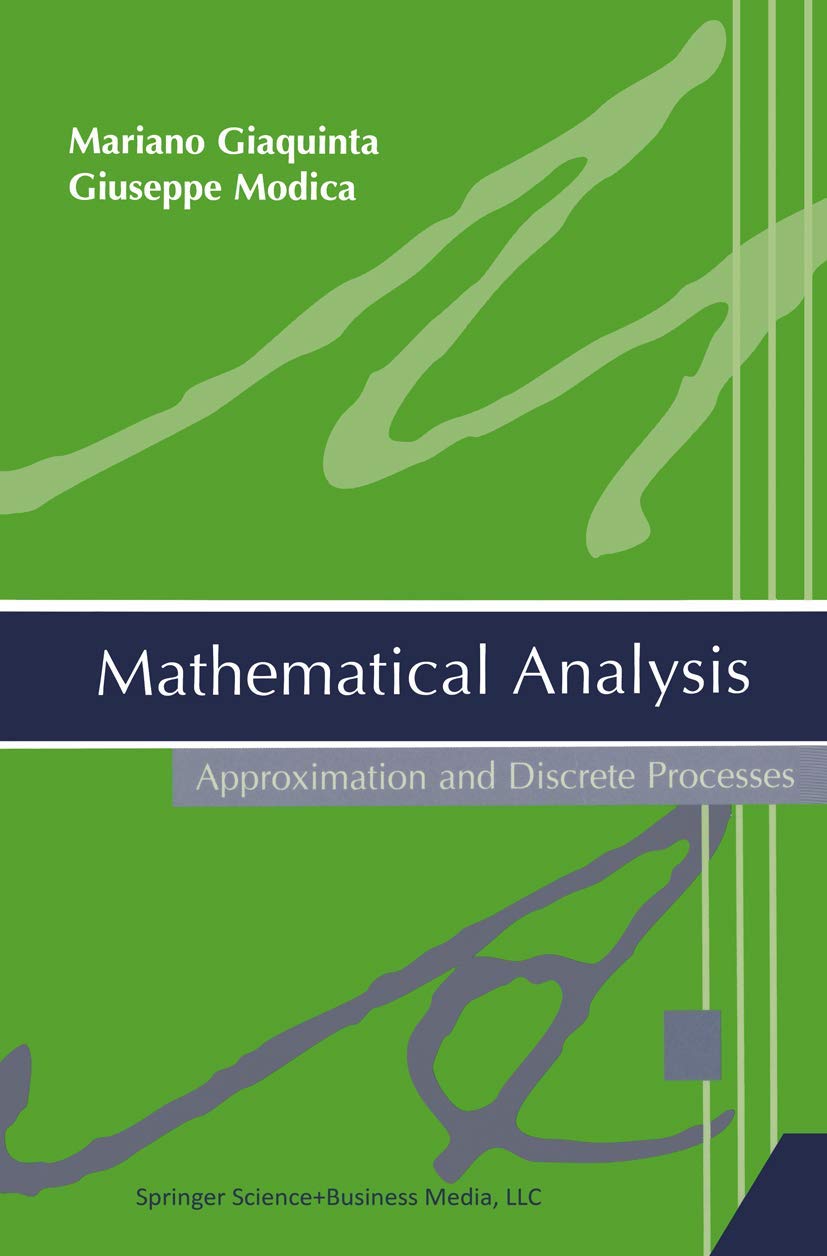
Mathematical Analysis - Introductory Volume on Discrete Processes
Mathematical Analysis - Introductory Volume on Discrete Processes
Price subject to change. Tap below for current.
Couldn't load pickup availability
In this review of Mathematical Analysis, the reviewer finds a focused academic volume aimed at students and researchers who need a clear entry to discrete processes and their relation to classical calculus. The book's single biggest reason to buy is its structured approach to sequences, combinatorial calculus, and the role of integers and complex numbers within approximation methods, making it especially useful for readers who will apply numerical thinking or use computers in mathematical work.
Key Features
- Clear focus on discrete processes: The text emphasizes sequences and discrete viewpoints that help readers rethink limits and continuity from a computational perspective.
- Foundational number systems: Early chapters review the real numbers, integers as a subset of the reals, and complex numbers to ground later discussion in familiar algebraic systems.
- Combinatorial calculus coverage: The book introduces elements of combinatorial methods that support discrete approximations and counting techniques used in applied problems.
- Introductory treatment of infinity: The authors present mathematical notions of infinity in an accessible way to connect discrete reasoning with classical analysis concepts.
- Structured two-part layout: Division into parts and chapters gives a readable progression from number systems through sequences to combinatorial tools and complex numbers.
Who It's For
Mathematical Analysis is best for undergraduate students in mathematics or related fields, beginning graduate students, and practitioners who need a concise, mathematically rigorous introduction to discrete approaches and numerical thinking. It suits readers preparing to use computers or numerical methods alongside classical analysis.
Those seeking an exhaustive textbook on measure theory, advanced functional analysis, or detailed numerical algorithms should look elsewhere; the volume is introductory and oriented to concepts rather than exhaustive algorithmic implementation.
Pros & Cons
Pros
- Focused exposition on sequences and discrete viewpoints that clarifies limits and continuity for computational work.
- Solid grounding in number systems helps readers connect integers, reals, and complex numbers with applied problems.
- Inclusion of combinatorial calculus and a discussion of infinity gives useful conceptual tools for approximation processes.
Cons
- Not a comprehensive numerical methods manual, so readers needing algorithmic detail or extensive examples may find it too concise.
Specifications
| Title | Mathematical Analysis |
| Authors | Mariano Giaquinta, Giuseppe Modica |
| Scope | Introduction to discrete processes and approximation ideas |
| Key topics | Real and complex numbers, integers, sequences, combinatorial calculus, infinity |
| Structure | Two-part volume with chapters on sequences and complex numbers |
| Audience | Undergraduates, beginning graduates, applied mathematicians |
Our Verdict
Mathematical Analysis is a concise, thoughtful introduction to discrete processes and their place within classical analysis; it is good value for students and researchers who need conceptual clarity about sequences, number systems, and combinatorial tools rather than exhaustive numerical algorithms.
Frequently Asked Questions
Does this book cover complex numbers?
Yes. One chapter is dedicated to introducing complex numbers and their role in the presented material.
Is it suitable for computer-based numerical work?
It frames discrete processes in a way that supports computational thinking, though it is not a hands-on coding or algorithm manual.
Who will benefit most from this volume?
Undergraduate students and beginning graduate students studying analysis or applied mathematics will gain the most from its focused approach.
Editor's Take
Mathematical Analysis is a concise, focused introduction to discrete processes, sequences, and number systems, well suited to students and researchers seeking conceptual clarity rather than exhaustive numerical algorithms.

Recently viewed
Recently viewed products will appear here as customers browse the store.