

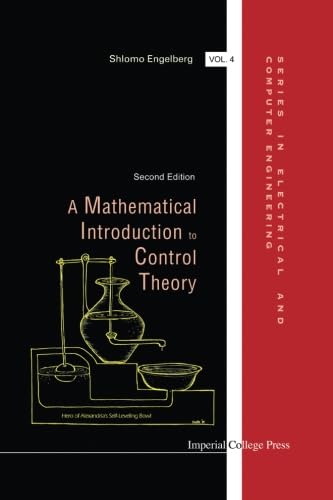
Mathematical Introduction To Control Theory, A (Second Edition)
Mathematical Introduction To Control Theory, A (Second Edition)
Price subject to change. Tap below for current.
Couldn't load pickup availability
Our review of A Mathematical Introduction To Control Theory (Second Edition) finds it best suited for students and practitioners who want a rigorous, mathematically grounded course text rather than a quick applied primer. The book's biggest strength is its systematic, theorem-driven presentation of both classical and modern control topics, making it especially valuable to graduate students, mathematicians and engineers who already know complex variables and differential equations. This review highlights how the balance of frequency-domain, time-domain and nonlinear material, plus Matlab orientation, supports learning across several levels.
Key Features
- Balanced coverage: Treats classical frequency-domain topics such as Routh-Hurwitz, Nyquist and Bode alongside modern time-domain control, giving readers a coherent progression from stability tests to state-space design.
- Mathematical rigor: Presents control theory in a systematic, theorem-based way so readers gain a solid conceptual foundation rather than only heuristic rules.
- Nonlinear and hybrid systems: Includes material on nonlinear control and hybrid systems that extends the book's usefulness beyond linear, time-invariant models.
- Matlab integration: Uses Matlab to illustrate concepts and computations, helping readers bridge analytic results with numerical experiments.
- Aimed at both mathematicians and engineers: Written to serve readers from different backgrounds by relying on mathematical prerequisites and engineering examples in parallel.
Who It's For
The book is ideal for upper-level undergraduates, graduate students, and researchers who want a rigorous introduction to control theory that emphasizes proofs and formal methods. It works well as a primary text for a one- or two-semester course where students are expected to supply background in complex variables, differential equations and basic algebra.
Those seeking an introductory, hands-on lab manual or a casual primer on control engineering may prefer a more application-first text; this edition assumes mathematical maturity and is not aimed at readers without the listed prerequisites.
Pros & Cons
Pros
- Comprehensive treatment of classical and modern topics that supports a deep understanding of control theory.
- Clear mathematical presentation that benefits readers who value rigor and formal proofs.
- Includes Matlab examples that make theory accessible through computation and simulation.
- Covers nonlinear and hybrid systems, broadening the book's scope beyond linear analysis.
Cons
- Requires prior knowledge of complex variables and differential equations, which limits use as a first exposure for beginners.
Specifications
| Title | Mathematical Introduction To Control Theory, A (Second Edition) |
| Author | Shlomo Engelberg |
| Edition | Second Edition |
| Scope | Classical, modern and nonlinear control; hybrid systems |
| Approach | Frequency-domain and time-domain with Matlab examples |
| Intended audience | Undergraduate and graduate students, mathematicians and engineers |
Our Verdict
For readers with the required mathematical background, this second edition is a high-value, rigorous introduction to control theory that combines classical topics and modern state-space methods with nonlinear and hybrid system material. Its Matlab orientation and theorem-driven approach make it a durable course text and reference for students and engineers who want more than an applied handbook.
Frequently Asked Questions
Does this book include practical computing examples?
Yes. The text uses Matlab to illustrate computations and simulations linked to the theoretical material.
Is prior coursework required?
Readers should be familiar with complex variables, differential equations and elementary modern algebra to use this book effectively.
Is the focus more on applications or proofs?
The book emphasizes mathematical rigor and proofs while still addressing engineering-oriented applications and computational examples.
Editor's Take
A rigorous, Matlab-oriented introduction to classical, modern and nonlinear control that suits advanced undergraduates, graduate students and engineers who have prior coursework in complex variables and differential equations.

Recently viewed
Recently viewed products will appear here as customers browse the store.